


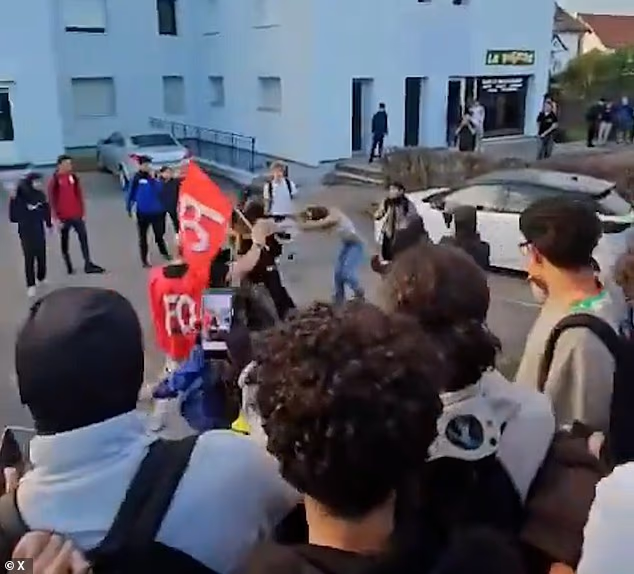
Student protests in France have escalated into a nationwide confrontation, with more than 2,000 people arrested, at least 65 teaching staff injured and dozens of schools damaged. Riot police have been deployed across the country as fires, clashes and attacks disrupted education in towns and cities including Paris, Marseille, Toulouse and Montpellier.
The demonstrations began over complaints about long school hours, overheated classrooms, inadequate facilities and staff shortages. The Government has acknowledged that the grievances are legitimate, but has condemned the violence accompanying the protests.
Officials said 40 of the injured staff were high school principals, while about 170 students had also been hurt. More than 100 high schools were reported to have suffered severe damage, and up to 400 schools were due to remain closed.
Around two-thirds of those arrested were in police custody, with officials believing that as many as 90 per cent were minors. Authorities in Yvelines reported a further 82 arrests during the morning.
Clashes spread across France
Several schools in Paris were targeted by fires. Flames were extinguished at the base of the entrance gate to the Léonard de Vinci high school in the 15th arrondissement, while the entrance to a vocational school in the 13th arrondissement was blackened after a fire involving bicycles and rubbish bins spread to the gates.
In Marseille, many schools planned to hold lessons remotely. A video from the city appeared to show a black-clad youth directing flames from a lit aerosol can at a woman near a bus stop. Onlookers screamed as the fire was aimed at her face before the youth walked away.
Other footage appeared to show male students attacking female education staff. In Besançon, a crowd was filmed watching as a teenage boy grabbed a woman by the hair and repeatedly punched her, stopping only when several people intervened.
A local account said the confrontation followed an argument over plans to set off firecrackers and cause damage. The woman was said to have thrown the first punch.
In the Paris suburbs, a trainee policewoman was filmed being pursued by a group of young men before being tripped and assaulted. The footage ended with the officer on the ground, holding a tear-gas canister, and being kicked once.
Paris prosecutors said they had opened an investigation. Interior Minister Laurent Nuñez said: “A young trainee lieutenant from the Paris police headquarters was chased, thrown to the ground, and assaulted by several individuals in the 20th arrondissement of Paris.”
He promised to “find and prosecute” those responsible.
Marine Le Pen described the footage as “unbearable”, writing: “The image of this young policewoman, pursued by a howling mob screaming its hatred, thrown to the ground and assaulted, is unbearable.”
She added: “These acts deserve exemplary punishments. Let her know that tonight, millions of French people offer her their warm support.”
Jordan Bardella, president of the National Rally, blamed what he described as “decades of laxity and mass immigration”, and asked: “How long will we tolerate this barbarism? How long will we let our country sink without reacting?”
In Montpellier, students faced riot police amid clouds of tear gas, while in Toulouse police helicopters monitored clashes outside the Déodat de Séverac high school. Protesters threw stones at officers and reporters, according to the account of events.
Tear gas was also used near a university campus in Strasbourg, outside a high school in Aubervilliers and at the Kerichen high school in Brest. In Rennes, students wearing black clothing and balaclavas gathered near a heavy police presence outside the Jean-Macé high school.
Lola, a 16-year-old student who did not give her surname, said: “As far as we’re concerned, we’ve won – our school is closed this morning.”
She accused police of using excessive force, saying: “It makes us even angrier – the police have no right to hit us or use tear gas on us.”
Government warns parents over student protests
Justice Minister Gérald Darmanin said an “active and violent minority” was taking part in the demonstrations and questioned whether all those involved were high school students.
He said he had asked prosecutors to hold parents responsible for damage caused by their children and to make them “pay for repairs”. The hard-left La France Insoumise described the proposal as an “absurd measure”.
Education Minister Édouard Geffray said parents “must clearly step up and tell their children not to go” to the protests.
“What matters now is ensuring our children are no longer out on the streets, because they are in danger,” he said.
Mr Geffray was due to meet education unions, parents’ associations and student groups in an effort to ease tensions.
Intelligence agencies believe politicians from the hard left, including members of La France Insoumise, helped initiate the protest movement. Manuel Bompard, a senior figure in the organisation, accused the Government of “descending into conspiracy theories”.
Jean-Luc Mélenchon, La France Insoumise’s de facto leader, called on students to remain “cool-headed” and use only “non-violent methods”. His appeal came as violence continued in several cities.
Former minister Bruno Le Maire called for a parliamentary inquiry into what he described as “the participation of LFI in acts of violence near high schools”.
