


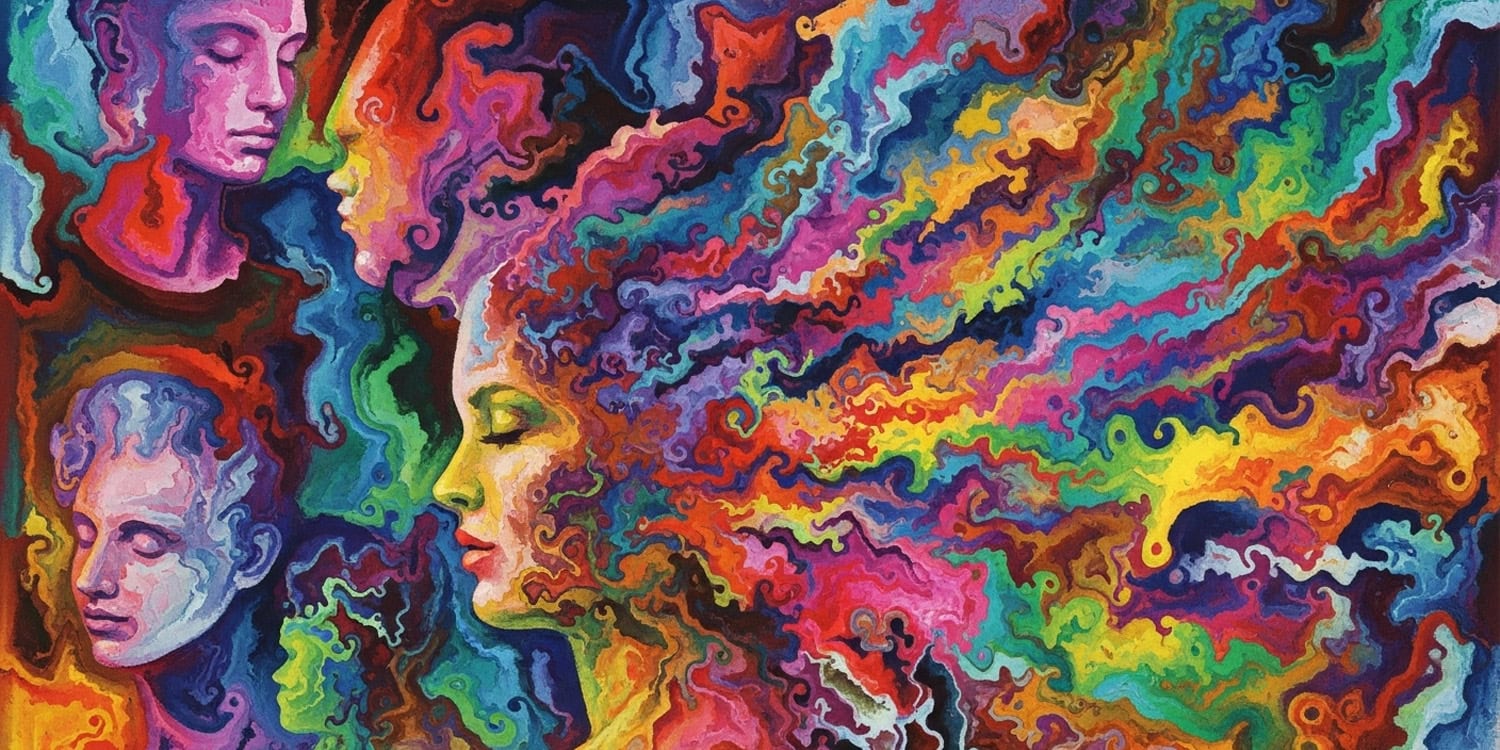
A reanalysis of a mid‑century art study has found that LSD encouraged professional artists to produce more abstract works, but did not reliably boost overall creativity, aesthetic appeal, or technical skill when judged blind by experts. The project revisits Oscar Janiger’s 1950s exploration of psychedelic art, conducted in Los Angeles, and involves researchers Mathilde Firmin, Clément Laloux, Robert Janiger and Baptiste Barbot from the Psychological Sciences Research Institute at UCLouvain in Belgium, with Barbot also linked to Yale University. The team assessed 140 verified artworks created by 20 established artists, produced before and during acute LSD intoxication.
The study coincides with renewed interest in psychedelics in clinical settings and ongoing debates about whether such substances can enhance creativity. It notes that while anecdotal accounts of breakthroughs circulate in technology and arts circles, subjective experiences during drug use can be misleading about true creative improvement. In psychology, creativity is typically defined as producing original work that also fits or works within its context, a balance that relies on both divergent thinking and convergent thinking.
The researchers situate their work in a broader body of evidence showing that psychedelics do not consistently yield a general creativity boost. A 2023 meta‑analysis, for example, concluded cognitive‑manipulation drugs were among the least effective means of enhancing creativity, with non‑drug approaches like training or meditation yielding clearer gains. A 2022 double‑blind trial with LSD suggested a dose could foster novel associations while reducing convergent thinking, and a later integrative review noted potential post‑dose gains on cognitive creativity tasks, though these studies often used puzzle tasks rather than finished artworks.
To test how LSD relates to finished art, Firmin and Barbot reanalyzed Janiger’s archival collection. They noted that research has largely focused on therapeutic potential rather than on the created products themselves, and aimed to bring a modern, systematic approach to a historical dataset. The project used materials from Janiger’s LA study, which enrolled more than 900 adults between 1954 and 1962 and invited 60 professional artists to produce artworks before and during LSD sessions in a natural studio setting. While the original researchers had reported more abstract, aesthetically pleasing, and creative works under LSD, their conclusions were critiqued for methodological flaws.
In the updated analysis, the researchers ensured 140 artworks could be reliably linked to the correct artist and time relative to dosing. They excluded 110 pieces lacking verified records of artist identity, production date, or dosing timing. The final sample comprised 20 artists, six of whom remained anonymous, with 33 baseline pieces created before LSD and 107 produced during the acute drug effects. The LSD dose was standardised to 2.5 micrograms per kilogram of body weight, and artists began creating roughly an hour after dosing, using a range of media including oil paints, watercolours, tempera, pastels, ink, graphite, on various supports.
Six judges, drawn from the United States, the United Kingdom and Belgium, evaluated the digitised, untitled artworks using an online adaptation of the Consensual Assessment Technique. The panel included four art specialists with more than a decade of experience and two quasi‑experts, a doctoral student in art history and a veteran designer. Judges rated each image on a seven‑point scale across four criteria—creativity, aesthetic appeal, technical quality and level of abstraction—without knowledge of the study’s aims or whether a piece was pre‑ or during‑LSD. The researchers used a consensus model to combine ratings and adjusted for outliers, with all data and analytic code published on the Open Science Framework. Linear mixed‑effects models accounted for multiple works per artist.
Preliminary checks found interrater consistency in the moderate to good range for aesthetic appeal, creativity and technical quality, with abstraction rated especially consistently. On the consensus scale, creativity, aesthetic appeal and technical quality correlated positively with one another, while abstraction varied largely independently and showed mild negative associations with the other traits.
When comparing pre‑LSD and during‑LSD artworks, abstraction emerged as the sole dimension that changed reliably, increasing by 0.80 points on the standardized scale. This represented a large effect size, indicating a shift away from literal representations toward non‑representational forms and symbols during the LSD sessions. In contrast, creativity, aesthetic appeal and technical quality showed no statistically significant differences between pre‑LSD and acute LSD paintings. A secondary analysis averaging scores by artist across sessions yielded the same overall conclusion, though removing two quasi‑experts produced a small, marginal uptick in creativity that vanished when consistency for creativity also declined.
The researchers stressed that the jump in abstraction was substantial and detectable by raters, while other measures did not show clear effects. “The increase in abstraction was large in size, meaning the shift toward more abstract artworks after LSD was substantial and clearly detectable by raters,” they explained. “For creativity, aesthetic appeal, and technical quality, effects were negligible to very small in size (although going in the expected direction), but with no statistically significant differences between pre-LSD and acute LSD artworks. It is possible that our limited sample size prevented us from detecting effects of smaller magnitude.”
The findings diverge from Janiger’s original 1989 report, which suggested higher creativity in LSD artworks. Firmin and Barbot attributed the difference to methodological shifts: the original study relied on a single rater and a selection of works likely chosen by researchers, whereas the reanalysis employed blind ratings from six judges using the Consensual Assessment Technique and a random selection of pieces. They argued that this demonstrates how revisiting historical data with modern methods can yield different conclusions.
Why LSD did not translate into higher creativity, the researchers propose, is likely twofold. The drug may impair convergent thinking and practical usefulness even as it facilitates divergent idea generation, and the dose used in Janiger’s sessions—although within a normal‑to‑high range—could simultaneously promote free‑flowing associations and hinder deliberate evaluation required to complete a cohesive painting. They also noted that personal meaning tended to intensify during psychedelic experiences, which could boost subjective inspiration without improving objective quality in the eyes of external judges.
The study also reflects wider tensions between subjective experience and observable outcomes. While participants reported vivid perceptual and emotional shifts, the blind ratings of the artworks did not show a corresponding rise in measured creativity. The authors point to related neuroimaging and cognitive findings, noting a gap between feeling inspired and producing work judged as more creative by external evaluators.
Several limitations colour the interpretation. The design could not separate pharmacological effects from participants’ expectations or the warm‑up period of a studio session, and the absence of a placebo group complicates causal claims. Moreover, the sample consisted of professional artists, so the results may not generalise to non‑artists or to everyday creative activities. The researchers emphasised that their findings do not settle the question of LSD’s effect on creativity, but rather describe a specific, archival context with its own constraints.
Firmin and Barbot urged caution against broad claims that LSD reliably boosts creativity. “There is a general belief that LSD improves creativity,” they wrote. “Although our study did not detect a significant effect of LSD on the creativity of professional artwork, we cannot conclude that LSD has no effect on creativity. We found no significant difference in creativity before and after LSD, but our sample was small, which may have limited our ability to detect effects. The study also had no placebo group, so we describe LSD as linked to greater abstraction rather than as its proven cause.”
Looking ahead, the researchers propose further work with archival material involving non‑professional participants or longitudinal designs that track whether psychedelic experiences inspire lasting creativity after the drug effects wear off. They also suggest employing immersive virtual reality to simulate hallucinatory visuals while participants draw or paint, providing a safe, controlled way to probe whether altered perception can shift artistic style without administering substances.
The study, Creativity Under LSD: A Reanalysis of Oscar Janiger’s LSD Studies Among Professional Artists, was authored by Mathilde Firmin, Clément Laloux, Robert Janiger and Baptiste Barbot.
