


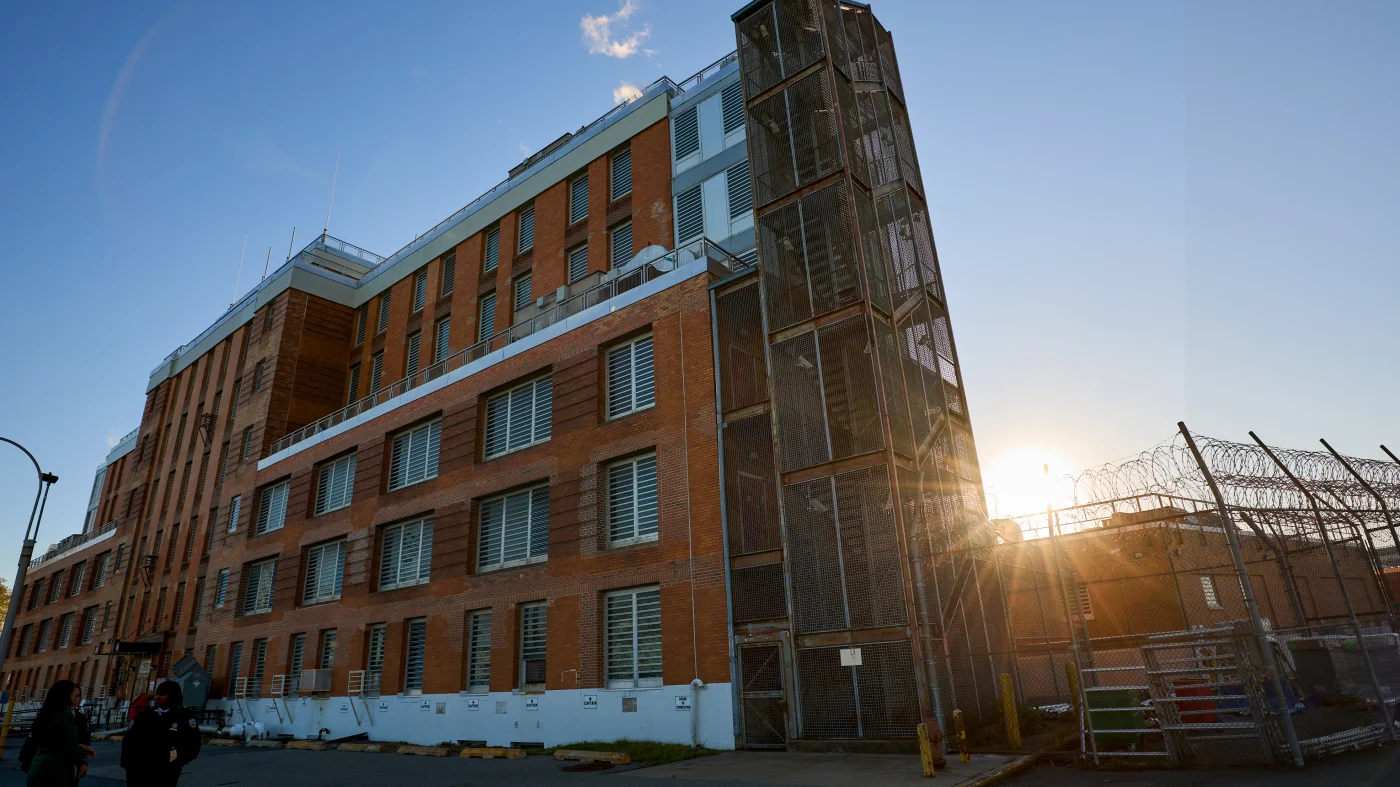
New York City officials have unveiled a plan to close Rikers Island, the troubled jail complex that serves as the city’s main pre-trial detention centre, and replace it with four smaller borough-based facilities.
Mayor Zohran Mamdani said the proposals were intended to end decades of abuse, neglect and violence at the prison complex, while reducing the number of people held in custody and changing the way the city approaches public safety.
“It is long past time to close what’s been a moral stain on our city,” Mr Mamdani said. “We cannot simply accept the old approaches to public safety just because they’ve always been done that way.”
Rikers, located on a former rubbish dump in the East River between Queens and the Bronx, has faced years of criticism over its deteriorating buildings and conditions. Lawsuits have accused staff of excessive force and sexual assault, while federal court records have described the complex as significantly more violent than comparable jails.
More than 50 people have died in the custody of New York City’s Department of Correction since 2022, almost all of them while being held at Rikers. The deaths included suicides, fatal assaults and cases in which people were found unresponsive.
A federal judge last year described the level of violence as an “unconstitutional danger” to both detainees and staff. The city subsequently lost control of the jail’s operations, which are now overseen by a remediation manager appointed to bring the system into compliance with legal requirements.
New York’s borough-based jails
The city council approved plans in 2019 to close Rikers by 2027 and build new jails in Brooklyn, Manhattan, Queens and the Bronx. Officials now acknowledge that the deadline will not be met, but Mr Mamdani said his administration believed it could complete the process.
“We’re not the first administration to talk about this,” he said. “We also know that the last administration had no interest in advancing this. And we are also confident that we can be the first administration to deliver on it.”
The new facilities are intended to be closer to courts and public transport, making visits easier for families, lawyers and support workers. They are also planned to provide more natural light and fresh air, alongside greater space for recreation, education and vocational training.
Together, the four jails are expected to hold about 2,000 fewer people than Rikers, which currently houses approximately 6,600 detainees. A Brooklyn facility is under construction and is due to be completed in 2029.
The plan also commits more than 250 million dollars over the coming years to reduce the jail population. Measures include diversion schemes, electronic monitoring, supportive housing and mental health treatment designed to keep people out of custody where possible.
Almost all those held at Rikers are awaiting trial. The average period spent in Department of Correction custody was nearly twice as long in 2025 as it had been in 2015, while almost a quarter of detainees had been held for more than a year.
Judge Joseph Zayas, chief administrative judge of New York’s state court system, said delays could be caused by a range of issues, including the handling of evidence and mental health assessments.
“The only way to solve this backlog problem is to hit each of these things. The sum of all of the efforts will help,” he said.
The city plans to establish a task force to accelerate cases, although judges and district attorneys operate independently of City Hall. Officials said they were working to improve co-operation across the justice system.
Lessons from Germany
The plan follows a series of efforts to examine how other prison systems operate. Nicholas Deml, the remediation manager, travelled to Germany with Stanley Richards, the city’s correction commissioner, earlier this year to study its prisons and jails.
German facilities are often regarded as an international model, although Mr Deml acknowledged that their approach could not simply be transferred to New York.
“While German correctional systems are not directly transferable to New York, they reflect a fundamentally different orientation — one that places human dignity at the centre of incarceration,” he wrote in his plan.
A subsequent visit to Berlin’s Moabit jail by a group including a prosecutor, judge, city council member and senior correctional official highlighted differences in the everyday experience of custody.
The visitors found a quieter environment, cells with windows and, in some cases, doors linking neighbouring cells so that detainees could speak to one another. Televisions were available in cells, while a cigarette vending machine in a corridor particularly struck Christopher Watler, the newly appointed chairman of New York’s Board of Correction.
Mr Watler said the significance was not the cigarettes themselves, but the message that detainees were still treated as human beings. The contrast was brought into focus at his first board meeting in New York, where callers from Rikers described black mould, missed medication and concerns about violence.
“New York City’s a great city. Our jail system isn’t great,” he said. “It’s a broken thing. But how do you repair broken things?”
Concerns over capacity and culture
Supporters of the plan say its success will depend on more than constructing new buildings. Officials have proposed additional staff training and mentoring, tighter oversight and expanded programmes for people in custody.
Elizabeth Glazer, a former city criminal justice official, warned that moving the existing system into new facilities would not by itself end the violence reported at Rikers. More than 700 women sued the city in 2023, alleging that they had been raped or sexually abused by staff.
Vincent Schiraldi, who previously served as the city’s correction commissioner, said it would be difficult to forecast a lower prison population with confidence. If the estimate proved wrong, he warned, the new jails could become overcrowded.
Other figures involved in the city’s justice system also questioned whether there was a contingency plan if crime rose or the population failed to fall sufficiently. Ms Glazer said the reduction could be achieved, but would require sustained attention and co-ordination for decades.
Tina Luongo, who leads the Legal Aid Society’s criminal defence practice, said the new proposals represented an opportunity after years of inaction. Her organisation brought the class-action lawsuit that led to the appointment of the remediation manager.
“We wait for these perfect plans, and for all the reasons we know, including funding, those perfect plans never come to pass. And so what do we do? We do nothing,” she said.
Mr Richards, the first formerly incarcerated person to lead the Department of Correction, said he wanted the new system to place greater value on both staff and detainees. He was held at Rikers himself 40 years ago.
“Everybody wants something to happen by tomorrow. And we are in a moment of urgency. But it takes time to turn,” he said.
The immediate focus remains basic safety and security, including procedures for securing doors. But city officials say the wider aim is to ensure that the failures associated with Rikers do not survive in New York’s next generation of jails.
