


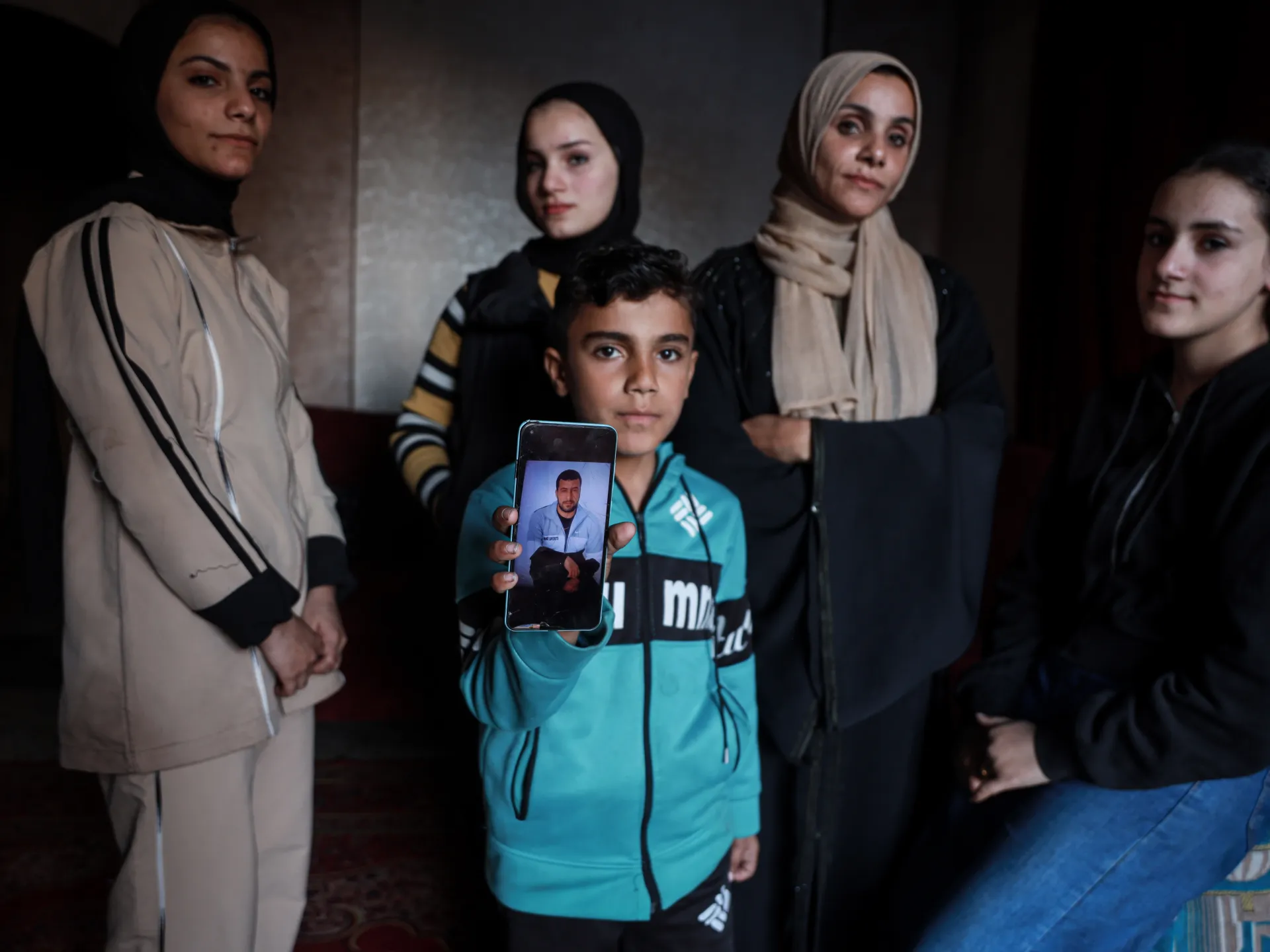
At least 48 prisoners from Gaza remain in Israeli custody after completing their sentences, according to the Palestinian Commission of Detainees and Ex-Detainees Affairs, leaving families waiting for reunions that were expected months or years ago.
Among them are Fadi Zughra, who finished an eight-and-a-half-year term in February 2025, and Hisham Harara, whose nine-year sentence ended in December 2024. Both men remain behind bars.
Their continued detention has raised questions over the legal basis for holding prisoners after their terms have expired. Palestinian prisoners’ organisations say Israel has relied on its Unlawful Combatants Law to keep people from Gaza in custody.
Passed in 2002, the law permits the detention of people classified as “unlawful combatants” without a criminal conviction, subject to detention orders and judicial review.
Families waiting for Gaza prisoners to come home
Zughra, 43, was arrested on 15 August 2016 while fishing at sea alongside other fishermen. His wife, Shmou, said the family was initially told that he had been killed before the International Committee of the Red Cross confirmed several days later that he was in prison.
He had worked as a fisherman since childhood. Shmou said he was accused of smuggling and sabotage, allegations she rejected, insisting that he had been trying to earn a living.
In February, friends told the family that Zughra had been released and was at Nasser Hospital in southern Gaza. His four children prepared to go and meet him, but Shmou insisted that the news be checked with the Red Cross.
She was right to be cautious. Zughra was still being held in prison.
“I was shocked, and the girls were very upset. One of my daughters even fainted,” Shmou said.
Harara’s family has endured similar disappointment. His wife, Hanan, repeatedly searches lists of released prisoners whenever reports emerge of a possible release.
On one occasion, she and her children travelled from Deir el-Balah, where they had been displaced, after hearing that prisoners had arrived at Gaza’s European Hospital. Harara was not among them.
“They tell me, ‘Mum, you keep checking the lists. We don’t want to look at them any more,’” Hanan said. “But I still check. I keep hoping that perhaps this time he will be among those released.”
Harara was arrested in December 2015 while travelling through the Beit Hanoon crossing, known as Erez in Israel, on his way to Jenin in the occupied West Bank, where he worked.
He operated heavy machinery and bulldozers, and had previously cleared rubble and demolished buildings damaged during Israel’s 2014 war on Gaza. Hanan said the allegations against him concerned tunnels, despite his work involving demolition and rubble removal above ground.
His family counted down to his release while displaced in southern Gaza. But the date passed in December 2024, when he completed his sentence, and he remained in custody.
“But that date [of his release] passed, and we are still waiting,” Hanan said.
Children separated from their fathers
The prolonged separation has left both families raising children without their fathers, while displacement during the war has added to the burden.
Shmou and her children — Almasa and Shahd, both 16, Lana, 14, and Sakher, 11 — used to visit Zughra about once every two months. Their last visit took place roughly six weeks before the war began.
Sakher was about seven months old when his father was arrested, but became close to him during prison visits.
“When Sakher visited Fadi, he would tell him, ‘Dad, I want to do this’ and ‘Dad, I want to do that.’ His psychological state has been very difficult,” Shmou said.
Hanan has brought up seven children without Harara. Their youngest daughter, Eileen, was a baby when he was arrested and is now 12. Her eldest son, Amjad, was 18 at the time and is now 28.
“When Hisham was detained, I became both a mother and a father,” Hanan said.
Both women have also struggled to find out what their husbands know about the war or whether they have received news about their families.
Shmou said former prisoners sometimes passed on messages from Zughra, confirming that he was alive and asking whether she and the children were safe. She also said she feared reports that detainees had been given false information about relatives’ deaths.
“The Israelis tell him that his family has been killed, or that one of his children has been killed,” she said. “They play with his mental state and his nerves.”
The International Committee of the Red Cross has said it has been unable to visit Palestinian detainees in Israeli detention facilities since the war began, restricting its ability to monitor their conditions directly.
Wider rise in Palestinian detention
The cases come amid a broader increase in the number of Palestinians held in Israeli prisons and detention facilities.
B’Tselem reported that the Israel Prison Service held 9,187 Palestinians on security grounds at the end of June 2026, including 1,554 people from Gaza. Palestinian prisoners’ institutions said in October that more than 9,400 Palestinians were in Israeli custody, including 1,419 detainees from Gaza classified by Israel as “unlawful combatants”.
Conditions for Palestinian detainees have deteriorated since the 7 October 2023 attack on Israel and the start of Israel’s war in Gaza, according to the material. The United Nations and human rights organisations have documented allegations of torture, including beatings, starvation and rape.
The UN Human Rights Office said in September that it had verified the deaths of at least 92 Palestinians in Israeli custody since October 2023.
During the war, Shmou and her children were displaced from western Gaza City, moving between Khan Younis and Rafah in search of safety. Her brother Mohammad became her main source of support, helping with the children and daily responsibilities, but he was killed during the war about a year and a half ago.
Hanan, meanwhile, raised her seven children alone through repeated displacement. Both families are still waiting for the men to return home.
“We want him to be reassured that we are OK,” Hanan said. “We want him to know that we are still here.”
Shmou said she wanted Zughra released before more of his children’s lives passed without him.
“I want him to be released,” she said. “His daughters have grown up, and his son has grown up too. He is losing his youth.”
