


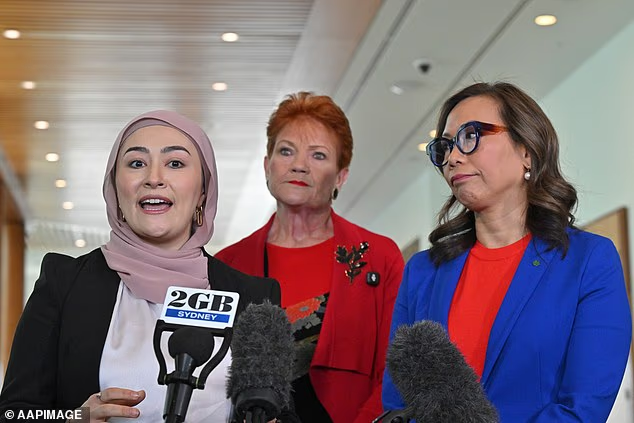
Pauline Hanson and Fatima Payman have joined forces in a parliamentary staffing dispute, demanding that Prime Minister Anthony Albanese overhaul the way additional advisers are allocated to MPs and senators.
The unlikely alliance also includes crossbench MP Dai Le, with the three women appearing together in Canberra to argue that the current system favours Labor and leaves some political opponents without adequate support.
The partnership marks a sharp reversal in relations between Hanson and Payman, who have clashed publicly in recent years.
In one of their most heated exchanges, Hanson questioned in late 2024 whether Payman was eligible to sit in Parliament because she was born in Afghanistan and had previously held Afghan citizenship. Payman responded by calling the One Nation leader a “disgrace to the human race”.
Payman said their political differences had not prevented them from working together on the staffing issue.
“We have different views on almost everything, but what we have in common is that we’re all women,” she said.
She also accused Mr Albanese of claiming to support women while treating female critics differently, pointing to his comments about former Australian of the Year Grace Tame, remarks involving Japanese Prime Minister Sanae Takaichi and a podcast appearance in which he joked about wanting to “shag” pop star Kylie Minogue.
“Australia has heard the Prime Minister’s recent comments about melons, Grace Tame and Kylie Minogue,” Payman said.
“He boasts about leading a female-majority caucus and points to his government’s record on women’s rights. But are those rights only extended to women who agree with him?”
Dispute over parliamentary advisers
Every federal MP and senator receives electorate staff to help run local offices, while the Prime Minister decides how many additional advisers are distributed across Parliament.
Those advisers work on policy development, legislative research, media management and political strategy.
Labor’s 124 MPs are supported by more than 500 advisers and ministerial staff, while the Coalition’s 68 parliamentarians have access to 96 additional support staff. The Greens, with one lower-house MP and 10 senators, have been allocated 17 extra staff, compared with five for One Nation’s six-member parliamentary team.
Payman is the only independent parliamentarian without a single additional adviser, according to figures released earlier this year.
She left Labor after disagreements over the government’s position on the Israel-Gaza conflict and alleged that she had been deliberately sidelined.
“I know the Prime Minister wants to punish me, but he should not be allowed to play favourites,” she said.
“There should be an independent process for determining parliamentary resourcing, not the whim of a petty man.”
Hanson has separately pressed Mr Albanese to increase One Nation’s adviser allocation, arguing that the party’s staffing does not reflect its growing parliamentary presence.
In an August letter, she said Commonwealth law used five members as the threshold for a recognised non-government minority party, and argued that One Nation should receive staffing on the same basis as the Greens.
“The Australian Greens meet that threshold and you have allocated their adviser staffing on that basis. One Nation now meets this threshold,” Hanson said.
Payman said the dispute showed that politicians with different views could still cooperate.
“We don’t have to agree with each other, but we can come together, join forces, and say we demand better from this government,” she said.
