


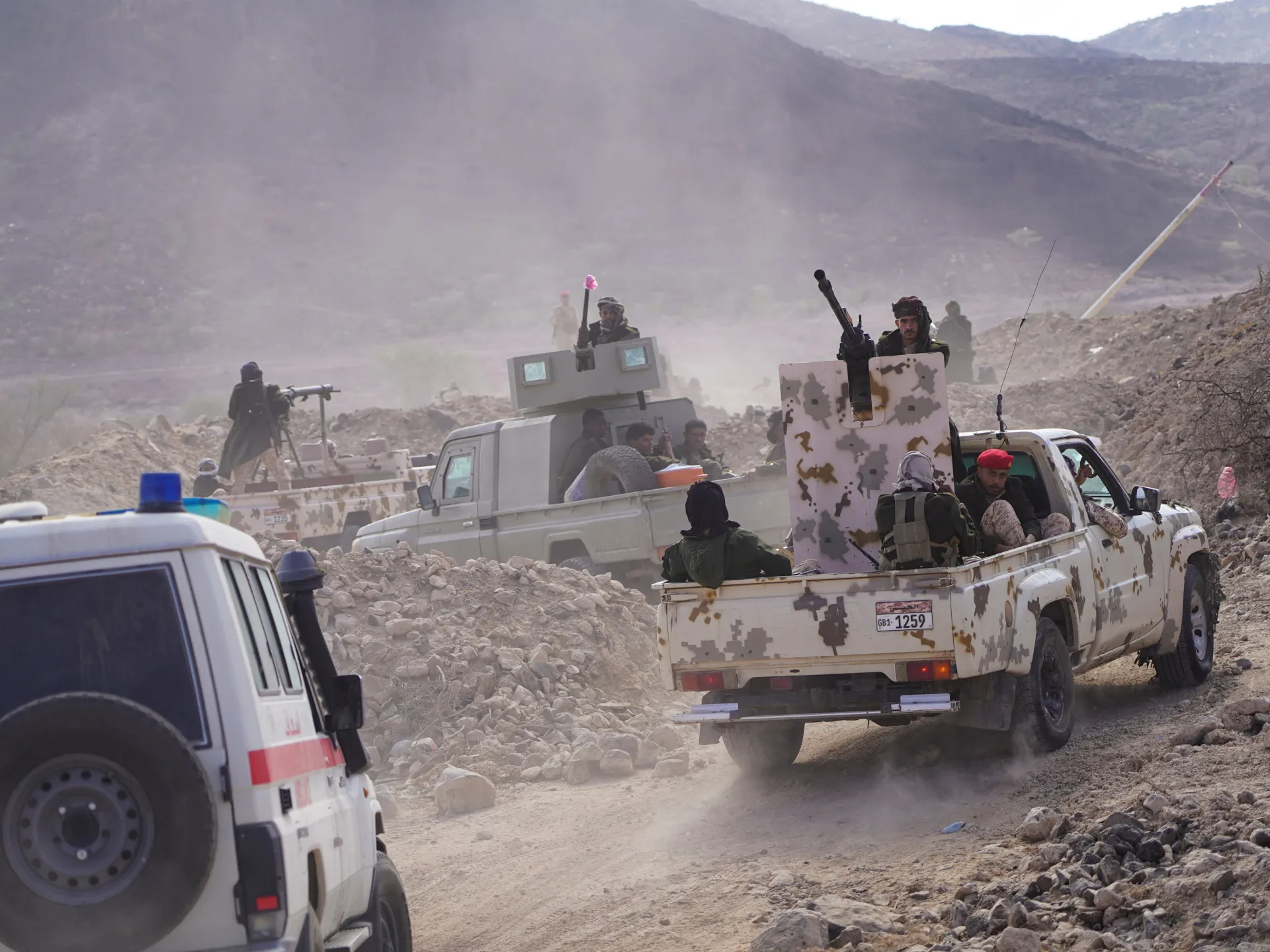
The Houthi advance on Aden has revived the fortunes of Yemen’s southern separatist movement, with the Southern Transitional Council (STC) positioning itself as a force capable of defending the government’s de facto capital.
Houthi fighters, also known as Ansar Allah, are now about 60km (37 miles) from Aden after government-aligned forces withdrew suddenly from key positions on Yemen’s Red Sea coast.
The STC seeks an independent state in southern Yemen and is believed to have backing from the United Arab Emirates. Its influence had waned after a Saudi-backed campaign by Yemeni government forces earlier this year, followed by an announcement that the movement had been disbanded.
Several senior STC figures rejected that announcement as “null and void”, however, and the group has since begun rebuilding its presence as the Houthi offensive gathers pace.
Aidarous al-Zubaidi, the STC’s leader, has launched a mobilisation campaign across the south to prepare for the defence of Aden, Lahij and al-Dhalea. Amr al-Bidh, a special representative for the STC president, said the movement was ready to commit its resources but needed control over its forces on the battlefield.
“No front can be held for long when the people defending it have no say in how it is defended. What’s missing is a political decision to let southerners lead their own defence. We’re ready to put every capacity we have towards defending Aden,” Mr al-Bidh said.
He blamed the weakening of government forces on the Red Sea coast, as well as the latest Houthi advances, on the earlier campaign against the southern separatists.
“In January, the most effective anti-Houthi force in Yemen was taken apart by decisions in Riyadh, not by the Houthis,” Mr al-Bidh said.
Southern Transitional Council remains divided
Abdy Yeganeh, policy director for Independent Diplomat, said the STC could become a significant barrier to the Houthi offensive despite efforts to marginalise it.
“Events in recent weeks have shown that despite attempts of marginalising the STC, they remain a credible local entity with significant popular support, with tens of thousands marching weekly across the south in their favour and with a capable military,” he said.
Ali al-Dahab, a military and strategic affairs expert, said the council remained politically divided and that parts of it had become heavily dependent on Saudi financial support.
“Without the support of the government and the support of Saudi Arabia, it cannot [repel the Houthis],” Mr al-Dahab said. “The capabilities of the Houthis have exceeded the combined capabilities of the government, let alone the [Southern] Transitional Council.”
The STC and Yemeni government forces have previously fought alongside each other against the Houthis, who seized Sanaa in September 2014. Their relationship has also been marked by clashes over control of positions and facilities in Aden and elsewhere in southern Yemen.
After STC advances in southern Yemen in December 2025, the Saudi-led coalition launched air strikes on what it said was a UAE-linked weapons shipment to southern separatists. Mr al-Zubaidi left Yemen, while some STC units were placed under the command of Saudi-backed forces.
The Southern Giants Brigades, one of the most powerful forces affiliated with the STC, is now aligned with Saudi Arabia.
Saudi Arabia has also changed the military command overseeing its forces fighting the Houthis. King Salman issued a decree on Monday replacing Lieutenant General Fahd bin Hamad al-Salman with General Fayyad al-Ruwaili, the country’s chief of the general staff.
Mr al-Dahab said the appointment would centralise decision-making during the offensive and give the role greater authority because Saudi Arabia’s chief of staff would be in command of the joint forces.
Mr al-Bidh said any lasting settlement would have to address the southern population’s demand to determine its own future, warning that agreements made without its representatives would not resolve the conflict.
