


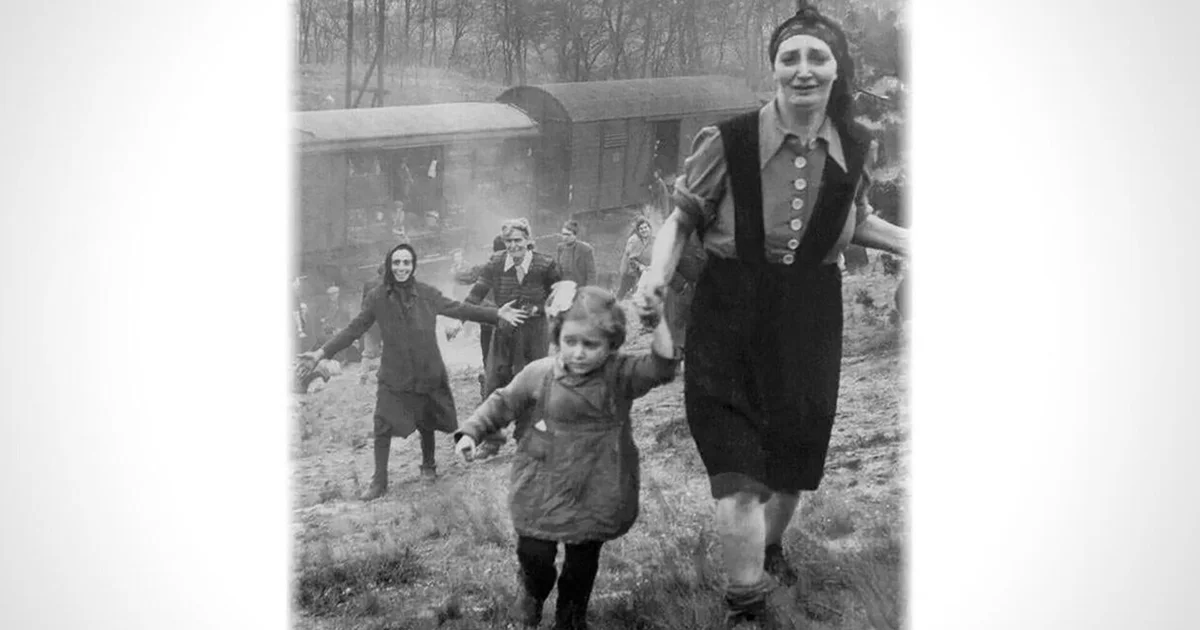
A little-known story of Holocaust survivors liberated from a train near Magdeburg in April 1945 has been brought to wider attention after a family’s old photographs led to interviews with survivors and the American soldiers who found them.
The photographs were discovered by Elizabeth Connolly as a child, in a drawer belonging to her father, US Army sergeant Carrol Walsh. Among images of toy soldiers was an envelope showing people she did not recognise, including a woman holding a young girl’s hand and another woman who appeared extremely thin.
When Connolly asked her father about the photographs, he told her only that they showed people he had encountered on a train. Walsh had received them from a fellow tank commander and, like many returning servicemen, rarely spoke about what he had witnessed during the war.
That changed in 2001, when Connolly’s son’s teacher, Matt Rozell, interviewed Walsh for a school project recording veterans’ oral histories. As the interview was ending, Walsh began to describe the train.
“A beautiful April day. We were zooming like crazy through the middle of Germany. We came across this train, and it was full of Holocaust victims,” he recalled. He said the people inside the carriages were in a “very distressed state”.
About 2,500 Jewish prisoners from Bergen-Belsen were packed into the train, which was being taken towards another concentration camp. On 13 April 1945, American troops advancing through Germany found the stopped train near Magdeburg and provided care for the survivors.
The survivors of the Magdeburg train
Rozell said he did not initially understand the significance of the account. “I was a young history teacher,” he said. “I was not schooled enough, believe it or not, in the Holocaust.”
After publishing the interview online, he was contacted by dozens of survivors and liberators. The responses led him to write A Train Near Magdeburg and organise reunions between former American soldiers and the people they had helped free.
Among those survivors was Peter Lantos, who was five years old when he was placed on the train with his mother. She believed that “anywhere can be better than Belsen”, where dead bodies had been left unburied in growing numbers.
Lantos’s father died of starvation at the camp, and he lost 21 members of his family during the Holocaust. He remembers the moment of liberation, when the sound around the train suddenly stopped and people began shouting: “Americans! Americans!”
Now 86, Lantos said he found it difficult to discuss his experiences but regarded doing so as a duty. “It’s a moral obligation to do it,” he said. “Because we are the last survivors. I’m 86. In few years’ time, no one can tell you, ‘Yes, it is true because I was there.’”
James Bulgin, head of public history at the Imperial War Museum in London, said those on board were “on the brink of death” when the American troops reached them.
“You might say, ‘Oh, they’re being saved from Belsen. They’re being sent somewhere else,’” he said. But, once the Nazis realised they would not be able to take the prisoners to their destination, “the plan emerges to kill them”.
Lantos and Rozell recently visited the Holocaust galleries at the Imperial War Museum with Bulgin, which include the story of the train.
The episode illustrates both the confusion of the final weeks of the war and the chance events that determine which stories survive. Rozell’s initial interview with Walsh was intended to record the memories of one veteran; instead, it opened a path to former prisoners and other liberators.
Filmmaker Mike Edwards, who has spent more than a decade working on a documentary about the train, also uncovered photographs taken on the day. One shows a liberated man wearing an image of himself from before the Holocaust.
“I’ve literally never seen anything like that before,” Bulgin said of the newly discovered material. He said each physical trace offered a fresh insight into the past.
For Edwards, the story is ultimately about the choices people make when confronted with suffering. “Each one of you, in your own lives, is going to have a ‘train near Magdeburg moment,’” he said, describing the choice of whether to care for someone and treat them as a human being.
Rozell said the American soldiers were not obliged to stop and help the prisoners, “But they did.” He also warned that remembering depends on learning: “We all say, ‘Never forget. Never forget.’ And it’s a great mantra. It’s very important. But what if we never learned it to begin with?”
