


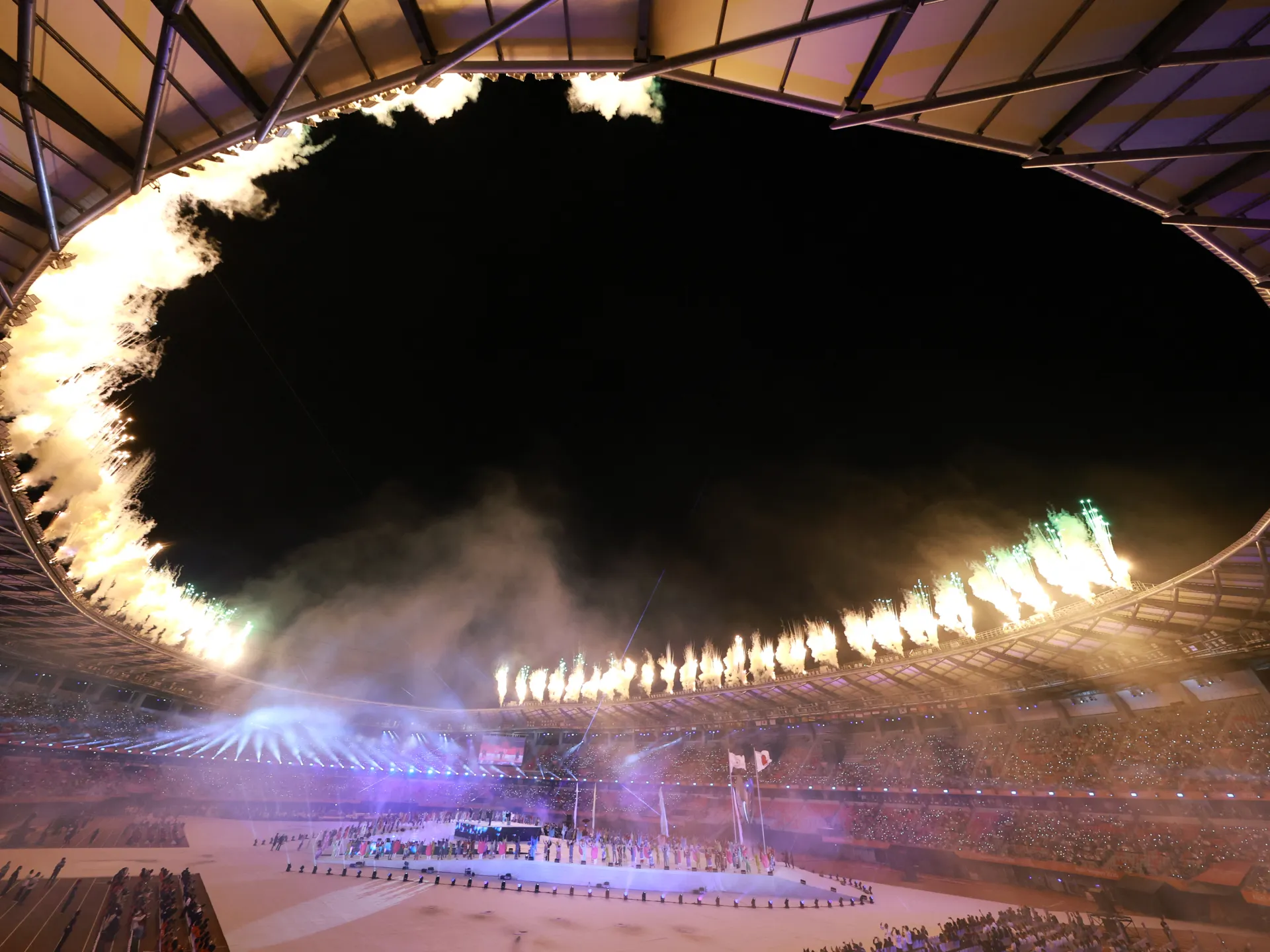
The Asian Games in Japan have opened after a troubled build-up marked by accommodation shortages, transport failures and a national anthem mix-up, with a colourful ceremony in Nagoya offering organisers an opportunity to reset the event.
Thousands of empty seats were visible at the Mizuho Park Athletic Stadium on Saturday, as warnings over an approaching typhoon followed record rainfall that had flooded parts of the city the previous week.
The 30,000-capacity venue hosted fans for the first time at an Asian Games ceremony in Japan since the Tokyo Olympics were staged behind closed doors because of Covid restrictions five years ago. The opening began quietly before developing into a large-scale display of music, colour and lights.
Organisers will hope the ceremony can draw a line under complaints from athletes and officials over the arrangements for the 17,000 competitors and team representatives taking part.
Asian Games accommodation problems
Instead of a traditional athletes’ village, organisers used hotel rooms, temporary wooden containers and a cruise ship in an effort to reduce costs.
Several delegations, including hosts Japan, reported problems including double bookings and other mix-ups. South Korea said the container accommodation at Garden Pier was too cramped for its basketball players.
India’s cricket board arranged separate hotel accommodation for its men’s team after concerns over the number of beds allocated by organisers. About 2,000 Indian families in Nagoya also offered to house athletes if the shortage continued.
International Olympic Committee president Kirsty Coventry defended the arrangements, saying she was “really impressed” with the accommodation. The former Zimbabwean Olympic swimmer said the priority was ensuring competitors had a positive experience overall.
She also said modular accommodation had been used at other events, although the units in Japan were slightly smaller than those used at this year’s Milano Cortina Winter Olympics.
Transport failures and anthem error
Transport problems added to the disruption. South Korea’s men’s basketball team missed a light training session on Sunday after its shuttle failed to arrive, hours before the side was due to play Japan in the final.
The football team had experienced similar problems earlier in the week. On one occasion its bus did not turn up at the team hotel; on another, the players were taken to a baseball ground instead of the Mizuho Rugby Stadium, delaying them by 30 minutes.
South Korea’s men’s hockey team was then left bemused when North Korea’s national anthem was played before its match against Bangladesh on Friday. The stadium announcer apologised quickly, but the error was particularly sensitive because North Korean symbols and the anthem are banned in South Korea.
There were also tensions around Taiwan’s delegation, which temporarily refused to take part in its welcoming ceremony after Lee Yang, the country’s sports minister and a former Olympic champion, was prevented from attending.
Despite the troubled preparations, Japan secured the first gold medal of the Aichi-Nagoya Games on Sunday when Takumi Hojo won the men’s individual triathlon.
Officials will now hope the competition itself can move beyond the opening-day problems, while a typhoon approaching eastern Japan threatens further disruption in the days ahead.
