


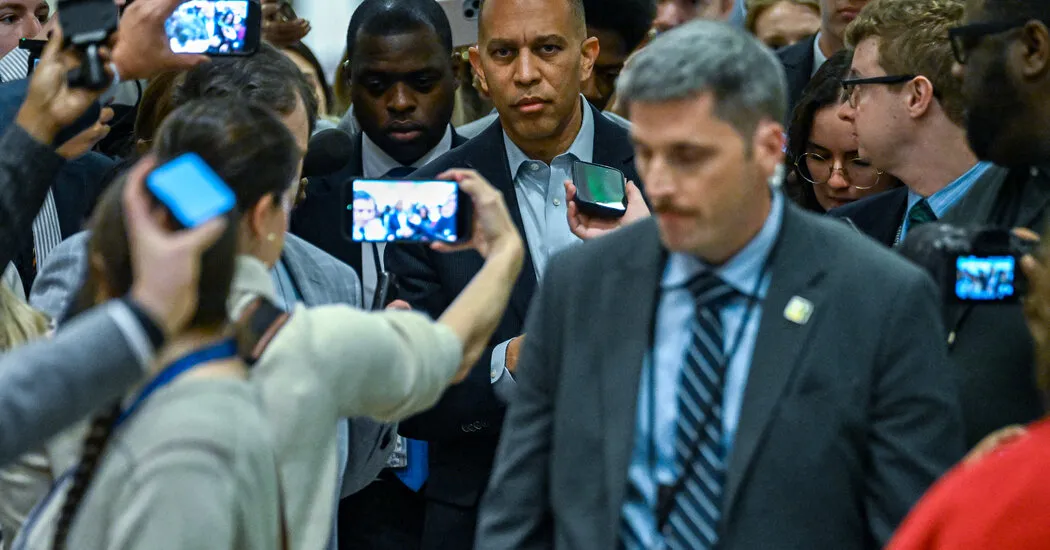
Hakeem Jeffries is being pushed towards an overwhelming nomination as the next Speaker of the US House, with Democratic allies seeking to secure public declarations of support before the party’s closed-door leadership elections next Wednesday.
Supporters of the New York Democrat are asking colleagues to sign a letter backing him, and some believe he should be chosen unanimously rather than through a secret ballot. Such a result would leave potential opponents little opportunity to register their dissent.
The campaign has prompted complaints from some incoming Democrats, who argue that the effort is designed to make Mr Jeffries’s nomination appear inevitable and to close down discussion of alternative candidates. No one has come forward to challenge him.
The New Democrat Coalition, representing 114 centre-left House Democrats and at least 40 members-elect, issued a statement supporting Mr Jeffries this week. His allies are seeking similar endorsements from other large groups within the party.
Mr Jeffries has been holding private meetings with existing and newly elected members as he makes his case for the leadership. He is due to attend a board meeting of the Congressional Progressive Caucus next week and aims to have spoken directly to every member by Wednesday.
He is in line to become the first Black Speaker after Democrats secured sweeping victories and won what was described as a historic majority. But resistance has emerged from an energised left, where some members view the reserved moderate as a symbol of the party establishment and corporate influence.
Several Democrats elected last week declined during their campaigns to commit to supporting Mr Jeffries. Progressive activists have since inundated members with calls and emails urging opposition to what they regard as the status quo.
Mr Jeffries has publicly dismissed concerns about his support. “You think I don’t have the votes nailed down?” he told a reporter this week, while adding that he took “nothing for granted” and that the process involved setting out “our vision for the future”.
Behind the scenes, however, his allies are working to ensure that any opposition cannot derail him. Jared Huffman, a progressive California Democrat involved in the effort, said there was confidence that the votes were available but that an active operation was under way to make the result secure.
“There is an accurate sense of confidence that the votes are overwhelmingly there, but there’s an active whip operation underway to take no chances,” Mr Huffman said. Supporters were contacting colleagues and “making sure this thing is airtight”, he added.
The approach has frustrated some new members. Don Leonard, an Ohio Democrat-elect who wants votes on ending US aid to Israel and on a constitutional amendment overturning the Citizens United ruling, said senior House Democrats had threatened to make his life a “living hell” if he did not back Mr Jeffries.
Mr Leonard later said he had spoken to Mr Jeffries and raised his concerns privately. In a video, he described being expected to “wear the team jersey and be a team player” despite having only just arrived in Washington.
Some of Mr Jeffries’s supporters have argued that members are entitled to vote against him, but that doing so would have little effect. Josh Gottheimer, a New Jersey Democrat, said Mr Jeffries deserved to be elected by acclamation, adding that members who did not consider the party’s victories sufficient could vote “no”.
Joseph Morelle, a New York Democrat overseeing the orientation of new members, said the process had generated little genuine drama. “I’ve been in a lot of whip organizations,” he said. “This is by far the easiest.”
Progressives are nevertheless using the leadership contest to seek commitments from Mr Jeffries. Pramila Jayapal, a Washington Democrat and former chair of the Congressional Progressive Caucus, said she was pressing for a committee hearing next year on a Medicare for All Bill.
Ms Jayapal acknowledged that her leverage was limited because nobody had challenged Mr Jeffries, but said he had reasons to embrace the liberal agenda. “You can’t beat somebody with nobody,” she said. “He knows he needs us, and we can be the wind behind his sails.”
Delia Ramirez, an Illinois Democrat, said she had also discussed with Mr Jeffries bringing the Block the Bombs Act to the House floor. The proposal would withhold certain offensive weapons from Israel, and Ms Ramirez said he had not given her a “no”.
The objections mark a reversal of the difficulty faced by Nancy Pelosi when she sought the speakership in 2018, when moderate Democrats resisted elevating the liberal San Francisco congresswoman. This time, the pressure is coming from the left, although Mr Jeffries has remained defiant.
“Our track record of success, decisiveness and a historic victory over MAGA extremism speaks for itself,” Mr Jeffries said last week. “There’s nothing else for anybody to say when it comes to what this House Democratic leadership team has been able to accomplish.”
Even members who have criticised the process have stopped short of saying they will vote against him. Melat Kiros, a Colorado Democrat-elect who describes herself as a democratic socialist, said it had been disappointing to feel that members were being told in advance who their leadership would be.
Mr Huffman predicted that the eventual number of protest votes would be small. “For now, there’s this little tempest,” he said. “I will wager that you’re going to see a surprisingly small number of protest votes.”
