


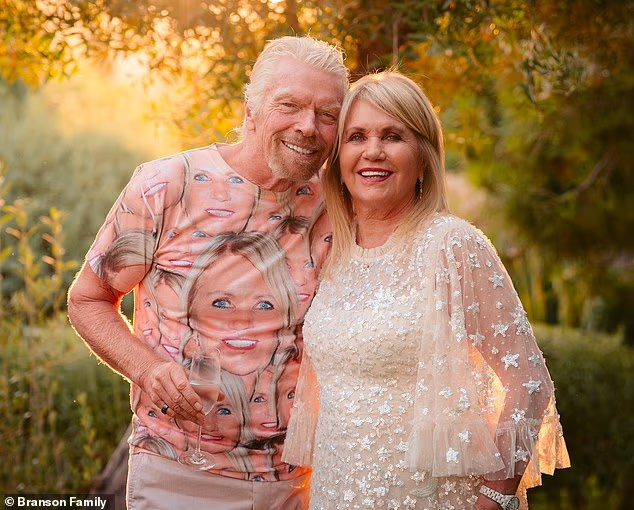
Sir Richard Branson’s wife, Lady Joan Branson, would probably have survived if she had been given preventative blood-thinning medication in hospital, an inquest has concluded.
The 80-year-old died at the Lister Hospital in Chelsea on November 24, 2025, after developing a pulmonary embolism caused by deep vein thrombosis following a fall at the couple’s Necker Island home in the British Virgin Islands.
Professor Fiona Wilcox, senior coroner for Inner West London, said Lady Branson had been at “very high risk” of developing a blood clot but was not given prophylactic anticoagulants, including Enoxaparin injections.
Delivering her conclusion at Westminster Coroner’s Court, she said: “I do find her death would have likely been prevented and the lack of anticoagulation did cause or contribute to her death probably.”
Doctors accepted blood-thinning medication should have been prescribed
Lady Branson was admitted to the private hospital on November 17 after suffering persistent pain from a fall several weeks earlier. She had a history of serious blood clots and had previously used anti-clotting injections while flying and during hospital admissions.
Dr Basir Kunduzi, who was on duty when she arrived, told the inquest that he believed she should have been prescribed anticoagulants and accepted that it was his responsibility to do so.
He said he had delayed the medication because Lady Branson had fallen and there was a possible risk of bleeding. He wanted a CT scan to establish whether she had suffered internal bleeding before prescribing drugs which could have made it worse.
Dr Kunduzi said he recorded his decision in her notes and expected the doctor taking over her care to review it. He told the court that he now understood the importance of communication between members of the medical team and had changed his practice.
Dr Nevil Pavithran, who later cared for Lady Branson, said she should have received anticoagulants within 12 hours of being admitted. He agreed that prescribing them would have been a straightforward decision by November 18 and said there was no bleeding risk from the medication at that point.
Dr Inaki Bovill, a consultant involved in her care, told the hearing that a venous thromboembolism assessment should have been carried out when she arrived and that the drugs should have been prescribed.
“It was a regret it wasn’t spotted by me that evening,” he said.
Dr Bovill said he should perhaps have been “much more forceful” in persuading Lady Branson to accept the injections. He also acknowledged that compression stockings and low-dose aspirin would not have been enough to prevent a blood clot.
Family questioned whether medication was offered
Lady Branson’s daughter, Dr Holly Branson, said in a statement to the inquest that Enoxaparin had never been offered while she was at her mother’s bedside during the first two days in hospital.
She disputed any suggestion that her mother had refused the injections because of concerns about pain, bruising or bleeding, saying Joan had used them extensively during flights and previous hospital stays whenever doctors advised her to do so.
Dr Branson also said her mother had not been given compression stockings for up to 48 hours after admission. She noticed they were missing and asked nursing staff about them, after which Lady Branson began wearing them.
However, Dr Ben Thomas, a consultant anaesthetist, told the court that Lady Branson had said she avoided blood-thinning injections because she disliked the bruising, although she accepted them when flying.
He later clarified that he understood her to mean she did not take the medication routinely, rather than that she had declined it in hospital. He said he regretted not asking further questions at the time.
The court heard that Lady Branson had an umbrella-like filter fitted in the vena cava, the major vein leading to the heart, after previous blood clots. Doctors said this was intended to prevent clots travelling to her lungs.
In a family tribute read at the inquest, Lady Branson was described as a deeply loved wife, mother, grandmother and friend, known for her warmth, kindness and compassion.
Sir Richard and Lady Branson married on Necker Island in 1989 and had three children. Following her death, he described her as the “most wonderful mum and grandmum”.
