


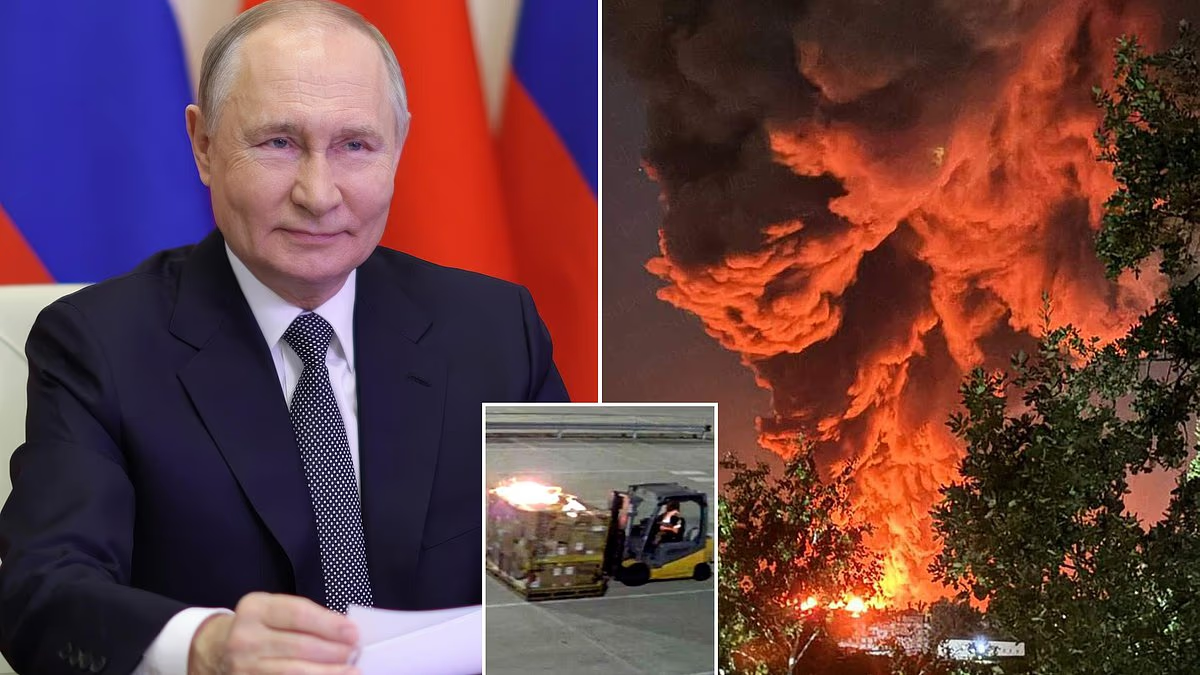
Fears are mounting that Vladimir Putin could be preparing to attack Europe, including potential drone strikes.
It comes after CIA director John Ratcliffe made a surprise trip to Moscow on Tuesday. It has been reported that the spy chief issued a warning to the Kremlin not to escalate the conflict in Ukraine, either by using a nuclear weapon or targeting Kyiv’s Western allies.
The ‘just don’t do it’ advice was based on US intelligence that Russia is primed to act after its campaign on the battlefield in Ukraine stalled again.
Following the visit, the Kremlin hinted it was not looking for peace with the West, warning ‘it is too early to say if the deep crisis in US-Russia relations can be overcome’, before boasting ‘Ukraine is definitely losing the war’.
The developments come at a particularly fraught moment for Nato, as Russian drones repeatedly test the defences of countries along the alliance’s eastern frontier. But other European nations are also increasingly coming under threat.
Just this month, Germany faced a series of unexplained drone incidents. Leipzig-Halle airport, a major Nato military logistics hub and European base for Ukraine’s Antonov Airlines, temporarily suspended flights after an armed drone was discovered next to a Ukrainian aircraft.
A cargo plane later collided with a small unidentified object, while drones were seen over a key military base in western Germany the following day.
Western intelligence assessments have grown increasingly stark, with US officials worried Moscow could attempt to seize Nato territory within weeks.
US officials reportedly believe Moscow could attempt to seize Nato territory
Potential scenarios range from a major cyber attack to armed groups occupying territory to an incursion along Nato’s eastern flank.
Moscow has already been accused of waging a shadow war across the continent through sabotage, cyber attacks, drones, disinformation and intimidation – tactics designed to cause disruption while staying below the threshold for a military response.
British spy chief Anne Keast-Butler has warned that the UK and its allies now occupy ‘a space between peace and war’, with Russian activity stretching ‘from the seabed to cyberspace’.
Security experts have told Prime Minister Andy Burnham to be prepared for a ‘direct response’ from Putin following his declaration of Britain’s ‘unwavering’ support for Volodymyr Zelensky’s forces.
Former Russian deputy foreign minister Andrei Fedorov said he could not ‘100 per cent exclude’ the prospect of ‘semi-military’ action against Britain following Mr Burnham’s visit to Kyiv on Monday.
The PM agreed to hand over blueprints for British-made components for the Scalp missile – a French version of the UK’s Storm Shadow cruise missile – allowing Ukraine to produce the long-range weapon domestically.
In return, he received what officials described as a ‘goldmine’ of battlefield data to help bolster British security.
Mr Fedorov said ‘sooner or later, there might be not only verbal but maybe some visible reaction from Russia towards the UK’.
Asked to elaborate on what this might look like, he said: ‘It might be so-called technical reaction, maybe some hackers attack from [an] unknown source.
‘There might be different political steps and I cannot exclude 100 per cent that there might be some semi-military [action].’
Russian drones are already testing European airspace and defences, posing a major threat to the continent’s safety.
Western fighter jets have been scrambled numerous times in recent weeks to shoot down drones. And incidents involving fighter jets being scrambled in response to Russian incursions have more than doubled on a year ago.
Russian opposition politician Garry Kasparov has warned that Mr Putin could first test Nato’s resolve in the Baltic region.
‘I think the chances [are] that he’ll cross Nato borders – Estonia, Latvia, Lithuania, Poland – just a small incursion using drones,’ he said.
‘I think the chances are growing because Putin needs a winning narrative and Ukraine doesn’t offer it.’
In recent weeks, Russia has also launched a new wave of attacks targeting European defence manufacturers, using local criminals to carry out acts of sabotage, according to Western intelligence sources.
Officials believe the attacks have been carefully calibrated to stop short of triggering Article 5, Nato’s mutual defence clause.
This week, Latvia detained three of its own nationals over a suspected arson attack on a drone manufacturer in Estonia, while there have been explosions at major arms manufacturers in Italy and Bulgaria this month.

A bomb disposal robot deployed by police at German airport Leipzig-Halle after a drone was found near a Ukrainian plane

Gas bubbles from the Nord Stream 2 leak reaching surface of the Baltic Sea in the area shows disturbance of well over one kilometre diameter
And earlier this year, four people were detained after a fire almost destroyed a Czech plant making drones and thermal optics for Ukraine.
Drone threats also extend to Britain’s critical infrastructure.
Writing for the Daily Mail, historian Mark Galeotti said: ‘Russia is operating against us on multiple levels, and the need for the public to be on guard has never been more urgent.’
Meanwhile, intelligence sources also say that the possibility of Russia moving from covert operations to a direct military confrontation with Nato – which had been seen as unlikely while Russia was fighting in Ukraine – can no longer be dismissed.
One theory is that Russia could attempt to seize a city or region in Poland or one of the three Baltic states.
All three were formerly part of the Russian Empire and have ethnic Russian minorities that Moscow has used in its propaganda.
They also sit between Russia and the Russian exclave of Kaliningrad, home to the Russian Baltic Fleet.
The Atlantic Council describes the Baltic states as a high priority for Russian disinformation and subversion, as well as potential outright aggression.
Polish security experts have warned of small troop incursions to target power stations, which could then be explained away as a result of a GPS navigation error.

Andy Burnham with Volodymyr Zelensky in Kyiv earlier this week. Britain will keep providing defence aid to Ukraine despite Russia’s threats
A ground-based attack could come from Kaliningrad – which borders northern Poland – or from Belarus to the east.
Finland and Sweden are also considered targets of Russian hostility following their decisions to join Nato.
Norway, meanwhile, shares a border with Russia and has strongly supported Ukraine and Western sanctions.
There are also fears that Russia could potentially seize a small island in the Baltic Sea to test Nato’s political unity and military response
However, Russia would be taking a huge risk by attacking Nato directly. The alliance still possesses vastly greater military resources than Russia, including more than three million active personnel, thousands of aircraft and more than 1,000 military ships.
That is why intelligence officials say the most immediate threat is likely to be from explosions, vandalism, fires and covert operations carried out from within Europe.
Since Russia’s full-scale invasion of Ukraine began in 2022, Western officials have linked Moscow to 191 acts of sabotage, arson and disruption across Europe, according to the Atlantic Council.
A Financial Times report cited by the Atlantic Council found that teenagers across Europe were being recruited through messaging apps such as Telegram to conduct sabotage, sometimes for relatively small payments.
In the last year alone, teenagers from Poland, the Netherlands and the UK have been arrested after being recruited by Russian hackers to spy and vandalise.

In 2025, 180 migrants mainly from Pakistan and Afghanistan used the tunnel to cross the border between Belarus and Poland
And Germany is now investigating a suspected Russian intelligence weapons cache discovered in a forest near Berlin.
Across Europe, suspected Russian-linked arson attacks have also targeted commercial and strategic sites, including an Ikea store in Vilnius and a shopping centre in Warsaw.
In Britain, a factory and warehouse complex belonging to a Ukrainian business leader was set on fire in March 2024.
British police said the ringleader had been recruited online and directed by people linked to the Russian mercenary Wagner Group.
Russian cyber units have targeted critical systems including power plants since at least the mid-2010s.
On the day Russia launched its full-scale invasion of Ukraine in 2022, a cyber attack against the Viasat satellite internet system caused outages across central and eastern Europe. The EU, US and UK later condemned the attack as Russian.
Nordic and Baltic countries have reported increased GPS jamming and spoofing since 2022, affecting civilian aircraft, ships and drones.
Some of Europe’s most vulnerable infrastructure lies not on land, but hundreds of metres beneath the sea. Yet the destruction of sections of the Nord Stream one and two gas pipelines in September 2022 exposed the vulnerability of Europe’s seabed infrastructure to sabotage by Russia.
The perpetrators remain disputed, but since then, the Balticconnector gas pipeline between Finland and Estonia was ruptured in October 2023 at the same time as a data cable, while in November and December 2024, two fibre-optic internet cables and two power cables in the region were severed.
Russia’s pressure campaign against Europe also extends to the continent’s borders, where it is increasingly using migration as a weapon.
Thousands of migrants have been sent across Poland’s eastern frontier with Russia’s ally Belarus in recent months.
In 2025, four tunnels were discovered under the border between the two countries – and 180 migrants mainly from Pakistan and Afghanistan were arrested when they emerged.
Belarus is said to have used specialists from the Middle East to design the tunnels, with Polish officials claiming these people had a ‘high level of expertise’.
Although it is difficult to prove which groups participated, it is thought that Islamic State, Hamas, Hezbollah and Kurdish fighters could be involved.
