


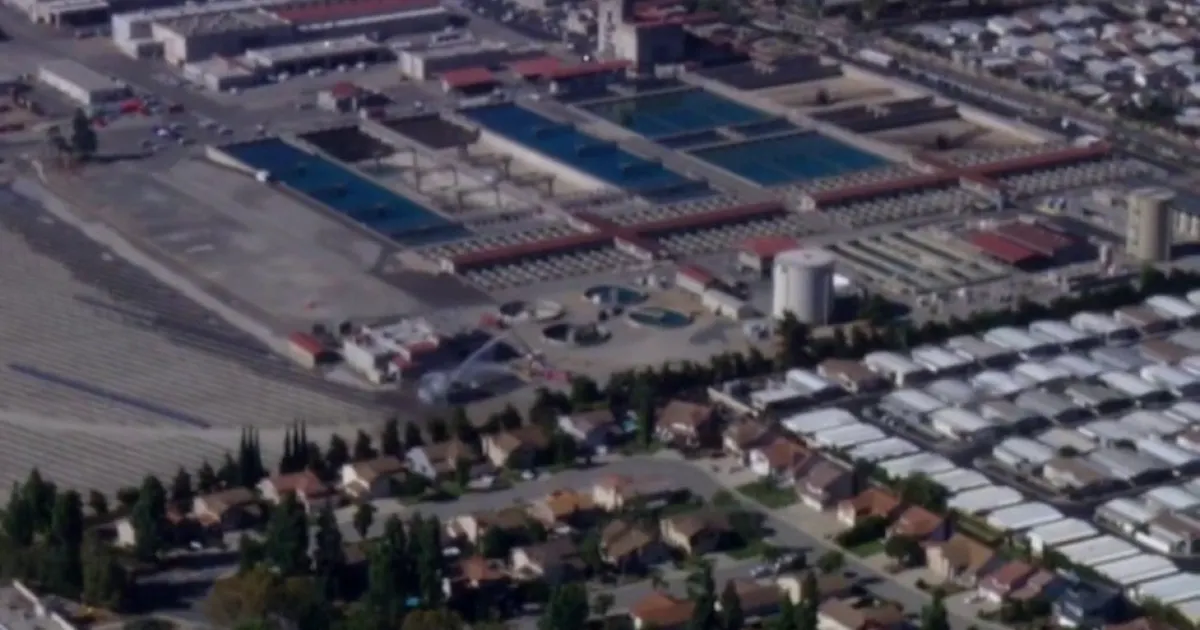
More than 500 homes remain under evacuation orders in La Verne, California, as emergency crews continue cooling two lithium-ion battery storage units at the Metropolitan Water District’s F.E. Weymouth Water Treatment Plant.
The original fire, which began after a minor explosion on Tuesday, 22 September, has been extinguished. However, officials say the batteries could heat up again, reignite or release hazardous vapours if cooling efforts are reduced.
Firefighters are maintaining a continuous flow of water over both units while monitoring their temperatures. When cooling was eased on Wednesday, the first battery rose to about 300F (149C), while the neighbouring unit reached approximately 112F (44C).
Officials say such temperature spikes can occur during lithium-ion battery incidents and that the cooling operation may continue for several days. Additional specialists were expected at the site on Thursday to assess the units and help determine how they can eventually be made safe.
La Verne battery fire evacuation zone remains in place
The mandatory evacuation area is bounded by Moreno Avenue to the west, Foothill Boulevard to the north, B Street to the east, and Paseo Drive, Winterhaven Drive and Kendrick Drive to the south.
La Verne police officers have carried out door-to-door checks at 504 homes and are continuing to patrol the neighbourhood. Residents who need accommodation have been advised to contact the department’s non-emergency line, with about 90 hotel rooms initially available. Metropolitan Water District officials are covering the cost of hotel stays for displaced residents.
Grace Miller Elementary School and Pelota Park remain closed. The University of La Verne, which was temporarily shut after the fire, reopened on Wednesday.
Overnight parking restrictions across La Verne will not be enforced until 5am on Friday, 25 September, to help residents who have been forced to stay elsewhere.
Air quality is being monitored around the clock by the South Coast Air Quality Management District and Los Angeles County fire hazardous-materials specialists. Officials have reported low-level effects consistent with a lithium battery incident, but no hazardous air conditions have been detected outside the plant.
The Metropolitan Water District said its water treatment operations had not been affected and that the water supply remained safe to drink. Run-off from the water being used to cool the batteries is also being collected and tested.
The battery systems were installed to help meet the plant’s energy needs and reduce its reliance on the electricity grid. Their exact cause of failure has not been established.
Officials say the units cannot be approached or dismantled until they have been fully de-energised and are no longer generating heat or hazardous vapours. Once safe, they will be dismantled and taken to a hazardous-waste facility, after which investigators will begin examining the cause of the incident.
