


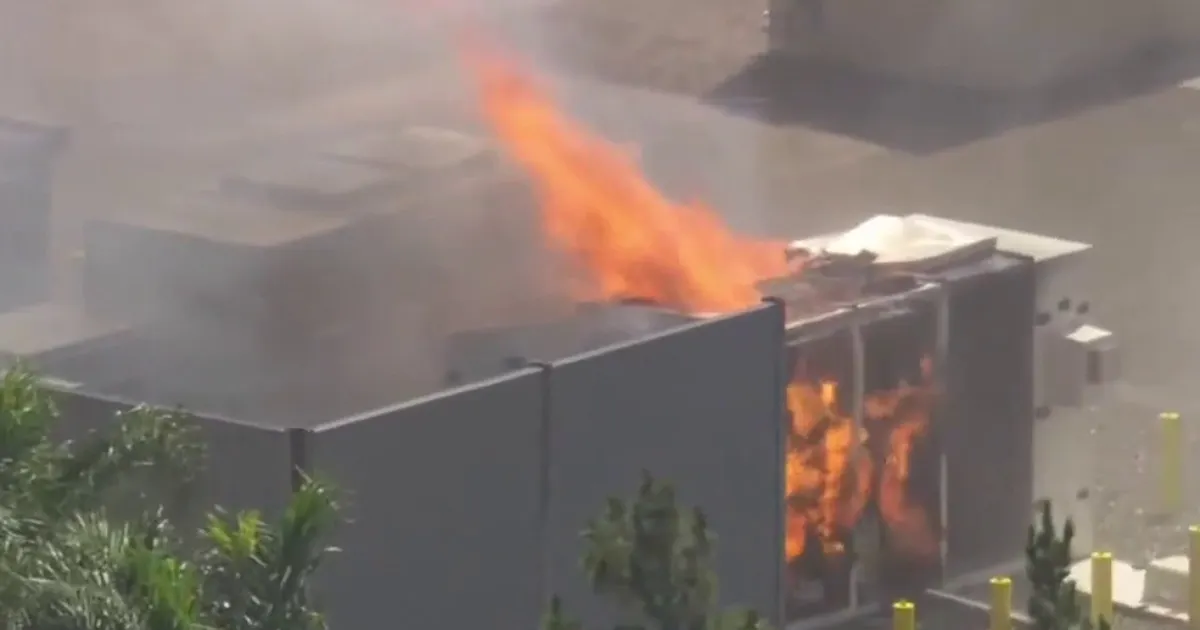
Evacuation orders and warnings were lifted in La Verne, California, on Friday after specialists safely dismantled fire-damaged lithium-ion battery equipment at a Metropolitan Water District facility.
Residents were allowed to return home and businesses could reopen from 6am, following an overnight operation involving firefighters, battery experts and emergency personnel at the Weymouth Water Treatment Plant on Wheeler Avenue.
The incident began at about 11.40am on Tuesday, 22 September, when a fire broke out in a battery storage unit beside a solar-panel field. The heat damaged a second unit, forcing crews to keep both systems under continuous observation and apply water to control their temperatures.
Firefighters and technical specialists disconnected individual battery packs in the affected second unit, reduced their voltage and separated the cells across a designated area. The measures were intended to prevent continued contact between the components and eliminate the risk of thermal runaway.
Crews also isolated a damaged section of the first battery bank, which had been largely destroyed by the original fire. Officials said both units had been made safe before the evacuation restrictions were removed.
The emergency response affected about 500 homes in the surrounding area. Grace Miller Elementary School remained closed on Friday, despite the wider lifting of evacuation measures.
Air-quality monitoring around the site has not detected hazardous readings outside the facility, while officials have repeatedly said the region’s drinking-water supply was not affected. Run-off from the cooling operation is being collected for testing.
The Metropolitan Water District said the two battery units were installed to support a 2-megawatt solar farm and help meet the treatment plant’s energy needs. The remaining undamaged units at the site are being taken offline and de-energised as a precaution.
The cause of the initial fire has not been established. MWD is expected to lead a joint investigation with the La Verne Fire Department, contractors and technical experts once the damaged material has been removed.
The battery debris cannot yet be transported because safety rules require a cooling period. Specialist packaging and neutralisation equipment is being brought in, after which the material will be placed in shipping drums and taken to a hazardous-waste facility.
Fire crews will maintain an overnight watch and continue air monitoring until the debris is cleared. A La Verne City Council meeting has been scheduled for Tuesday, 29 September, to discuss the incident and the city’s response.
