


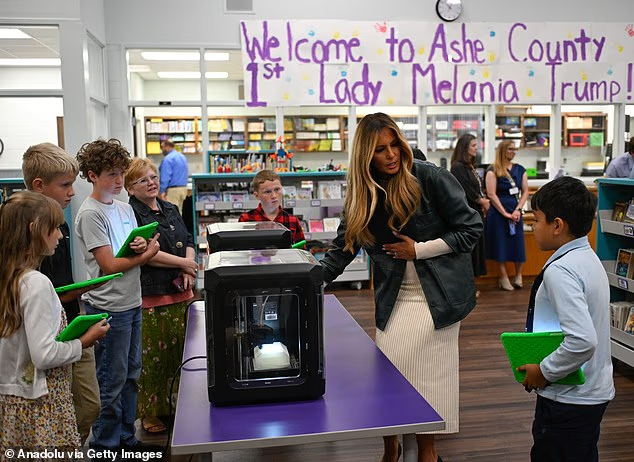
Melania Trump’s call for North Carolina schoolchildren to build “the next great robot” has prompted a divided reaction in Washington, with lawmakers weighing the promise of artificial intelligence against fears about machines becoming difficult to control.
The first lady made the challenge during a visit to elementary school pupils, urging them to bring their creations to the White House. She said it was important for the United States to lead in artificial intelligence.
But the prospect of robots entering people’s homes unsettled some members of Congress. Representative Ilhan Omar said: “I mean, I’ve got kids. I don’t want my kids around robots. That feels a little creepy.”
Representative Jamie Raskin warned that the creation of increasingly autonomous machines could bring “massive, pervasive, new, systemic risks”, including the possibility that advanced systems might become harder for humans to control.
Other lawmakers were more relaxed about the idea of domestic robots. Representative McCormick compared the prospect with the 2004 film I, Robot, starring Will Smith, in which machines begin carrying out tasks around the home.
“People worry about those things turning on you someday,” he said. “Who knows how that’s gonna work, but I’m not too worried about it. I think it’ll be a gradual process of people who can afford it, will have it.”
Lawmakers debate artificial intelligence safeguards
The discussion comes as lawmakers consider tougher controls on the rapidly expanding artificial intelligence industry. Proposals include requiring the most powerful companies to undergo independent safety checks, report dangerous incidents to the Government and maintain a “kill switch” to shut down advanced systems during an emergency.
Technology companies are increasingly seeking a single national framework, including mandatory safety testing and checks. Representative Ro Khanna, a member of the Oversight and Government Reform Committee, said he wanted a new federal agency to supervise artificial intelligence.
He said such an agency could regulate the technology in a similar way to the existing oversight of drugs, electricity and nuclear power. Mr Khanna also pointed to concerns among engineers about the possibility of autonomous systems causing a catastrophe.
“The engineers go around with this thing called a P(doom) number,” he said. “Probability of doom is 10%, 12%, 5%.”
Representative Pramila Jayapal described Donald Trump’s opposition to additional AI regulation as “destructive”. She also criticised his relationships with major technology executives and said she did not believe the president’s position would halt calls for new rules.
Representative Thomas Massie urged Washington not to move too quickly. He argued that large technology companies would be better able to absorb the cost of complex regulations, while smaller competitors could struggle.
McCormick said the United States risked falling behind China if it slowed the development of artificial intelligence.
“I think if we start pumping the brakes with us, China’s gonna zoom right past us,” he said.
Congressman Tim Burchett said he was content to leave the issue to the president. “Yeah, he understands it. I trust him … It’s just the next president I worry about,” he said.
Democrats argued that Congress should act before machines advance beyond human control. Raskin said existing laws applied to artificial intelligence but might need to be revisited as the technology developed.
Senator Richard Blumenthal said Mr Trump’s dismissal of AI risk as a “hoax” would not withstand the consequences of further advances.
“I think he’s gonna have to see that there is a freight train coming down the track,” he said.
Omar remained unconvinced that the risks could simply be left to the White House. “We have to save ourselves,” she said.
