


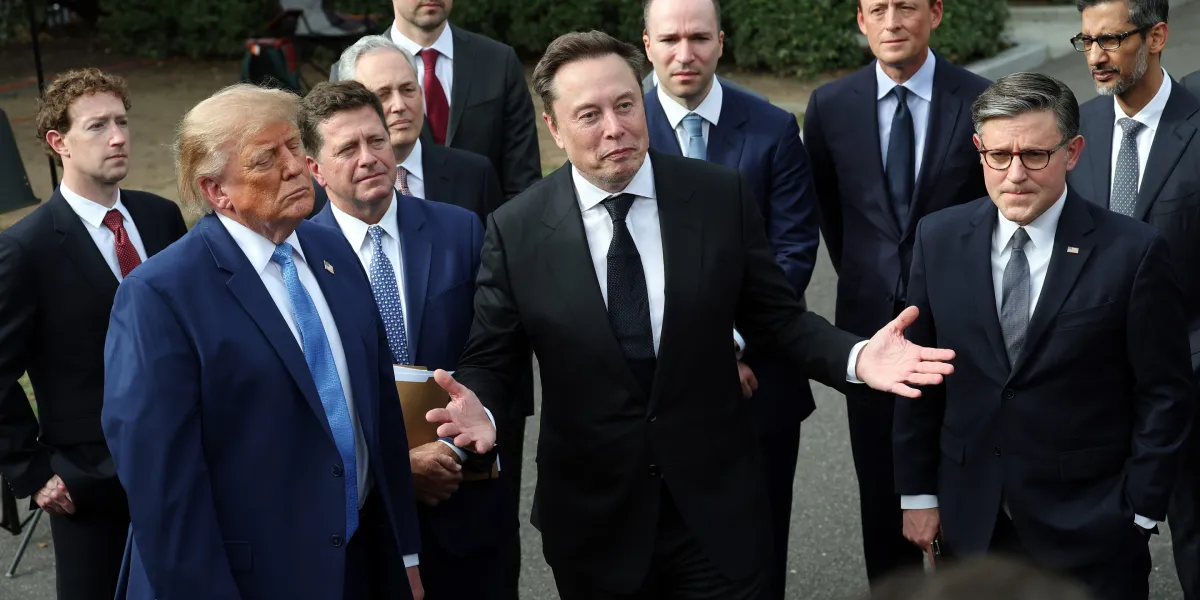
Donald Trump has secured a voluntary White House AI pact signed by the leaders of Anthropic, OpenAI, Google, Meta, xAI and Nvidia, as his administration seeks to persuade the technology industry to police itself rather than face new regulation.
The agreement, presented by Mr Trump as “morally binding”, was signed by Dario Amodei, Greg Brockman, Sundar Pichai, Mark Zuckerberg, Elon Musk and Jensen Huang at a White House luncheon attended by some of the most influential figures in technology.
Under the Joint Commitment on Frontier Responsibilities, the companies have pledged to establish “robust” internal controls covering cybersecurity, biosecurity and chemical threats. They also agreed to ensure their systems do not “hack or access technical systems in unintended ways”.
The signatories said they would appoint independent external auditors, create board-level oversight committees and meet regularly to develop common safety standards.
The commitments stop short of formal regulation, but go further than some earlier voluntary promises. Anthropic and OpenAI had already backed the use of external auditors, while efforts by the two companies to establish shared safety standards had reportedly stalled.
Industry safety rules under pressure
Google, OpenAI and Anthropic are now pressing ahead with plans for an industry-run AI safety standards body, with a launch targeted for the end of this year or early 2027.
The move highlights the balancing act facing the leading AI laboratories. They want to demonstrate that they can respond to safety concerns and introduce safeguards, while avoiding measures that could be portrayed as government regulation or as conflicting with the Trump administration’s opposition to new rules.
Mr Huang and Mr Zuckerberg have aligned themselves with Mr Trump’s anti-regulation position. Mr Amodei and OpenAI chief executive Sam Altman, by contrast, have warned that developers should slow the pace of progress and “pace the frontier”.
Mr Trump told the United Nations General Assembly last week that he would oppose “any attempt to construct a globalist scheme to control” AI. He has argued that the United States cannot afford to slow down while China advances.
However, the administration has said that existing laws still apply, even if it opposes the creation of new AI regulations.
The Federal Trade Commission has opened a broad safety investigation into OpenAI and Anthropic, focusing in part on the risks posed by AI agents after a series of incidents. FTC chair Andrew Ferguson is preparing civil investigative demands that could require executives to provide documents and testify about the safety of their models.
Vice-President JD Vance said companies remained responsible for products released online, arguing that existing laws applied where systems could be used for cyberwarfare or otherwise harm American consumers.
