


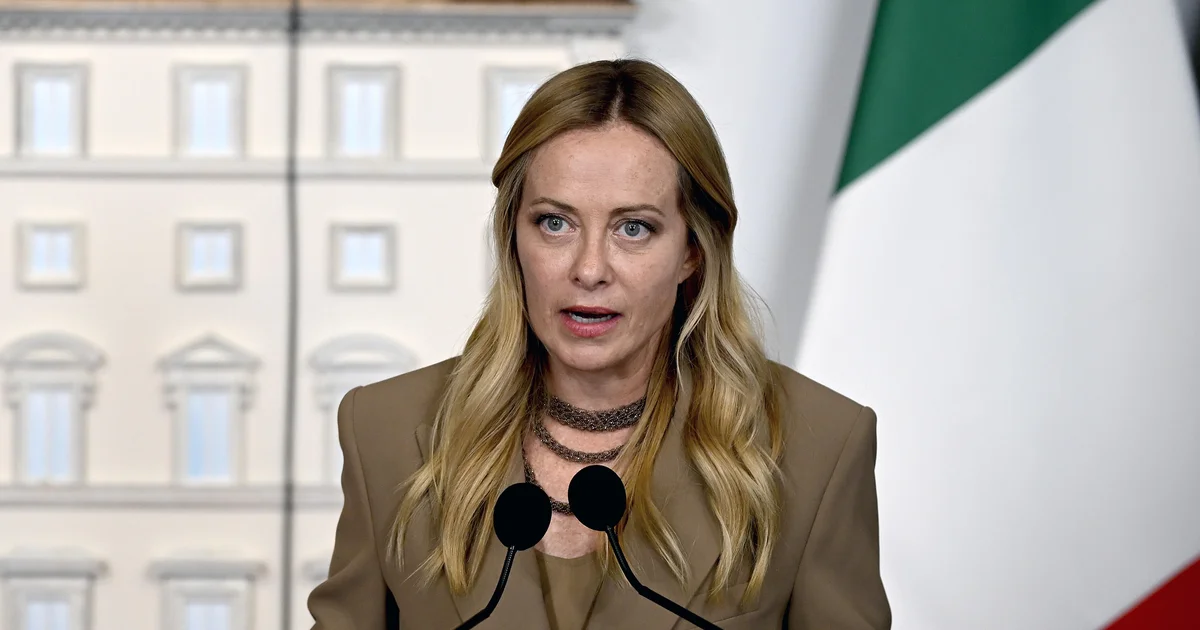
Italy’s prime minister, Giorgia Meloni, has announced plans to introduce a legal limit on foreign students in classrooms and ban face-covering garments, including the burqa and niqab, in schools.
She said the government would propose legislation limiting the number of foreign students in individual classrooms to about 30 per cent. The measures would need to be approved by parliament before they could become law.
Meloni made the announcement during a speech at Fenix, an event organised by Gioventù Nazionale, the youth wing of her conservative Brothers of Italy party.
“If in a classroom there is only one child who doesn’t understand Italian, it is possible that that child will manage, with the help of his peers and teachers, to learn the language and integrate fast,” she said.
“But if these children are many, or even the majority, that’s not integration anymore, that’s abandonment.”
Students without Italian citizenship currently make up about 11.6 per cent of total school enrolment across the country, according to figures from Italy’s Ministry of Education cited by the ISMU ETS Foundation, an immigration-focused think tank.
Under Italy’s citizenship system, children born in the country to non-Italian parents do not generally become Italian citizens automatically at birth. They can apply for citizenship after turning 18 if they have remained in Italy.
Face-covering ban in Italian schools
Meloni’s proposed school restrictions would also prohibit clothing that covers the face. The measure would not apply to all Islamic head coverings.
“At school, you go with your face uncovered, and in Italy no one, in the name of a real or presumed tradition, can decide that a young woman has to hide,” Meloni said. “Equality between men and women is non-negotiable.”
France, Belgium and several other European countries have already introduced restrictions on face coverings in public places, although the scope and legal basis of those measures vary.
A legal limit on foreign students in individual classrooms would be a first in Europe if adopted, according to the source material.
Mariagrazia Santagati, a sociology professor at the Catholic University of the Sacred Heart in Milan, said some areas with shrinking populations had higher concentrations of residents from non-Italian backgrounds, which could lead to larger numbers of non-Italian students in classrooms.
She questioned how the proposed classroom limit would work in practice, saying Italian state schools were based on inclusion and open to every child regardless of their legal status or religion. “We are for multiculturalism,” she said.
Meloni’s announcement comes as Italy looks towards next year’s general election, with the prime minister facing competition from both the left and the right.
