


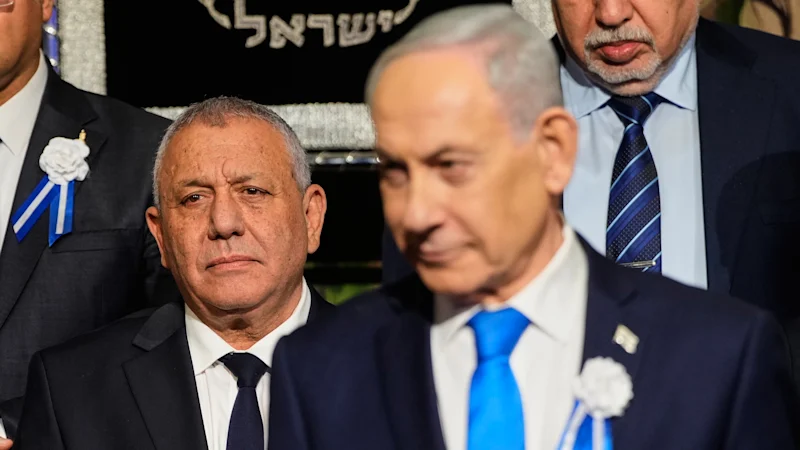
Benjamin Netanyahu has offered his main rival, Gadi Eisenkot, the chance to serve first as prime minister in a proposed unity government, as pressure mounts on Israel’s prime minister to surrender power.
The proposal would see both men hold the top office, with Eisenkot taking the first turn and Netanyahu serving initially as alternate prime minister. Analysts described the move as an apparent attempt to prevent Netanyahu being removed after last month’s inconclusive election.
Netanyahu said the offer was intended to avert what he called an “existential threat” from Arab parties entering government. Without firing a single bullet, he claimed, “hostile elements will take control of the country from within”.
The proposal has immediately exposed divisions among Netanyahu’s opponents. Eisenkot, a centre-right former military chief of staff, made removing Netanyahu the central promise of his campaign, but has struggled to assemble a parliamentary majority.
His mandate to form a government is due to expire in about a week. He can ask President Isaac Herzog for an extension of up to two weeks.
Israel’s 120-seat parliament was left without a clear majority after the October election. Netanyahu’s coalition won 53 seats, while parties supporting Eisenkot secured 48. Parties representing Israel’s Arab minority won a combined 19 seats.
A unity government between Netanyahu’s Likud party and his opponents could provide a stable majority, but would force Eisenkot to decide whether to abandon his pledge to end Netanyahu’s rule.
He could instead seek support from Arab parties, which are viewed by many Jewish Israelis as insufficiently Zionist, or from ultra-Orthodox parties that are unpopular with many of his voters. Either route would carry political risks.
Eisenkot is also expected to remember the collapse of a previous power-sharing arrangement in 2020. Benny Gantz, another former military chief of staff, joined Netanyahu in a government under which Gantz was due to become prime minister second. Parliament was dissolved before he took the office.
The latest proposal has split Eisenkot’s potential allies. Yair Golan, leader of the left-wing Democrats party, rejected what he called Netanyahu’s “stunts and tricks” and urged the immediate creation of a “government of change and salvation”.
Naftali Bennett, whose Together party has 12 seats, urged Eisenkot to negotiate with Netanyahu, saying the prime minister was “doing the right thing”. But Yair Lapid, a co-founder of Bennett’s faction, described the offer as a “transparent scam by a serial fraudster”.
Eisenkot had appeared to be moving towards a coalition of Netanyahu’s rivals, securing agreements with the Democrats and the right-wing Yisrael Beiteinu party. Both parties strongly oppose Netanyahu.
A key obstacle has been whether Arab parties can support such a coalition without alienating right-wing groups. Eisenkot said parties seeking to join must denounce Hamas as a terrorist organisation.
Mansour Abbas, leader of Raam, the largest Arab party, said his party had signed a parliamentary bill containing language defining Hamas as a terrorist organisation. “What’s written is written – that Hamas is a terrorist group,” he said in a television interview.
Abbas has condemned the Hamas-led attacks of October 7 2023, which killed about 1,200 people, and has called for Hamas to disarm in line with Donald Trump’s ceasefire plan. He said he had previously delayed formally adopting the designation partly because he did not want it used to justify “total war” against Palestinians.
It remains unclear whether his statement will satisfy Eisenkot’s condition. The two rival leaders are expected to meet north of Tel Aviv on Sunday for coalition negotiations, in their first known formal meeting since the election.
