


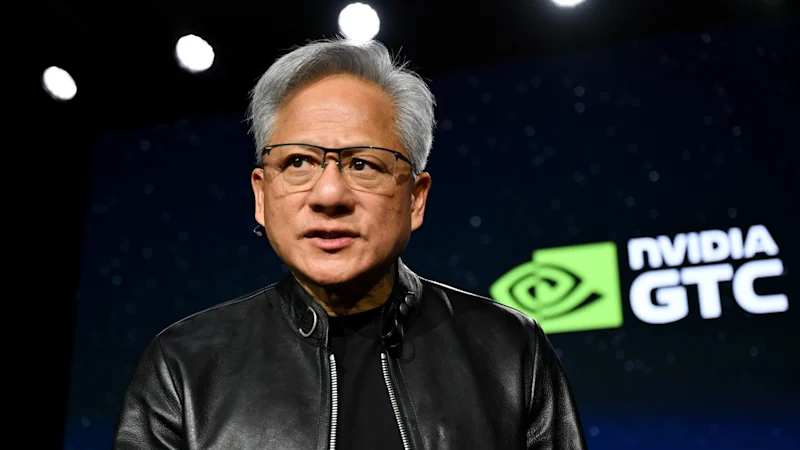
Nvidia has reinstated Jensen Huang as chief executive, president and a director just 11 days after he resigned amid allegations that he had an affair with a woman suspected by US intelligence of being linked to Chinese espionage.
The company’s board voted unanimously to bring back its founder after receiving what it described as assurances from senior US government officials that his return would not threaten national security.
Donald Trump, who has acted as an adviser and confidant to Huang, said he had personally lobbied Nvidia’s board to reverse its decision. “I spoke to them, let me just put it that way. And I convinced them,” the US president told CNBC.
Mr Trump said the company needed to retain Huang’s expertise. “We have to protect our geniuses – and he’s certainly a genius,” he said, adding: “The bigger threat would be losing the brainpower of someone like Jensen. That would be a far bigger threat than anything we’re talking about.”
Vice-president JD Vance was also involved in the discussions over the weekend and was described as an emissary who helped address concerns among Nvidia’s directors.
Nvidia shares closed more than 31 per cent higher on Monday, while the technology-heavy Nasdaq rose 6.5 per cent and the S&P 500 gained 4.7 per cent.
Nvidia investigation to continue
The board said it had been satisfied by Huang’s candour and his ability to lead the multitrillion-dollar company following a series of meetings. It will nevertheless continue an investigation into the allegations until its conclusion.
Huang, 63, has backed the inquiry and agreed to co-operate fully. The board has also created a National Security and Export Control Committee to oversee trade compliance and national security risks.
The controversy centres on Alice Huang, a Chinese citizen who ran a data-centre company based in Singapore. She is not related to Jensen Huang and has been accused of funnelling information to Beijing, although the claims remain unproven.
Nvidia announced two weeks ago that it would investigate reports suggesting Jensen Huang had been the target of a foreign intelligence operation. He later resigned after reports about the relationship and other infidelities, acknowledging that he had cheated on his wife.
The New York Times reported that Alice Huang had been in contact for more than a year with an official from China’s Ministry of State Security while she was having a secret affair with Jensen Huang. Mr Trump dismissed the significance of the report when questioned about it.
“Who wasn’t in contact?” he said. “I just left China. I had a great summit; it was at the top of the line. President Xi respects our country greatly again.”
Mr Trump said Attorney-General Todd Blanche had confirmed that the US government had no evidence Huang had broken the law. White House communications director Steven Cheung said the president had been “totally involved” and that Nvidia’s board had made the right decision.
Huang said he was honoured to return and accepted the responsibility with “the greatest humility and renewed commitment”. He thanked interim chief executive Colette Kress, chairman Harvey Jones, the company’s executive staff, employees, shareholders and partners.
“Above all, I am grateful for the love and support of my family. I can’t wait to get back to work,” he said.
Pressure over Nvidia’s China links
The decision came as the Trump administration faced mounting pressure to scrutinise Nvidia’s dealings and advanced-chip exports to China.
The Commerce Department added Megaspeed, a cloud-computing company where Alice Huang was previously an executive, to its entity blacklist. It said the company posed a significant risk of being involved in diverting advanced computing products to unauthorised users or uses.
Howard Lutnick, the commerce secretary, had faced criticism for not blacklisting the company earlier despite pressure from other parts of the administration.
Mr Trump said he had encouraged Nvidia to continue examining compliance with US export controls, but did not refer to the unfinished inquiry into whether Huang had been compromised by foreign intelligence.
Democratic Senate leader Chuck Schumer said Huang’s reinstatement strengthened the case for congressional investigations. He said committees would examine the conduct of the Trump administration, Huang, other Nvidia executives and anyone who had put national security at risk for financial gain.
Republican senators also questioned why the board had changed its position within days. John Curtis of Utah said he wanted to know what had altered since Nvidia previously indicated that Huang would not return, while Rick Scott of Florida said the reinstatement “looks terrible on its face” and called for Congress to receive a full briefing.
Huang founded Nvidia in 1993 and built it into the world’s biggest producer of advanced chips and one of the central companies in the artificial intelligence boom. The business has become a key part of the US technology competition with China.
Videos posted online by Nvidia employees showed staff cheering and applauding as Huang returned to the company’s headquarters in Santa Clara, California. “Let’s get to work,” one employee shouted.
Elon Musk, the chief executive of SpaceX, welcomed the decision, writing: “The mistake has been corrected. Everyone I know at Nvidia wanted Jensen back and it shows.”
