


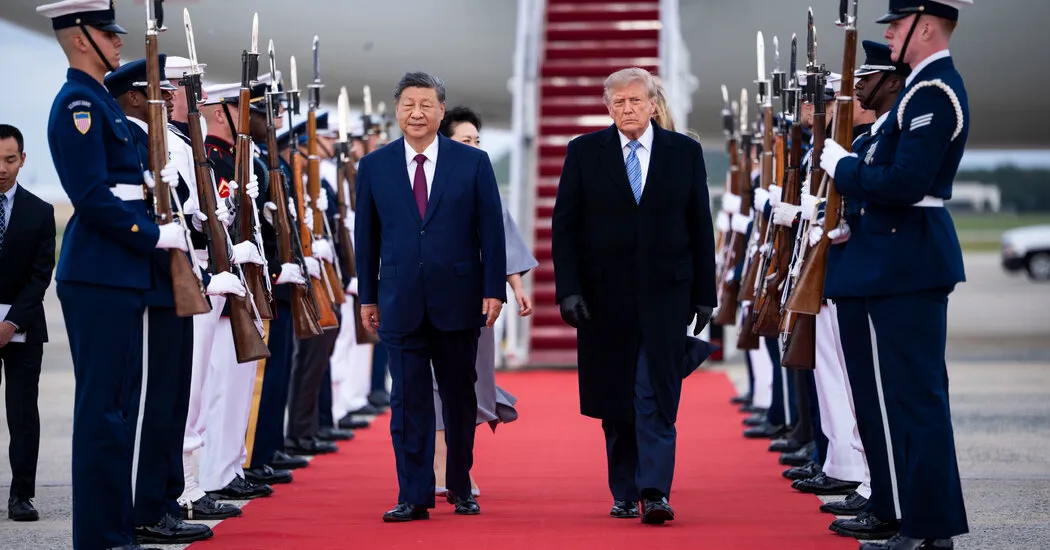
President Donald Trump is expected to meet China’s leader Xi Jinping in Shenzhen without Jensen Huang, the former Nvidia chief executive who had become a prominent presence at the president’s diplomatic engagements with Beijing.
Mr Huang stepped down from Nvidia last week after revelations that he had engaged in affairs, including a relationship with Alice Huang, a Chinese executive whom US intelligence officials believe to be an asset of Beijing. China has rejected the intelligence assessment as “smears and slanders”.
The allegations have created a political storm in Washington and raised fresh questions about the sale of advanced American semiconductor technology to China. But they do not appear to have changed Mr Trump’s favourable view of the technology executive, or his approach to this week’s meeting with Mr Xi.
Mr Trump has continued to describe Mr Huang as an “honourable man” and has questioned reports that he was briefed about the intelligence concerning the relationship. In an interview on Thursday, he said Mr Huang’s resignation depended on whether Alice Huang was a spy.
“Well, the big thing is, was the woman a spy?” Mr Trump said. “And I don’t know if that’s been determined yet, but if the woman was a spy, yes. If the woman was not a spy, perhaps it would be different. But I can tell you this: Somehow, he’ll end up in his feet. I mean, I know him. I know him pretty well. I always thought of him as a fine man.”
The president also said he did not remember being briefed that Mr Huang had been in a close relationship with the woman. However, Secretary of State Marco Rubio told him about the intelligence while they were travelling to China in May, and the president had reportedly been briefed on the matter at least once before.
Mr Trump has said he does not intend to raise the Nvidia affair with Mr Xi, although he suggested that the Chinese leader could choose to do so. White House officials said on Friday that the matter was a national security issue but did not expect it to be discussed during the leaders’ meeting.
Questions over Nvidia technology exports
The controversy has intensified an internal administration debate over whether controls on artificial intelligence technology and advanced chips sent to China should be tightened. Commerce Secretary Howard Lutnick, who has argued for less restrictive limits on chip exports to Asia, is expected to travel with Mr Trump.
Treasury Secretary Scott Bessent on Friday blamed the Commerce Department for failing to prevent advanced Nvidia technology from being sold to Megaspeed, a Singaporean company that employed Alice Huang and built data centres supplying computing power to Chinese companies.
“You will have to ask them about their internal processes,” Mr Bessent said of the Commerce Department, adding that Treasury had supported a stricter approach for months.
Mr Huang had accompanied Mr Trump during key contacts with Mr Xi this year. He joined the president on Air Force One during the May journey to China and later sat at the head table at a White House state dinner for the Chinese leader.
Mr Trump had valued Mr Huang’s business success and his argument that keeping China reliant on American-made chips could help preserve US technological dominance. The president has also treated espionage as an unavoidable feature of relations between major powers.
“You know what they say? That China spies on us. I say you’re right, and we spy on them, too,” he said in September.
The president is expected to focus his talks with Mr Xi on China’s restrictions on rare-earth metals and magnets, as well as nuclear proliferation and the war in Iran. The meeting will be followed by a gathering involving Mr Xi and Russian President Vladimir Putin.
Republicans and Democrats are demanding answers from Mr Huang and Mr Lutnick, who have both been asked to testify before the Senate Banking Committee in December. The political pressure could yet lead Mr Trump to impose new restrictions on technology exports to China.
Craig Singleton, a China expert at the Foundation for Defense of Democracies, said the revelations could strengthen support in Washington for cutting off Chinese access to American chips. Kenton Thibaut, a China fellow at the Atlantic Council, said the affair was damaging for Beijing as it sought to keep relations with Mr Trump stable and avoid further export controls.
