


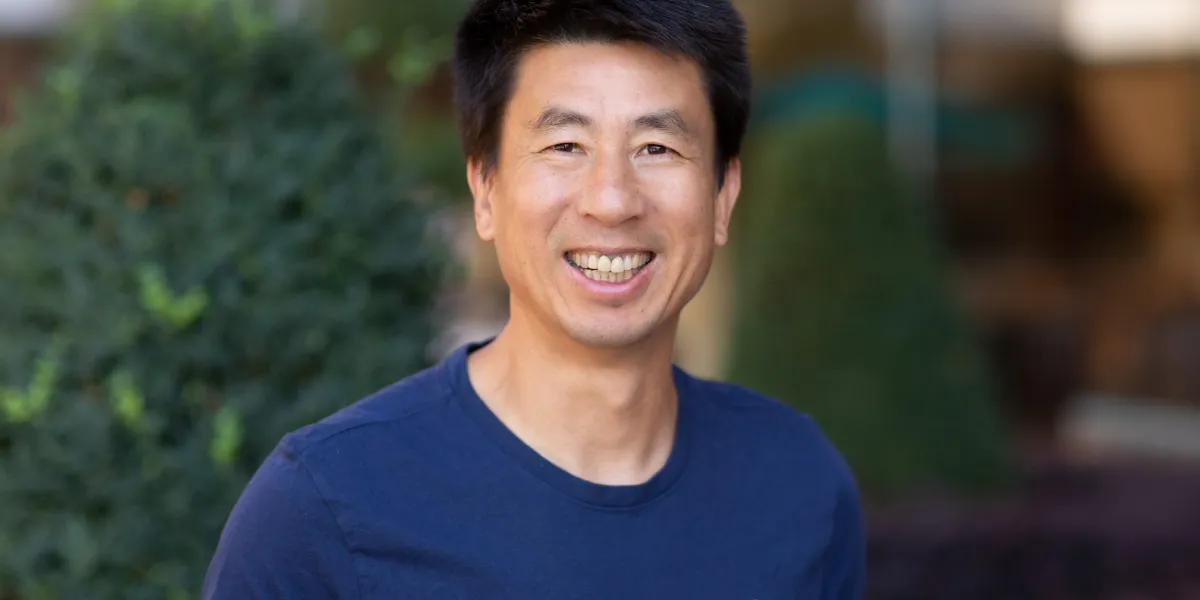
Sam Liang, the millionaire chief executive and co-founder of Otter.ai, has described how a frugal upbringing in China continues to shape his lifestyle and the way he runs the speech-transcription company.
Despite leading a business with more than 240 employees and annual revenue of $100 million, Liang said he avoids luxury, skips the free lunch provided at Otter and relies on a homemade smoothie for breakfast, lunch and an afternoon snack.
His daily routine includes a three-mile run before work, while his main indulgence is travelling around the world to compete in marathons. He has completed 12, including the London Marathon earlier this year with his wife.
From recorded lectures to Otter.ai
Liang’s business was inspired by a problem he encountered after moving from China to the United States to study. Struggling to understand his professors because of the language barrier, he took a Sony Walkman to class, recorded lectures and replayed them until he could follow the material.
That experience eventually led to Otter.ai, which Liang co-founded with Yun Fu in 2016. The company says its software has transcribed more than one billion meetings for more than 40 million users.
The pair spent two years developing the technology under the name AISense before launching a free version of Otter in February 2018. A paid tier followed three months later.
Liang said the idea initially met scepticism because voice data was expensive and artificial intelligence had yet to become a mainstream business tool.
“Many investors thought we were crazy,” he said. “We were well ahead of the game, long before ChatGPT and the proliferation of AI meeting assistants.”
The company’s fortunes changed as the pandemic shifted meetings online. Otter’s revenue grew by 800 per cent between 2019 and 2020, and by the time it raised $50 million in Series B funding in February 2021, it had transcribed more than 100 million meetings.
Last month, Otter secured a further $320 million in financing. Its investors include early backers of Google, Zoom and Tesla, while the service is being integrated with OpenAI, Claude and Google.
Liang’s frugal approach
Liang, who studied at the University of Arizona before completing a PhD at Stanford, said his upbringing during and after China’s Cultural Revolution had left him wary of unnecessary spending.
“I grew up in China during and after the Cultural Revolution, when even food was rationed,” he said. “That experience taught me to live very simply. I don’t feel I need luxury; the basics are good enough, so I don’t feel comfortable with anything that feels excessive in price.”
He said the same principle applied to Otter, where he preferred careful spending on staff, tools and marketing rather than outlay intended to create an appearance of success.
Liang began his career at Cisco and Tropos Networks before joining Google in 2006. His work on the company’s “blue dot” helped form the basis of Google Maps, but he left in 2010 to co-found Alohar Mobile, which was acquired by Alibaba in 2013.
At Stanford, he was mentored by David Cheriton, who had also guided Google founders Larry Page and Sergey Brin. Liang said the academic had “instilled in me the importance of true big thinking” and encouraged his ambition to build a company.
A routine built around running
Liang lives in the suburbs of Mountain View, near Palo Alto and Otter’s headquarters. He usually wakes between 7am and 8am after working into the evening, checks Slack and his emails, then runs before heading to the office.
His breakfast smoothie contains nuts, oatmeal, fruit and protein powder, and is based on a recipe associated with Arnold Schwarzenegger. Liang drinks a third in the morning and stores the remainder in two bottles for later in the day.
Although Otter provides free lunch as an employee benefit, Liang said he normally sticks to the smoothie, followed by a healthy home-cooked meal in the evening. He typically eats out during the week only for business meetings.
Running also provides his main escape from work. On Saturdays, he may run between 13 and 18 miles, with the activity giving him time away from screens and helping him think through problems.
Liang said building Otter had involved personal sacrifices, including a period when his wife was the only earner while he worked to establish the company. He also regrets not having more time with his children before they went to university.
He now keeps in touch with his family through a weekly Zoom call. Retirement is not currently part of his plans; he said he wanted to continue building and learning for as long as he remained healthy and curious.
