


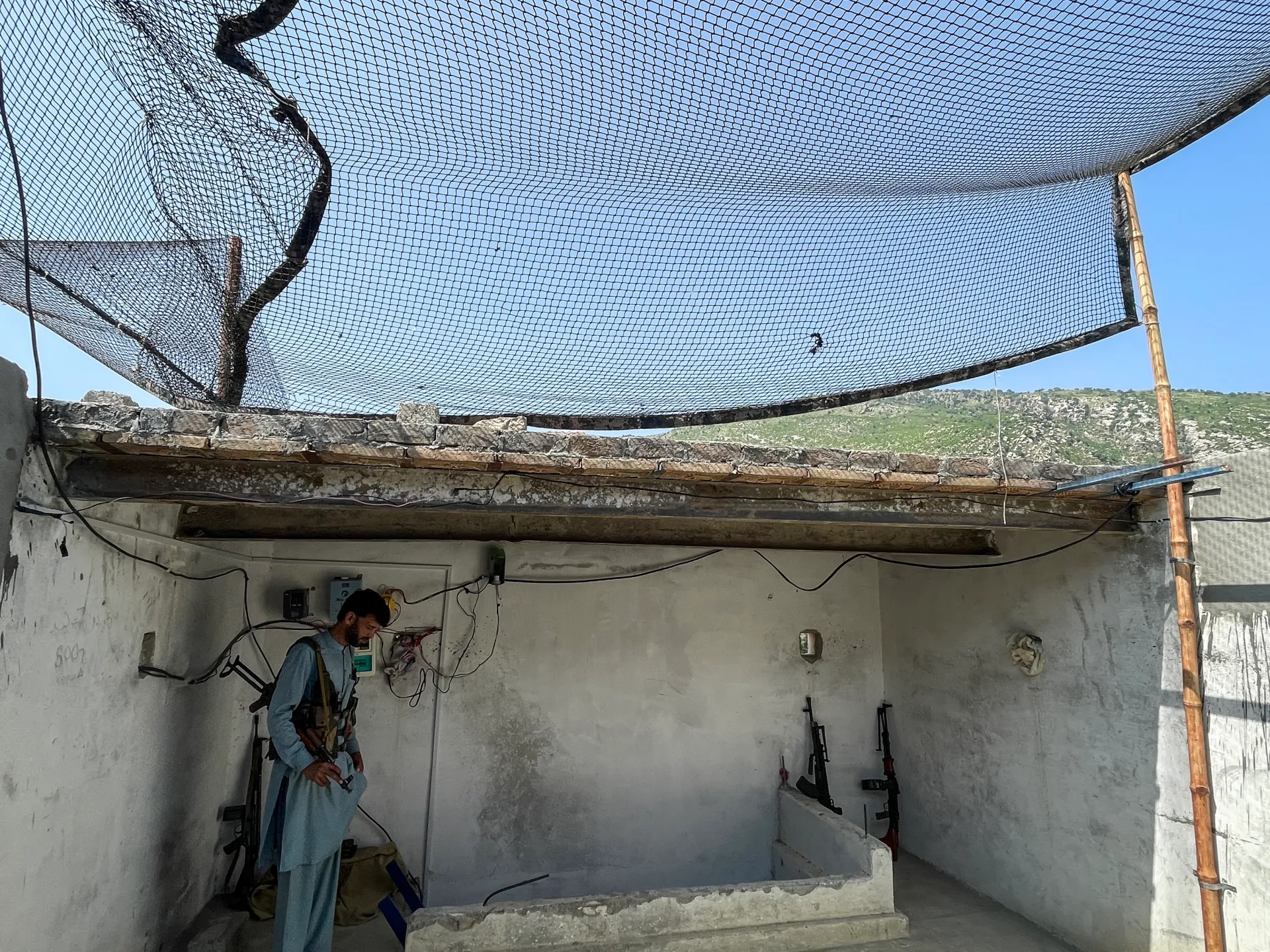
Police in Pakistan’s north-western Khyber Pakhtunkhwa province are stringing fishing nets above vulnerable checkposts in an attempt to reduce the threat from explosive-laden drones and quadcopters.
The low-cost measure was introduced in Hangu district after armed groups began combining drone attacks with mortar fire and gun battles. Officers say the nets have provided an additional layer of protection at several posts, although security experts have questioned how effective they would be against determined attacks.
At the Sarki Piyala police checkpost, inspector Fayyaz Khan and his colleagues came under attack on April 16 when drones dropped explosives before fighters opened fire from surrounding positions. The confrontation lasted about seven hours, killing the driver of an armoured vehicle and injuring a constable, Khan said.
“There was a great deal of fear because we were in the middle of a battle. At that moment, we did not even know whether we would make it back home alive,” he said.
The checkpost is about 30km from the Afghan border in a district that police describe as one of the most sensitive in the province. At least 16 attacks have been recorded in Hangu this year.
Fishing nets were installed above the Sarki Piyala post two months ago, stretched between rooftops and perimeter walls to form an overhead barrier. Police said no drone attacks had taken place there since the system was put in place.
“If a drone comes over the checkpoint, there is a possibility that it could get caught in the net and be defused or stopped,” Khan said.
He added that even if a drone exploded above the net, the debris could be dispersed rather than falling directly on officers below. A standard checkpost can be covered for about 400,000 Pakistani rupees, or 1,435 dollars, according to Hangu district police officer Tariq Habib.
Habib said the netting system was being installed at vulnerable police stations and checkposts across Hangu, with further funding requested from the provincial government.
A spokesman for the Khyber Pakhtunkhwa police said similar nets had been deployed in the districts of Kohat, Karak, Bannu, Lakki Marwat and Dera Ismail Khan. Military outposts at some locations in the province have also adopted the system.
Questions over protection offered by fishing nets
The move follows a series of deadly attacks claimed by Tehreek-e-Taliban Pakistan, commonly known as the Pakistan Taliban. On July 29, attackers used bomb-laden quadcopters against a police outpost in Hangu before launching a ground assault, killing at least 11 officers and wounding 28.
Fifteen attackers were also killed in the hours-long battle, which was claimed by the TTP. Pakistan has repeatedly accused Afghanistan’s Taliban government of allowing the group to operate from its territory, while Kabul has denied the allegation and described the attacks as an internal Pakistani security issue.
Another clash in Hangu on September 20 killed six soldiers and eight attackers, according to the Pakistani army. Two days earlier, an attack in nearby Kohat district killed 23 people, including 16 police officers, and involved the bombing of a mosque.
Police officer Zeeshan Khan said no drone or quadcopter attacks had occurred at Sarki Piyala or the nearby Baliamena checkpost since the nets were installed. He estimated the arrangement could reduce potential losses by 40 to 50 per cent, while acknowledging it could not eliminate the danger.
Security analyst Imtiaz Gul described the measure as a “cheap ploy” that could create a false sense of security, arguing that police stations were not always the intended targets of drone attacks. He said the more important issue was whether security institutions could intercept drones soon after launch.
Analyst Fida Adeel said the concept had been adapted from military camouflage nets and used in Ukraine to intercept drones. However, he cautioned that its effectiveness would depend on the design and positioning of the netting, and said claims about the level of protection required proper testing.
Khyber Pakhtunkhwa police spokesman Abdul Salam Khalid said a formal trial had been conducted in Kohat. An explosive was dropped on one of the nets during the test but did not detonate, he said.
For residents living near the checkposts, the attacks have disrupted daily life, with some families keeping children away from school. Social activist Mohammad Usama, from Baliamena, said people feared stray bullets and other debris reaching their homes.
“We just pray that Allah ends terrorism in our country so that we can live peacefully in our area, our children can continue their education and people can go to work without fear,” he said.
Back at Sarki Piyala, Khan said the nets were not a complete defence but offered reassurance to officers on duty. “We cannot say that the netting system provides complete protection,” he said.
