


An island popular with holidaymakers has been rocked by the discovery of four dead bodies belonging to missing persons – after police lied to relatives that they were alive.
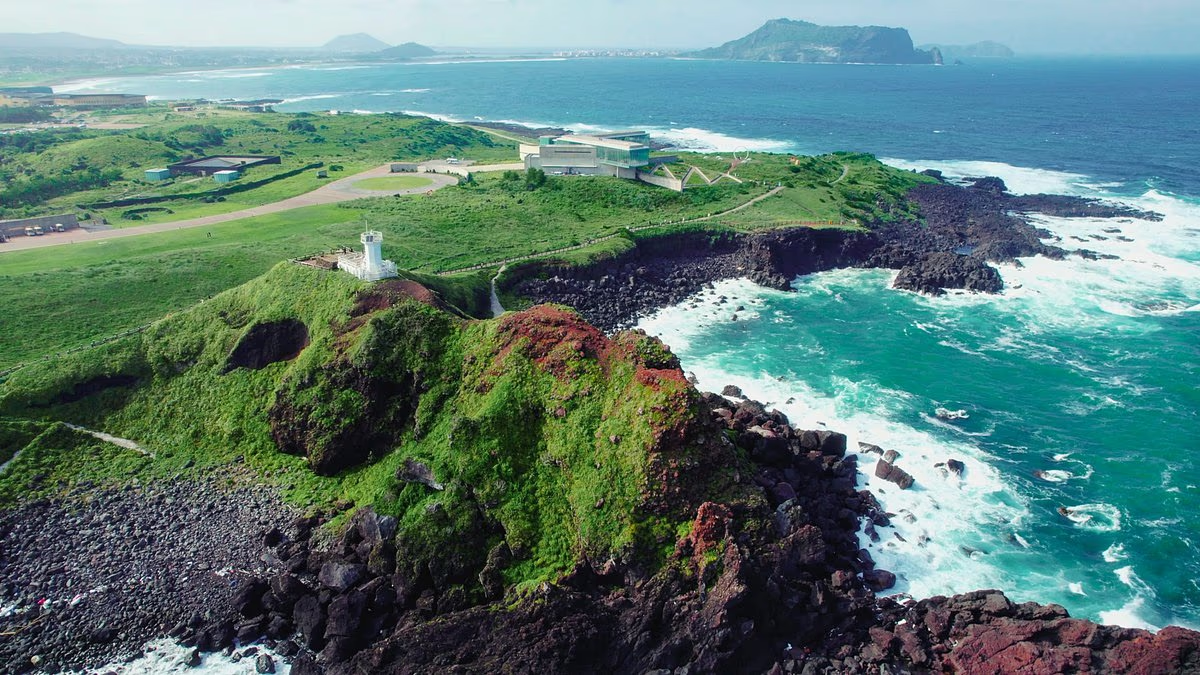
On the tiny Jeju Island in South Korea, known for its mountains, white sand beaches and peaceful volcanic landscape, the bodies turned up in just three days.
Last week the body of a missing man in his 60s was found after he was reported missing 51 days earlier. The next day, a man in his 70s was found in the water off the northern coast of the island.
Just two days later a further two bodies were found, including 37-year-old Jang Mi-ran, whose body was found on Monday after her boyfriend reported her missing in May.
Authorities on Tuesday detained the investigator, surnamed Bu, who closed both Jang’s and the 60-year-old’s cases. He has been accused of falsifying records and neglecting his duties.
Jang’s case generated national attention after Bu allegedly closed her case early without confirming her whereabouts and falsely recording her death as a ‘traffic accident casualty’.
Her body was found at a palm tree farm about 547 yards from where she was staying. She was believed to have killed herself, according to local reports.
Bu allegedly told Jang’s boyfriend that he had spoken to her over the phone and she did not wish to speak to her partner.
The dead bodies of four missing persons have been found on an island in South Korea. Jang Mi-ran’s (pictured) body was found on Monday after her boyfriend reported her missing in May

Police officers inspect the scene where the body of Jang was discovered at a palm tree farm

An investigator, surnamed Bu, who closed both Jang’s and the 60-year-old’s cases, has been accused of falsifying records and neglecting his duties.
The boyfriend tried reporting her disappearance again in July, but it was dismissed. It was only when he took it to a police station in Seoul that it was finally picked up.
In the case of the elderly man who went missing at the end of June, Bu reportedly closed the case and told the family he was safe but he ‘did not wish to disclose his location to the family’.
The man’s son told reporters: ‘We believed the police when they said my father was safe and waited, but after 51 days, what returned was his body.’
The causes of death have not been confirmed in any of the cases.
Bu denies the charges against him and insists he did contact the missing persons, according to police.
Authorities are investigating all 298 cases that have been handled by Bu and are looking into 10 for improper closure.
‘The arrest warrant against the defendant was issued over concerns of flight risk and evidence tampering,’ detective Jung Tae-won said at a news conference on Wednesday.
The government launched a task force to ‘swiftly examine all missing cases the defendant had handled,’ he added.

On the tiny Jeju Island in South Korea , known for its mountains, white sand beaches and peaceful volcanic landscape, four dead bodies turned up in just three days
The scandal prompted President Lee Jae Myung to order a probe into the handling of Jang’s case. He instructed his cabinet to present a reform plan for the police force.
‘Recently, serious concerns have emerged over a lack of discipline within the police and irresponsibility in maintaining public safety,’ Lee said at a cabinet meeting on Tuesday.
‘Please give some thought to how the police should be reformed going forward, including the establishment of a body tasked with overseeing police reform,’ he added.
Police have also launched a comprehensive review of all missing persons cases closed over the past three years – some 310,000 cases – in response to the scrutiny, Yonhap news agency reported on Wednesday.
Jeju is one of the most popular tourist hot spots in South Korea and received more than 13 million foreign and domestic visitors last year.
Some experts say the low crime rate may be part of the reason why missing persons cases are not taken seriously.
‘After experiencing on the field that the absolute majority of missing adults are found quickly, [the officers] tend to assume all cases are like that,’ Lee Yung-hyeock, a professor specialising in police science at Konkuk University, told Yonhap news agency.
More than 70,000 adults are reported missing in South Korea each year and 99 per cent of them are resolved within a month.
