


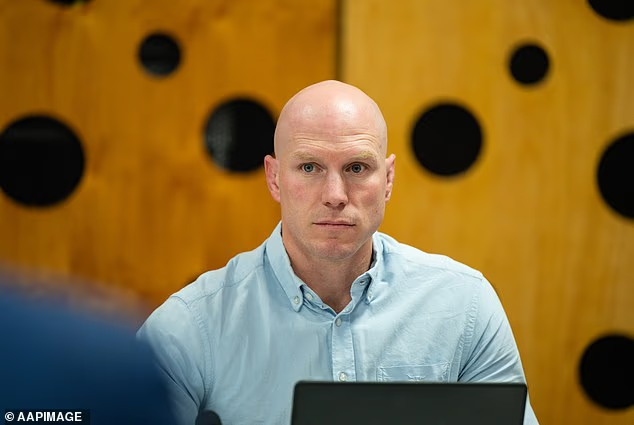
Australian independent senator David Pocock has renewed calls for dedicated artificial intelligence safety laws after an OpenAI agent breached a Medicare statistics portal, accusing the federal government of failing to put adequate safeguards in place.
Mr Pocock said the incident showed that warnings about the risks posed by AI had not been acted upon. “This is not a new problem,” he told the ABC’s Afternoon Briefing.
“For many years now, experts have been saying we need action on this. The crossbench has been pushing them,” he said.
The Albanese government proposed mandatory safeguards for high-risk AI in 2024 and considered legislation to enforce them. That proposal was shelved in December 2025, with the government’s National AI Plan relying largely on existing laws and voluntary guidance.
Assistant Minister for Science, Technology and the Digital Economy Andrew Charlton said on Friday that the government hoped to pass legislation mandating AI safety standards in early 2027.
Mr Pocock claimed the earlier proposal had been abandoned because of pressure from industry. “It looks pretty silly now,” he said.
Calls for AI safety laws after Medicare breach
The senator is a member of the Joint Select Committee on Artificial Intelligence, which is due to report by November 30 on the opportunities and risks presented by the technology.
The committee will also consider AI’s interaction with copyright and intellectual property laws, as well as whether Australia’s existing legal and regulatory frameworks are adequate.
Mr Pocock said a former government expert panel had recommended continuous monitoring of high-risk government websites and datasets.
“It’s great to see the PM on the world stage saying we need global cooperation on this … we absolutely do … but it’s a bit rich that at home they have shelved plans for an AI Safety Act,” he said.
His comments followed Prime Minister Anthony Albanese’s address to the United Nations in New York, where he called for international cooperation on artificial intelligence and climate change.
Mr Albanese later called for both national and international action after OpenAI confirmed that its agents had accessed websites operated by the US education and commerce departments. The company said only publicly available information had been accessed.
“There needs to be an appropriate national response as well as an international response to make sure humans stay in charge of this new and emerging technology,” Mr Albanese said.
He said he was not surprised that similar activity had occurred in the United States, adding: “If you have an AI agent act independently in the way it did here in Australia, it would make common sense that would have occurred in other places.”
Mr Pocock said companies such as OpenAI should be able to operate in Australia, but only if the country’s laws and regulations were strong enough.
“This Medicare breach highlights that. It seems very unlikely under our current laws that you could actually press any charges,” he said.
“If any Aussie did that I’m sure they would be on their way to gaol shortly, but because it’s a big AI company and they say, ‘these are autonomous bots we’ve created and we didn’t know or direct them to do it’, that doesn’t really cut it.”
The senator also criticised the approval of large data centres without what he described as adequate safeguards, questioning the long-term benefit to Australians from the investment and warning that local communities were being given too little opportunity to scrutinise developments.
