


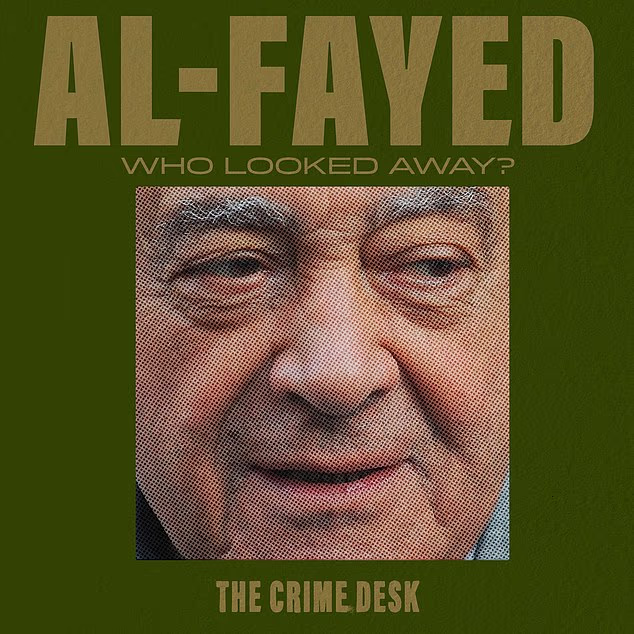
A new podcast series examining allegations against Mohamed Al-Fayed has detailed claims that the former Harrods owner operated an abuse network comparable in scale and organisation to that of Jeffrey Epstein.
The series, Al-Fayed: Who Looked Away?, focuses on the accounts of women who say they were sexually assaulted or trafficked, and asks why repeated allegations did not result in criminal charges against the businessman before his death in 2023.
Among those featured is Joanna Brittan, who says she was taken to Al-Fayed’s Surrey estate after being dismissed from her job as a translator and personal assistant to United Arab Emirates diplomat Ahmed Obaidly in 1990.
Ms Brittan, then 25, says she was ordered into a limousine outside an office in Knightsbridge. She recalled that the chauffeur locked the doors before driving her out of London, while Obaidly remained silent.
She said the vehicle eventually arrived at a country estate where armed men were positioned around the grounds. At the house, she recognised Al-Fayed, then the 61-year-old owner of Harrods.
Ms Brittan believes she was drugged during lunch by Obaidly and Al-Fayed and sexually abused by one or both men. She has no memory of what happened afterwards and says the gap may have been caused by drugs, although memory loss can also occur following traumatic abuse.
She later came to understand the incident as trafficking after exchanging messages with Virginia Giuffre, who helped expose Epstein’s exploitation of young women and girls. Ms Giuffre, who died in 2025, described Ms Brittan as “a beautiful soul” and offered her support.
Joanna Brittan’s account
Ms Brittan had moved to London to work for the Al Nahyan family and was assigned to Obaidly, a senior and well-connected diplomat. She says that soon after taking the job she was told she had to undergo a sexual health examination if she wanted to remain employed.
“It was literally a gynae exam, bloods, [checking for] STDs,” she recalled.
She also alleges that Obaidly repeatedly propositioned her, attempted to rape her during a trip to the south of France and later raped her several times at his home in London. There is no suggestion in the account that members of the Abu Dhabi royal family knew about or condoned the alleged abuse.
Afterwards, Ms Brittan says, Obaidly took her to Harrods, where she met Al-Fayed in the chairman’s suite. She recalled the two men speaking Arabic while looking at her, leaving her with the impression that she was being “paraded as a trophy”.
Not long afterwards, she was dismissed and taken to Al-Fayed’s estate. She says he told her that she would live there as a nanny to his children, a decision apparently made between the two men.
She remembers laughing at the suggestion and says both men became angry. After that, she recalls nothing until she was away from the estate.
Ms Brittan reported her allegations to police in 2017 after watching a television documentary featuring women who said they had been assaulted by Al-Fayed. She says the Metropolitan Police told her that no further action would be taken because Obaidly had died in 2015 and there was insufficient evidence against Al-Fayed.
She was told that her report would remain on file and that officers might have a case if another woman came forward. Another alleged victim who contacted police after watching the same programme was reportedly given a similar response.
After Al-Fayed’s death, the Met said it had received allegations from 21 women between 2005 and 2023. Material was presented to the Crown Prosecution Service on five occasions, but Al-Fayed was never charged.
Al-Fayed and Epstein links
The podcast alleges that Al-Fayed’s businesses, properties and yacht were used as settings in which women were targeted and abused. It draws comparisons with Epstein, whose victims included Ms Giuffre and who was accused of using a wider international network to exploit young women and girls.
According to material described in the series, Epstein used private airport terminals operated under the name Harrods Aviation. Such facilities could avoid standard immigration checks, making it easier to move women between countries, the podcast says.
One woman, identified as Natalie, said she was directed by Epstein to Al-Fayed’s yacht, the Jonikal, off St Tropez in 1997. She said she was assaulted there.
The yacht was also used by Princess Diana and Dodi Al-Fayed during the summer before their deaths, although Natalie said she did not recall seeing the couple.
The series also examines claims involving Harrods staff and associates. Kelly Walker-Duncalf, who worked as a recruiter at the department store for 15 years, was described by former employees in a 2025 television documentary as “Al-Fayed’s Fixer”. At least three survivors alleged that she personally introduced them to Al-Fayed.
When approached by the documentary makers, Ms Walker-Duncalf responded through her lawyer that she had not been aware of Al-Fayed’s crimes and had not facilitated them.
Michael Ward, who became Harrods’ managing director in 2005, has apologised on behalf of the store to survivors but said he had no knowledge of abuse and that no formal complaints were brought to him. There is no direct evidence that he personally knew about Al-Fayed’s crimes.
Dr Ann Coxon, one of the doctors accused of carrying out sexual health checks on Harrods employees and passing confidential results to Al-Fayed, has categorically denied the allegations and remains a doctor in good standing.
Neither Ms Walker-Duncalf, Mr Ward nor Dr Coxon has been charged with a criminal offence.
Claims of a wider system
Another survivor, identified as Carrie, said she was 20 when she began a summer job at Harrods in 1994. After two weeks, she was taken by security staff to meet Al-Fayed, who she says became fixated on her.
She alleges that she was subjected to a sexual examination at a private medical facility before being taken to an apartment on Park Lane owned by Al-Fayed.
“There were two glasses of champagne on the table and lots of extravagant gifts – Chanel No5 perfume and outfits,” she said. “And he emerges in a satin dressing gown that’s open. He’s completely naked underneath.”
Ms Carrie said Al-Fayed assaulted her and that she escaped by claiming her father was waiting outside.
The podcast also examines allegations against John Macnamara, a former Metropolitan Police detective chief superintendent who became head of security at Harrods. Survivors have claimed that he threatened them, intercepted communications and helped suppress allegations against Al-Fayed.
Mr Macnamara, who died in 2015, retained links with police officers during his time at Harrods. He is alleged to have invited officers to the store for drinks and distributed Harrods hampers to those who were friendly with him.
In one case, a former nanny who accused Al-Fayed of sexual assault was arrested on suspicion of theft in 1994. It was alleged that Mr Macnamara had arranged false charges to intimidate her. She was not charged and later received £12,000 in compensation from Al-Fayed.
The allegations extend beyond Harrods. Women are also said to have been procured through the Ritz Paris and Fulham Football Club, which Al-Fayed bought in 1997. A book published last year alleged that West Heath school in Sevenoaks, Kent, which he also owned, was used to procure underage girls.
Lawyers representing more than 275 survivors have warned that compensation claims could exceed £150 million, more than twice the amount Harrods has set aside.
Some survivors, including Ms Brittan, have been recognised by the Home Office as victims of trafficking. However, police have not reclassified Al-Fayed’s alleged crimes as trafficking rather than sexual assault.
The distinction is significant because a trafficking classification could bring additional resources, stronger legal powers and greater penalties for those alleged to have assisted the abuse.
