


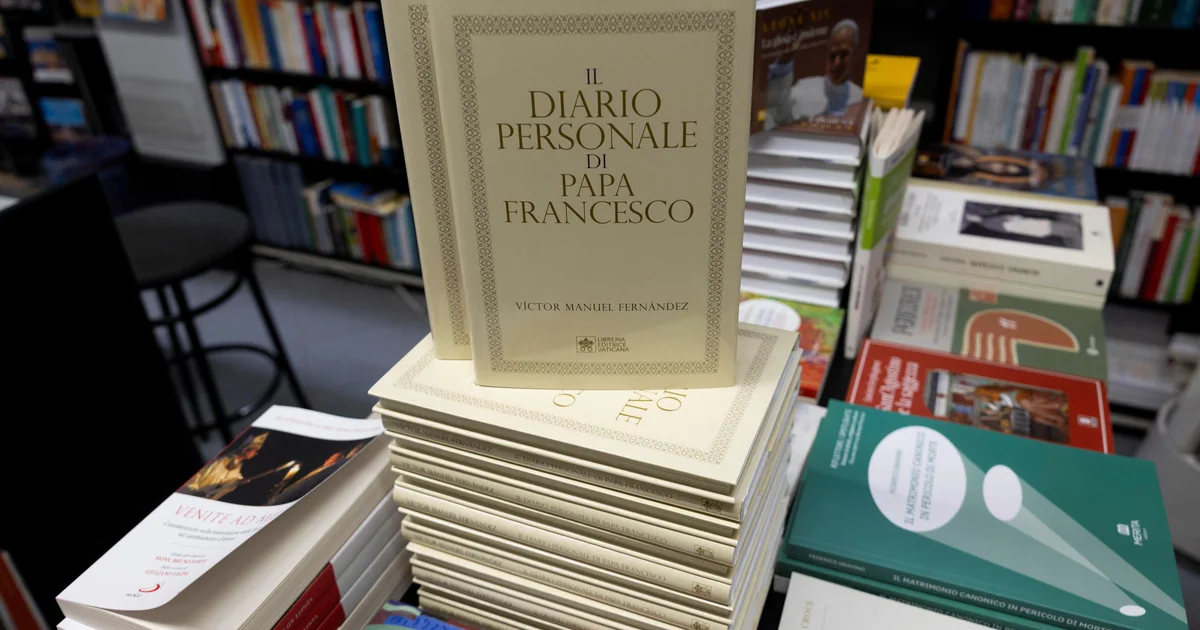
The publication of Pope Francis’s private diary has revealed his account of seeing the “gates of hell” during the clergy sexual abuse scandal, along with what he described as mystical encounters with the devil during his ministry.
The Private Diary of Pope Francis, released globally in several languages, offers an intimate record of the late pontiff’s fears, doubts, spiritual struggles and temptations. The writings were kept in a leather-bound calendar and span his career from 1992, when he was auxiliary bishop of Buenos Aires, to 18 August 2024.
Francis died in April 2025 at the age of 88, after 12 years as pope.
Pope Francis and the Chile abuse scandal
The diary describes three encounters with the devil, two during Francis’s time in Buenos Aires and another after his troubled visit to Chile in 2018.
Francis faced widespread criticism during the trip after appearing to discredit victims of Chile’s most notorious abuser. Following challenges from journalists during the flight back to Rome, he commissioned an investigation and concluded that the victims had been right and that he had been misled by the Chilean church hierarchy.
“Devastated because of the situation in Chile and the dialogue with the journalists on the airplane,” he wrote later. “I became aware of how serious the problem was. … It was hard for me to admit what happened in Chile; I didn’t think it was so serious.”
In an entry dated 7 June 2018, Francis wrote that he had “saw the entrance to hell. Pagan seduction in full force” in relation to the scandal. In the months that followed, he recorded: “What shame and evil this has brought on the church!” and “Once more the gates of hell.”
He later described seeing and hearing the devil during a meeting in Rome. In an entry dated 24 January 2021, he quoted the voice as saying: “Now I’ve gotten everything I wanted.” Francis wrote that he could not forget the figure’s “powerful raspiness”.
A crisis over power and authority
The diary also records a profound spiritual crisis between 2021 and 2022. It began amid severe physical pain, the coronavirus pandemic and upheaval inside the Vatican over a financial investigation authorised by Francis.
Cardinal Víctor Manuel Fernández, who selected and contextualised the diary entries, writes that the crisis was connected primarily to Francis’s exercise of power. The pope was troubled by the temptation to act as though he alone could solve every problem and to place himself above the world.
Fernández describes this as a temptation towards “reductive curiosity” and omnipotence. He says Francis ultimately overcame the crisis by placing himself entirely in God’s mercy.
By 30 December 2022, Fernández writes, Francis understood the ordeal as “a powerful invitation from the Lord to become aware of an accumulation of interior darkness that he had to overcome so he could be free”.
Fernández links the experience to two of Francis’s final major teaching documents: a 2023 text on confidence in God’s merciful love and a 2024 encyclical on Christ’s human and divine love.
The cardinal, an Argentine theologian who heads the Vatican’s doctrine office, said he had feared the diary might be “left forgotten in some storage”. He was allowed to publish selected passages by Francis’s successor, Pope Leo XIV.
Francis had shown Fernández the diary and told him: “From this, you will all see.” Fernández said he later told Leo that he wanted to study the material, explain its meaning and make it known, adding that the new pope showed “intense interest”.
Some of the most confidential material has not been published. Fernández said Francis wrote those thoughts in an indecipherable code, while entries concerning third parties were also omitted.
The published diary contains little discussion of church administration and instead focuses on Francis’s inner life. It includes a favourable assessment of then-Cardinal Robert Prevost, now Leo XIV, whom Francis described as “A great pastor, a generous missionary and an irreproachable man.”
The posthumous publication of a pope’s personal spiritual writings has precedent. Pope John XXIII’s autobiography, Journal of a Soul, was published by his secretary in 1960, while the personal notes of St John Paul II were published in 2014 despite his wish that they be destroyed.
