


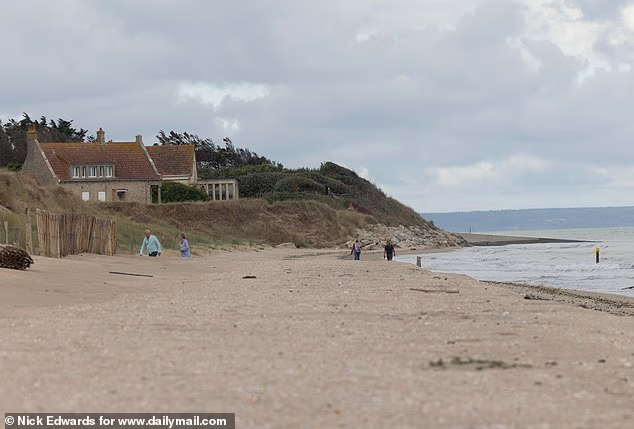
A migrant boat launched from Utah Beach in Normandy was escorted across the Channel to Portsmouth after French authorities intercepted it, raising fears among officials that people-smuggling gangs are opening a new route to Britain.
The 34ft inflatable was carrying an estimated 130 passengers when it set off at about 3.30am on Sunday. It had travelled only around four miles, in the relative shelter of the Bay of the Seine, when four French boats intercepted it.
Rather than turn the vessel back, the French crews shadowed it for roughly ten hours, in line with their rules of engagement, while alerting British authorities. The dinghy was eventually met at sea by lifeboats from Bembridge and Yarmouth on the Isle of Wight, supported by a rescue helicopter.
The migrants were transferred to the two RNLI boats, with lifejackets provided to those who did not already have them. The lifeboats then continued towards the south coast while in contact with Border Force.
Both Portsmouth and Southampton declined requests to bring the group into their commercial ports, saying they did not have the facilities to process such a large party. The migrants were eventually taken ashore at Eastney Landing, near Portsmouth, at about 5pm.
The operation triggered a tense confrontation with anti-immigration protesters, who gathered at the landing point and blocked the only road leading in and out. Some protesters waded into the water as the passengers arrived, while riot police were deployed to hold them back.
The stand-off lasted until the early hours of Monday. The migrants were moved by coach almost 12 hours after reaching the UK coast to begin the asylum process.
The new route from Normandy
The crossing was significant because the boat had departed from Utah Beach, the historic site where American troops landed on D-Day in 1944. The stretch of coast is about 25 miles south-east of Cherbourg and more than three times farther from Britain than the beaches around Calais.
It was described in the source material as the furthest recorded small-boat crossing, although the passengers did not complete the journey unaided after the dinghy was intercepted. The route between Normandy and the Solent covers about 95 miles and includes the Raz Blanchard, or Alderney Race, where some of Europe’s strongest currents are found.
The successful operation has prompted concern that smugglers may increasingly look west as police disruption makes launches around Calais and Dunkirk more difficult.
A senior French Interior Ministry source based in the Calais area said: “The geographical focus of the people smugglers is definitely changing.”
“They are finding it much harder to get boats launched in the Pas de Calais, and so are moving west, across to Normandy,” the source said.
“We expect far more of the mega-dinghies to appear here in the coming weeks and months. The success on Sunday proved the voyage can be done.”
Donna Jones, the police and crime commissioner for Hampshire and the Isle of Wight, said the crossing raised concerns that the Normandy-to-Portsmouth route could become a “destination of choice for people traffickers”.
A spokesman for France’s Maritime Prefecture said that “unusual routes”, including departures from Normandy, were likely to be attempted as the shorter crossing from Calais towards Dover became less viable.
The French authorities have introduced surveillance and reconnaissance operations aimed at disrupting launches and intercepting boats, engines and supply routes. The measures have been supported by £660 million a year from the UK Government, according to the source material.
However, the prospect of large profits is encouraging gangs to adapt. Smugglers are said to charge about £2,000 per passenger, meaning a boat carrying more than 100 people could generate gross receipts of over £250,000.
Migrant camps near Cherbourg
Several temporary camps in Normandy are being used by people hoping to reach Britain. One, known locally as “The Jungle”, is situated in woodland behind a school and sports centre on the outskirts of Cherbourg, about 30 miles from Utah Beach.
About 15 tents have been erected on wooden pallets in a clearing, with clothes hanging from surrounding trees and a makeshift kitchen at one end. An Afghanistan flag hangs from a tree near the entrance, alongside discarded shopping trolleys and a broken portable toilet cabin.
The camp has existed in some form for around a decade. It was previously used by people attempting to hide in lorries travelling from Cherbourg to Britain, but increased port security and a 4-metre barrier topped with barbed wire have made that route more difficult.
One resident said: “The people here change. Most move every few weeks or months. They want to come to England. They only stay here for a bit and dream of the UK.”
Another said: “We want to be able to take the boat, leave Cherbourg and get to England. We have family on the other side.”
A further camp near Ouistreham, east of Cherbourg towards Le Havre, is home to about 20 mostly Sudanese men. Eight tents, portable toilets, cooking equipment and chairs have been set up beside a canal.
One man said he had travelled there from Calais to recover after breaking his pelvis while attempting to board a lorry bound for Britain. He was considering his options but said most of those living at the camp wanted to reach the UK.
On Utah Beach itself, there was little evidence of the departure days later, apart from a discarded toothbrush, tablets and a piece of jewellery. A local dog walker said they had not seen a police officer in the area for 30 years.
That may change as French authorities prepare for the possibility of further launches from the Normandy coast.
