


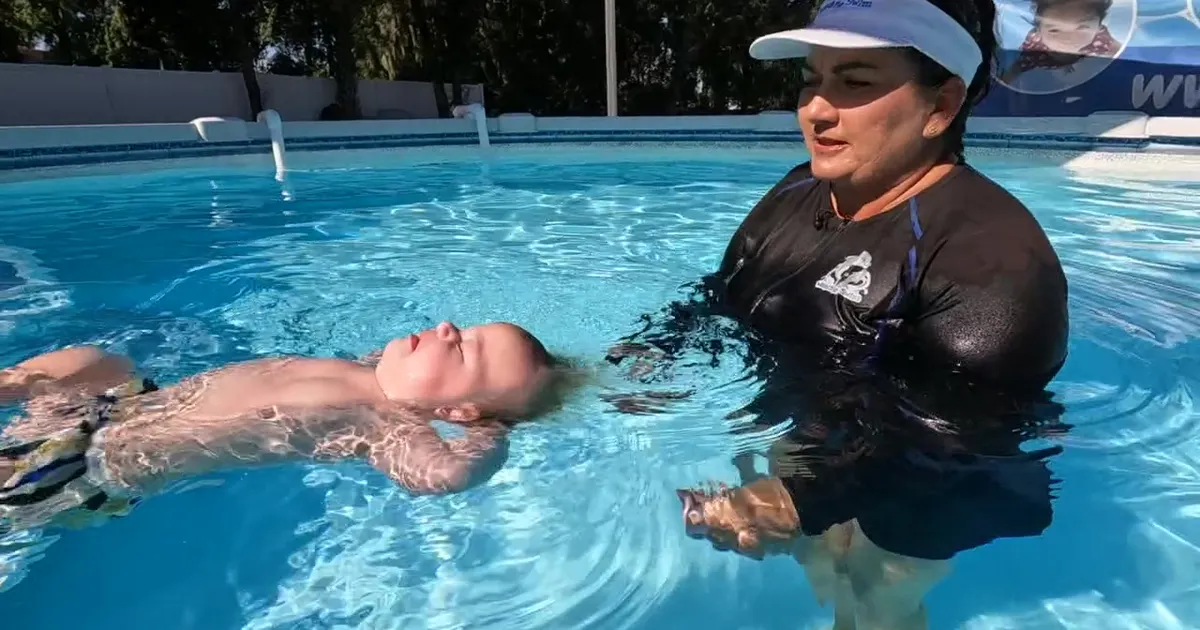
A Florida mother whose 16-month-old son was found unconscious in a swimming pool has turned the near-fatal accident into a campaign to teach children survival skills in the water.
Kari Bahour, from Riverview near Tampa, was working as a paralegal when the incident changed the course of her life. Her son was discovered face down in the pool, not breathing, after slipping into the water.
“He was found in a pool… face down, unconscious and not breathing,” Bahour said. “Just seeing your child completely lifeless, that changed the trajectory of my entire life.”
Her son made a full recovery, but Bahour said the experience exposed how quickly and quietly a drowning can happen, even when other adults are nearby.
From near-drowning to water safety mission
Bahour went on to train as a survival swim instructor and founded Watch Me Swim, where she teaches young children how to respond if they unexpectedly fall into a pool, lake or pond.
The lessons are designed to help children float, roll on to their backs, regain their breathing and reach the side of the pool. Sessions are short and highly focused, with children practising techniques intended to give them a chance of surviving until help arrives.
“I didn’t know drowning was silent,” Bahour said. “Drowning does not discriminate. It happens to the best of parents.”
She says the danger is particularly difficult for families in Florida, where swimming pools, lakes and ponds are part of everyday life.
After four children drowned in the Tampa Bay area over Mother’s Day weekend in 2014, Bahour decided that teaching lessons alone was not enough. She established the Water Smart Tots Foundation to help families who could not afford survival swimming instruction.
The foundation uses donations and grants to provide scholarships, allowing children to take lessons and return for refresher sessions without their families taking on the full financial cost.
Bahour’s work is focused on giving young children practical self-rescue skills rather than simply teaching conventional swimming strokes.
Her organisation says she has spent decades working in drowning prevention and has taught thousands of infants and young children. The programme is also intended to support families who might otherwise struggle to access specialist instruction.
Children learn to roll, float and reach safety
Amanda Myers enrolled her children because her family lives around water and owns a swimming pool. Her three-year-old son Colton and five-year-old daughter Peyton practise in the pool for about 10 minutes at a time.
“I wanted to make sure my kids were safe with so many lakes, and we own a pool,” Myers said. “It was a requirement for us to make sure that my kids would have the skills to survive and save themselves.”
Myers said the children are taught to roll over, float and move towards the edge if they fall into the water.
“Having three kids, I’m outnumbered all the time,” she said. “If they were to fall in, they know how to roll over, get to the edge and save themselves.”
Her family qualified for financial assistance through Water Smart Tots, enabling the children to continue with refresher lessons.
“It is a very invaluable resource for families,” Myers said. “It helps keep them safe without having the financial burden of swim lessons.”
For Bahour, every child who learns how to react in an emergency represents a chance to prevent another family from experiencing the fear and heartbreak that followed her son’s accident.
