


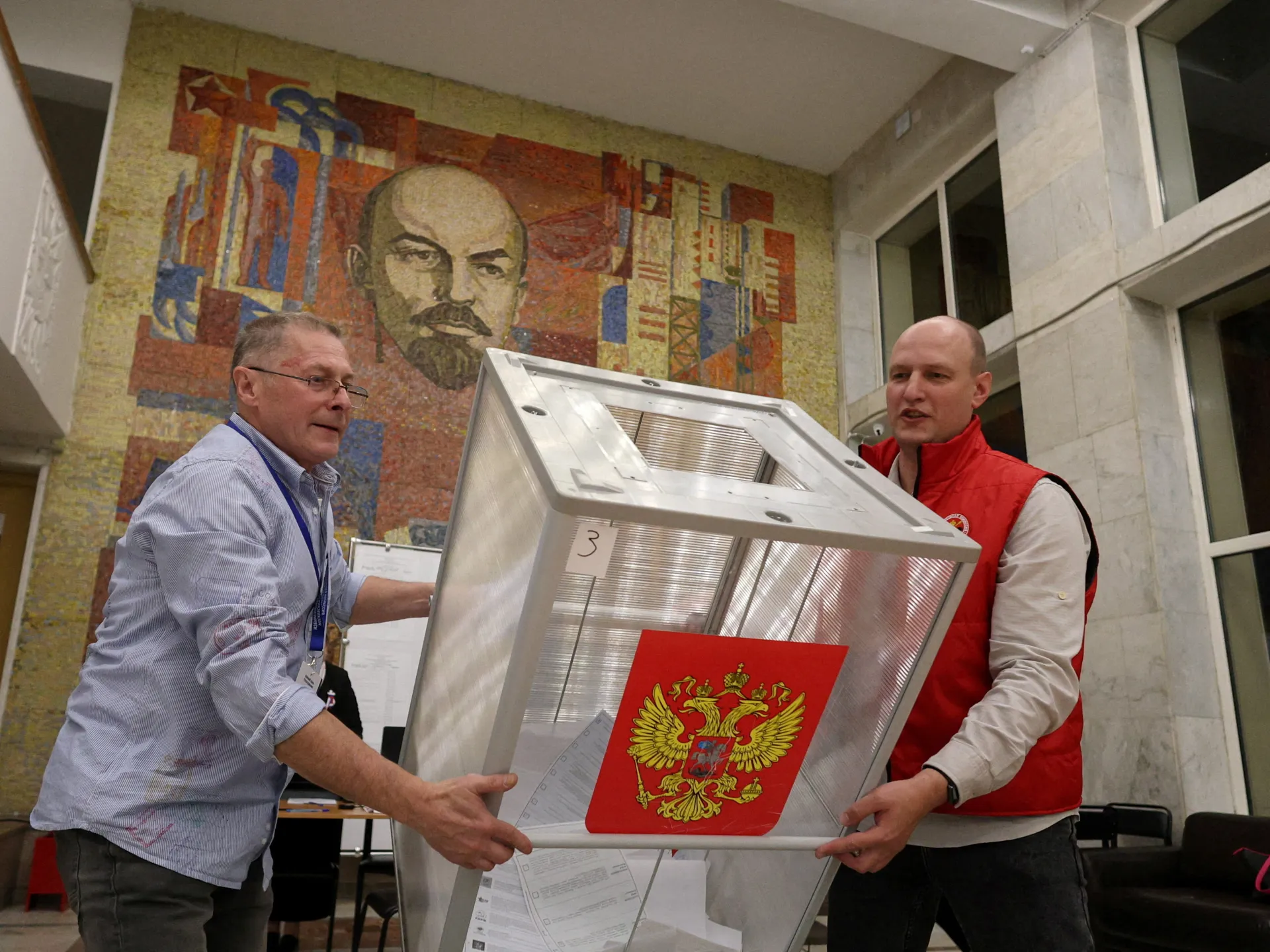
Russia’s wartime parliamentary elections have closed with the ruling United Russia party expected to retain its dominant position, as Vladimir Putin’s government sought to present the tightly controlled vote as a test of public support for the war in Ukraine.
The election was the first parliamentary contest since Russia launched its full-scale invasion in 2022. Initial results put United Russia comfortably ahead, while the Central Election Commission said turnout had reached 56.66 per cent by the close of voting.
Official results and final turnout figures are expected on Monday morning. The three-day election began on Friday and involved 111 million eligible voters.
Ukraine attacks reported during Russian parliamentary elections
Russian officials accused Ukraine of attempting to disrupt the vote after Kyiv launched hundreds of drones at Moscow and other Russian regions. The TASS state news agency described the strikes as the biggest attack of their kind since the war began.
At least three people were killed in the Moscow region and two others died in the Russian-held part of Ukraine’s Kherson region, according to the regional governor and election commission. One of those killed was an election official.
Russian authorities also reported attacks on electronic voting systems and communication lines, although they said the election process was largely unaffected.
The ballot included residents of four Ukrainian regions that Moscow annexed after the invasion but does not fully control, as well as people in Crimea, which Russia annexed in 2014. Kyiv condemned voting in the occupied areas as illegal and called on foreign governments not to recognise the result, while the European Union described it as a “blatant violation of international law”.
Voters cast two ballots for the 450-seat State Duma. Political parties contested half the seats, while the remainder were decided in single-seat constituencies.
United Russia is widely expected to preserve its overwhelming control of parliament. Smaller parties regarded as the “systemic opposition”, which generally support the Kremlin’s position on major issues, are also expected to retain their representation.
The Kremlin’s control over the campaign and state media, alongside the absence of a genuine opposition, has left little prospect of a major challenge to the ruling party. The liberal Yabloko party, the only registered political organisation to publicly criticise the war, was removed from the party ballot by Russia’s Supreme Court last month and fielded only a few dozen constituency candidates.
Some anti-war politicians were imprisoned or forced to leave Russia before campaigning began. Moscow also did not invite election observers from the Organization for Security and Cooperation in Europe, accusing it of applying “double standards” in its criticism of Russia.
