


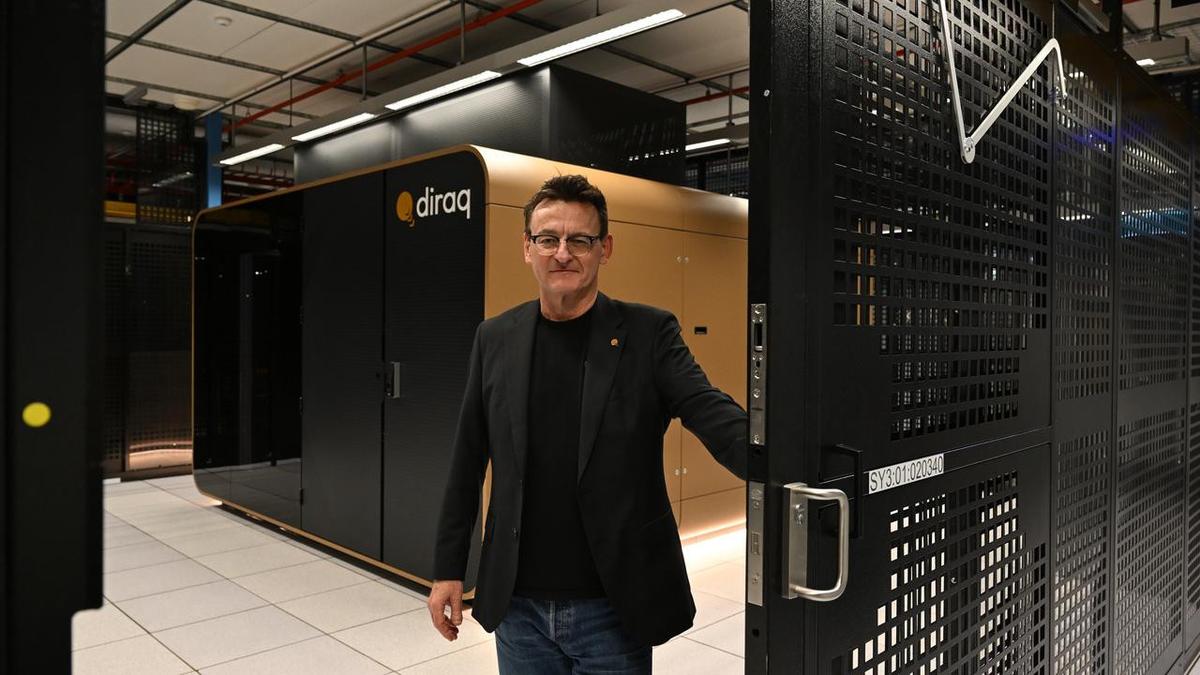
A quantum computer installed inside a commercial data centre in Sydney could help bring life-saving medicines to patients faster, according to the Australian technology company behind the prototype.
Diraq has placed what it says is Australia’s first quantum computer at a facility in Alexandria, owned by US-based Equinix, the world’s largest data centre company.
The machine is powered by a silicon chip no larger than a postage stamp. Unlike a conventional supercomputer, it is designed to tackle problems in which the number of possible solutions can increase exponentially, including those involving molecules.
Diraq chief executive Andrew Dzurak said the technology could transform pharmaceutical research by allowing companies to assess potential treatments more efficiently.
“The molecules we have in our body or in pharmaceuticals … cannot be calculated with conventional computers,” he told AAP. “A quantum computer is able to solve those problems with a fraction of the resources.”
Pharmaceutical companies currently spend billions of dollars searching for and testing possible treatments. Mr Dzurak said a quantum computer could save significant amounts of time and money in that process.
The system’s small size and relatively modest resource requirements also distinguish it from the large, power-hungry racks used for artificial intelligence. Diraq’s silicon-based computer is housed in a cylindrical refrigeration unit roughly the size of a domestic hot-water heater.
Its power and water consumption are a fraction of those used by a traditional data centre, potentially avoiding some of the concerns associated with locating such facilities in built-up areas.
Access to the quantum computer in Sydney data centre facilities is tightly controlled. Reaching Diraq’s enclosure requires staff to pass through five separate fingerprint scanners.
Mr Dzurak said placing the machine alongside artificial intelligence systems and high-performance supercomputers could also prove valuable, as the technologies would be able to work together on complex problems.
“It just makes a lot of sense to have them all integrated together in one location,” he said.
Diraq ultimately hopes to sell thousands of quantum computers to industries by the end of the decade. Mr Dzurak said the company was confident its systems would be competitive on price once they had been built and proven to work.
