


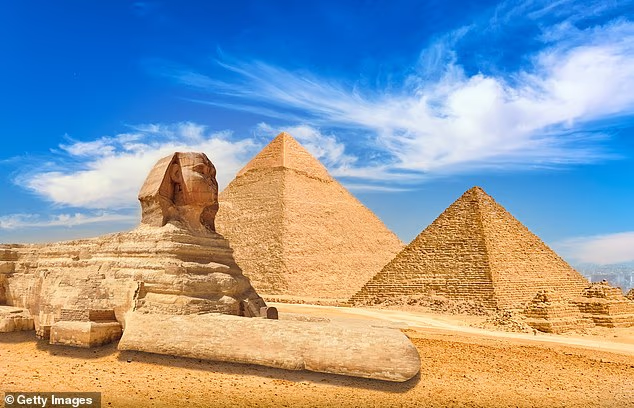
Rocks used to build the Great Sphinx of Giza may contain the fossilised remains of an ancient crocodile species, scientists have suggested after identifying a previously unknown predator in the same limestone formation.
The crocodile, named Herugavialis cairensis, lived around 54 million years ago. Its remains were found in Egypt’s Mokattam Formation, the rocks quarried more than 4,000 years ago to create the famous monument.
Dr Paul Burke, of the Swedish Museum of Natural History, said it was possible that fossils of the animal remained within the Sphinx itself.
“It could! It was built from the same rocks where Herugavialis was found, so who knows,” he said. “What I don’t recommend is tearing apart the Sphinx to see if there is!”
The new species was identified from a fossilised skull discovered during excavations in the 1920s. Researchers had originally classified it as belonging to the false gharial, or Tomistoma schlegelii, one of the living members of the gavial family.
More recent palaeontological analysis, including CT scanning to examine the inside of the skull, revealed differences that showed it represented an entirely distinct extinct species. The findings have been published in Royal Society Open Science.
The name Herugavialis refers to the ancient Egyptian god Heru, who may have inspired the Sphinx. Co-author Professor Philip Mannion, of University College London, said the choice also reflected the coincidence that both the monument and the fossilised skull are missing the tip of the snout.
Although the end of the fossil is damaged, its long, narrow shape and sharp, pointed teeth offer clues about the crocodile’s diet. Dr Burke said its anatomy resembled that of the modern Indian gharial, which feeds mainly on fish.
Fish fossils are also preserved in the Mokattam Formation, leading the researchers to suggest that Herugavialis hunted fish in the waters of the region.
Gavials once lived across much of the world for more than 100 million years, including in shallow marine environments. At least two other long-snouted gavial species are thought to have shared the same habitat as Herugavialis.
Dr Burke said the Mediterranean region had supported a wide variety of crocodiles, including gavials, during much of the past 50 million years. Their numbers changed alongside global temperature and sea-level shifts before crocodiles disappeared from the region as the Mediterranean dried out about six million years ago.
