


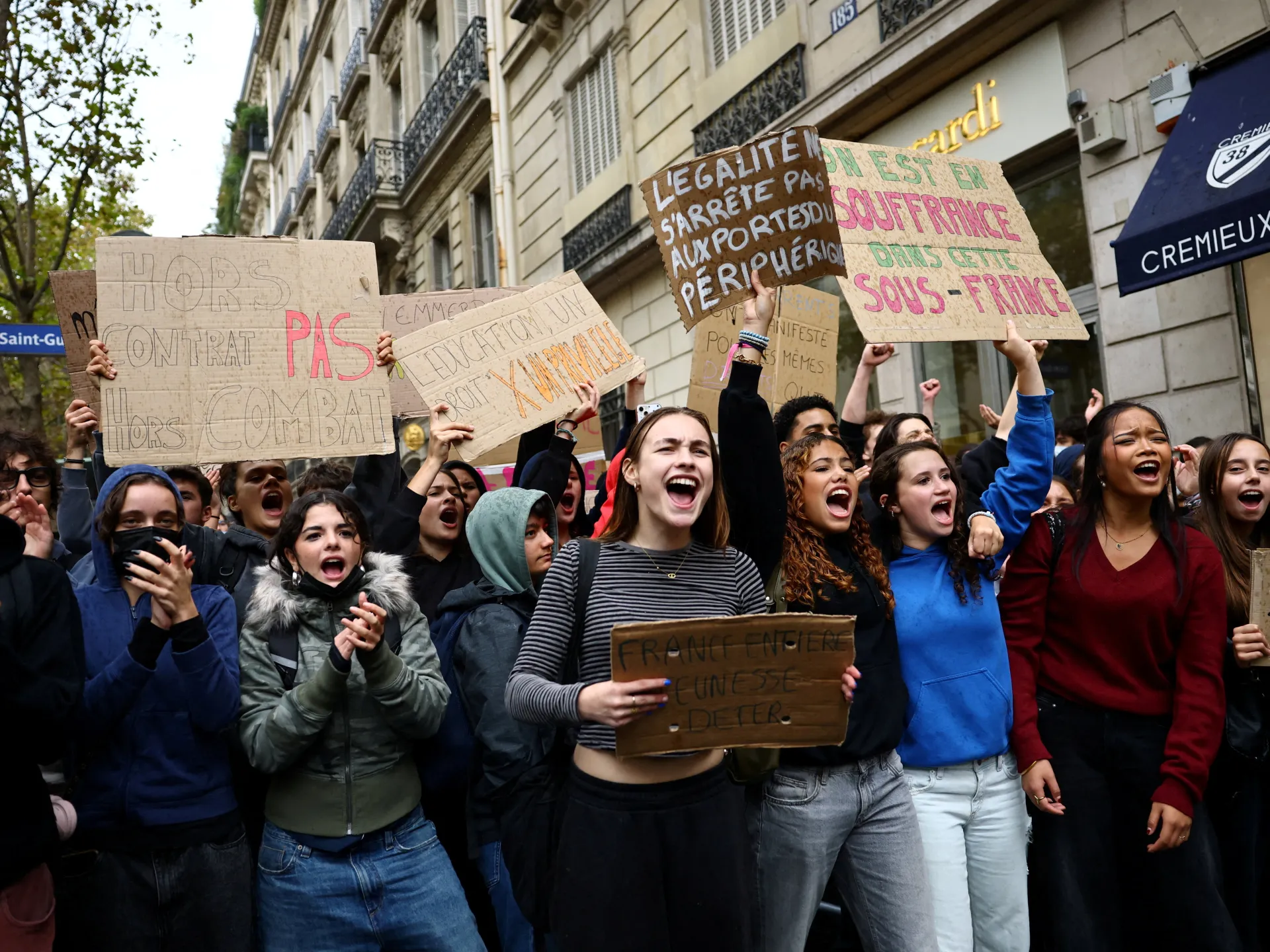
French high-school students protesting over deteriorating education standards say meetings with President Emmanuel Macron and senior ministers have produced sympathetic conversations but few concrete commitments.
Marius Mensil, a 17-year-old co-leader of the Union Syndicale Lyceenne, said officials listened, smiled and acknowledged the legitimacy of the students’ demands before failing to act.
“They’re very good at listening to us. They welcome us, smile at us, tell us, ‘Yes, you’re right, your demands are legitimate’, and in the end, they do nothing,” he said.
Student representatives have held meetings in government offices with Mr Macron, Prime Minister Sebastien Lecornu and Education Minister Edouard Geffray. Some discussions lasted as long as two hours.
Mr Mensil said the education minister had mainly exchanged arguments with students and used technical language to explain why their proposals were not feasible. Mr Macron and Mr Lecornu, he said, took notes and appeared attentive but stopped short of making firm commitments.
The protests began in schools in the overseas territory of Mayotte before spreading to mainland France, starting with a school in Creteil, south-east of Paris, on September 17. Demonstrations then reached Saint-Denis and other parts of the country, attracting groups with additional grievances.
For two months, students have blocked school entrances and demonstrated in the streets, demanding a major overhaul of the education system.
They are calling for more teachers, better maintained buildings and timetables that take account of students’ biological rhythms. They also want to be confident that achieving the baccalaureate will allow them to continue to university.
“We’re not asking for five-star restaurants, MacBooks, or castles… We’re asking for enough teachers, buildings where the ceilings aren’t falling on our heads and class schedules adapted to our biological rhythms,” Mr Mensil said.
Students demand changes to Parcoursup
A central demand is the complete reconstruction of Parcoursup, the university admissions system. Students claim it is discriminatory and lacks transparency, leaving rejected applicants unable to discover why they were refused.
They also argue that the platform and some degree courses take account of the academic standing of an applicant’s school, potentially disadvantaging high-achieving pupils from poorer areas.
Student groups are seeking an emergency programme to repair failing school buildings, more teachers on permanent contracts and an additional 10 billion euros for education.
The Government has recruited 920 substitute teachers and plans to hire a further 3,000. Next year’s budget includes funding for additional substitute teaching hours, while a commitment of 1 billion euros a year through to 2030 has been made for building renovations.
Officials have also promised greater opportunities for high-school representatives to take part in national education discussions. Mr Geffray said class sizes would be capped at 28 pupils from the start of the 2027 academic year in the most disadvantaged schools, with smaller classes for specialised subjects.
The Government has rejected calls from some students to abolish Parcoursup, but has agreed to update the platform. Mr Geffray said some measures would be introduced quickly, while others would be included in the 2027 budget bill.
Mr Mensil described the concessions as “a few crumbs”, although he said they showed the campaign was having an impact. “The government is starting to give in,” he said.
A separate consultation, called “High school students, the floor is yours”, received more than 100,000 submissions during the 18 days it was open from October 6. About 70 per cent of respondents said the education system was ill-suited to their needs, citing long, intense days and poorly organised timetables.
More than half of those taking part, 56.3 per cent, said school buildings were run-down, poorly insulated or inadequately equipped. They also raised concerns about absent teachers, class sizes, Parcoursup and the effect of school conditions on mental health.
Bilal Narjissi, a 17-year-old pupil from the Paul-Eluard school in Saint-Denis and a member of the Renouveau Lyceen student union, said pupils from disadvantaged schools were not sufficiently represented in meetings with officials.
He said some schools in suburban and rural areas had collapsed roofs, water leaks, rats and classes of 30 pupils. Mr Narjissi has invited a special adviser to the prime minister to visit his school and see the conditions first-hand.
Although he described his initial meeting with officials as relaxed and constructive, he said the economy, education and labour ministries had remained firm on issues including reform of the baccalaureate.
Students say they will continue protesting until the Government provides concrete responses. Representatives were due to meet the prime minister again, with Mr Mensil warning that further discussions would serve little purpose without tangible political results.
