


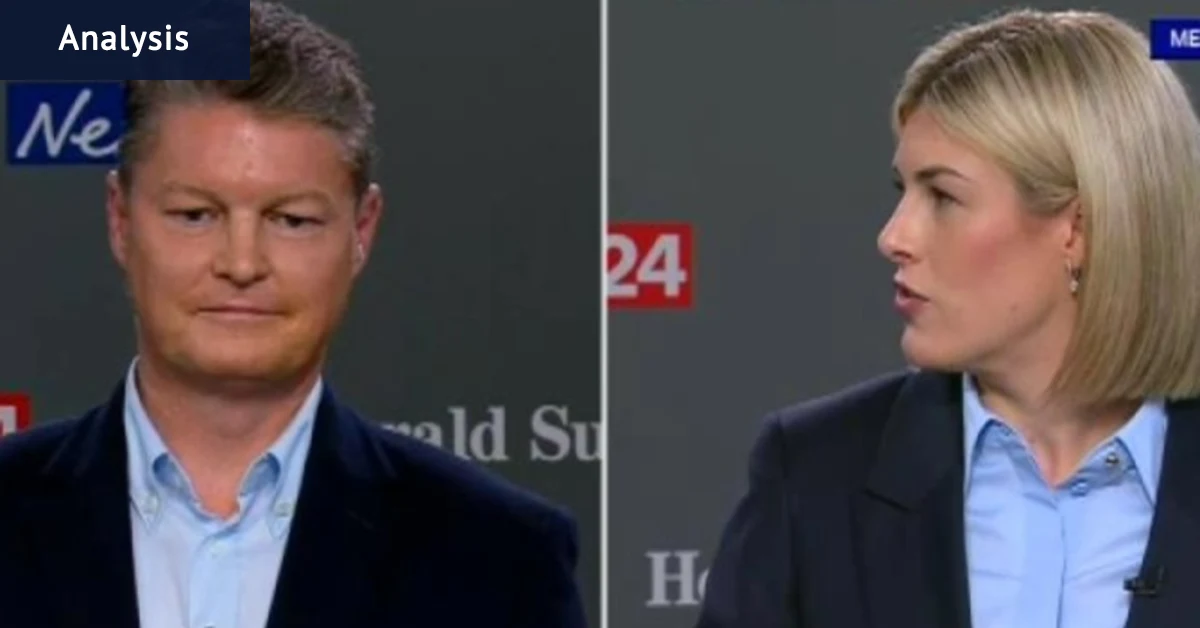
Victoria’s only televised leaders’ debate of the election campaign offered voters a rare, candid clash between Premier Ben Carroll, Opposition Leader Jess Wilson, One Nation leader Warren Pickering and Greens leader Ellen Sandell – but was watched by relatively few of the people who will decide the result.
The four-way debate took place at Melbourne’s Sofitel hotel on Tuesday night in front of 100 undecided voters, with early voting due to begin the following morning. The leaders confronted one another over education, health, energy, the Suburban Rail Loop, protest permits, debt and financial management.
Yet the event’s central significance lay in its limited reach. At a time when voters were about to start casting their ballots, the leaders made detailed arguments and exposed sharp policy differences, while much of the electorate was unlikely to see the exchange in full.
Mr Carroll repeatedly accused Ms Wilson of wanting to “Americanise” Victoria’s health system, while Ms Sandell attacked corporate donations and warned about the influence of “tech bros” and “vampire” data centres. Mr Pickering used the debate to challenge whichever of the other leaders strayed within range.
Ms Wilson also brought a combative style to the discussion, at one point telling the other leaders: “Just let me finish.” The contrasting performances offered an insight into the personalities behind the campaign, from Mr Carroll’s careful, staccato delivery to Ms Sandell’s free-ranging attacks and Mr Pickering’s evident enjoyment of the confrontation.
School funding clash dominates Victorian election debate
One of the most pointed exchanges concerned school funding and a decision taken while Mr Carroll was education minister. Ms Wilson pressed him over what she described as a secret $2.4 billion cut to public schools.
“How do you explain that?” she asked. “Why weren’t you upfront with Victorians when you did it?”
Mr Carroll responded that Labor had delivered record funding to Victorian schools over the past 12 years. While that was true, Ms Sandell argued that schools would not be fully funded under Victoria’s agreement with Canberra until 2034.
She noted that her daughter, who is in grade three, would be close to finishing high school by then.
The exchange exposed the difficulty facing Mr Carroll as he seeks to defend Labor’s record while distancing himself from decisions made by the previous government. He was also challenged over whether he was attempting to erase former premier Daniel Andrews from voters’ memories.
“You can say his name, it’s OK,” Ms Wilson told him.
“I know I can, Jess,” Mr Carroll replied.
Ms Wilson added: “It’s not Voldemort.”
Mr Carroll was stronger when Ms Wilson questioned why he had not spoken out during his years as a minister and deputy premier when he disagreed with government decisions.
He said he had taken a stand since becoming premier, citing his support for a royal commission, tougher crime policies and a generous pay deal for teachers. “My history shows that I stand up when I need to,” he said.
The debate also included a question from an audience member called Billy, who told the leaders: “Nobody believes a word you’re saying any more.”
After taking a long route to his question, he asked how they would improve transparency and accountability so that mistakes were dealt with in a trustworthy and honourable way. “Because honourable should be removed from most politicians’ titles,” he said.
Ms Wilson replied: “Thanks Billy, I completely hear you…”
What each leader needed from the debate
There was no straightforward winner in a contest involving four party leaders, but each appeared to achieve a different objective.
Ms Wilson avoided a major mistake and used the school funding dispute to put Mr Carroll under pressure. Mr Pickering demonstrated that One Nation could compete in the next parliament, while Ms Sandell produced a series of lines likely to be used in edited clips aimed at voters beyond the debate audience.
Mr Carroll faced the most difficult task. With Labor needing something extraordinary to prevent a heavy defeat on November 28, he had to defend the party’s legacy while presenting himself as a leader willing to abandon parts of it.
He did not produce the spectacular performance his campaign required, but he held his ground in a debate that gave all four leaders an opportunity to make their case.
