


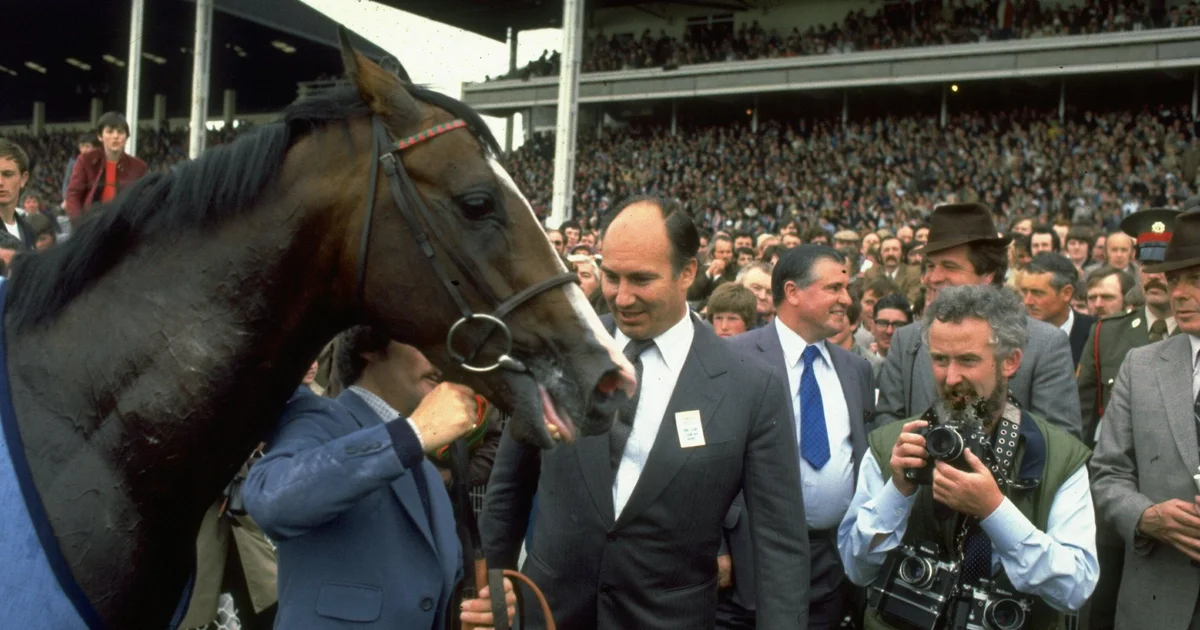
The kidnapping of champion racehorse Shergar remains one of Ireland’s most enduring unsolved mysteries, decades after masked gunmen seized the stallion from a County Kildare stud farm. The horse was never found, no one was arrested and the suspected Irish Republican Army plot has never been conclusively proved.
Shergar had become a national sporting hero after winning the 1981 Epsom Derby by 10 lengths. He was later victorious in the Irish Derby and retired to Ballymany Stud Farm, where his owner, the Aga Khan, hoped he would establish a valuable bloodline.
His distinctive white face and powerful stride made him instantly recognisable. Racing commentator Derek Thompson, who watched Shergar compete, described him as “probably the best of all time”.
The stallion’s breeding rights were divided into 40 shares, each sold for £250,000. In today’s currency, the syndication was worth more than $50 million, making Shergar one of the world’s most valuable horses.
The Shergar kidnapping
On the night of February 8 1983, armed and masked men broke into Ballymany. They forced head groom Jim Fitzgerald from his home at gunpoint and ordered him to take them to Shergar’s stable.
Fitzgerald was driven about 30 miles from the farm before being released. The kidnappers then left with Shergar, warning him not to speak about what had happened.
Filmmaker Alison Millar later interviewed Fitzgerald, who she said remained haunted by the incident. Recalling the raid, he said: “It was in early February. And we were in the sitting room. And the next thing, a knock come at the door and these gangsters come in with guns.”
The abduction took place against the backdrop of the Troubles, the period of sectarian violence that had convulsed Northern Ireland for almost 30 years. The IRA was suspected of carrying out the kidnapping to raise money for its campaign, although that theory has never been established in court.
“Shergar wasn’t any horse. He was the most expensive horse in the world,” Millar said. “Someone had come up with the idea of kidnapping Shergar and holdin’ him to ransom.”
The following day, Thompson and two other horseracing journalists were contacted by people claiming to be the kidnappers. They were directed to Belfast’s Europa Hotel, then to a farmhouse outside the city, where a series of telephone calls took place.
The callers said they wanted money in exchange for the horse. Demands made to the Aga Khan’s office reportedly shifted from £40,000 to £2 million.
Three days after Shergar disappeared, Thompson received what proved to be the final message: “The horse has had an accident. He’s dead.” No further contact was made.
The police investigation produced few clues, while public fascination with the case continued to grow. Hoax reports and claims from self-styled clairvoyants added to the confusion, including one supposed sighting that turned out to involve a dead sheep.
Theories about Shergar’s fate ranged from claims that he had been taken abroad to suggestions that he had been killed soon after the kidnapping because his captors could not control him. The latter view was linked to a memoir by former IRA member and informant Sean O’Callaghan.
O’Callaghan wrote that Shergar had been taken towards County Leitrim, near the border with Northern Ireland. Journalist Tommy Conlon said the remote area could have provided a place to dispose of the horse’s remains, but Shergar has never been recovered.
O’Callaghan’s account named Kevin Mallon, a convicted IRA operative, as the alleged ringleader. Attempts were made to contact Mallon at a house near Dublin, but he did not agree to answer questions about the case.
With key figures now dead and memories fading, the fate of Shergar remains unknown. Millar said the suspected killing represented a particular tragedy because the horse had become “such a symbol of Ireland” and its “freedom”, beauty and wildness.
