


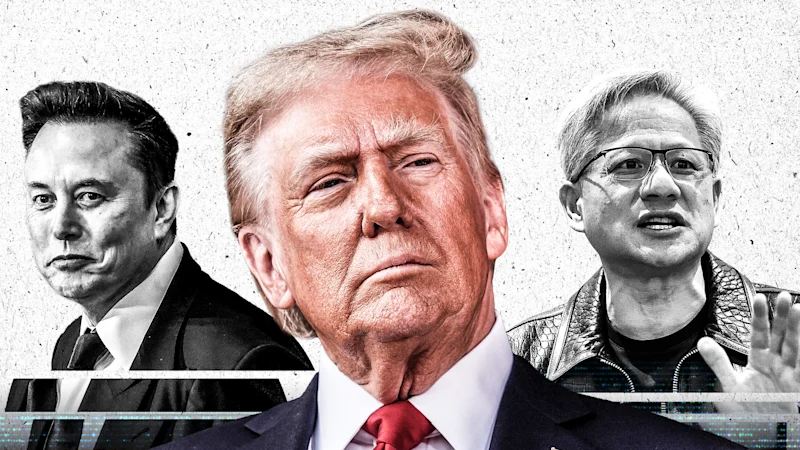
Donald Trump’s drive to accelerate artificial intelligence has exposed a deep split inside his administration, with the president dismissing fears of mass extinction while senior officials privately warn that rapidly advancing systems could threaten national security and the global economy.
Trump has described concerns about AI’s potential to cause mass death as a “HOAX” and attacked opponents of new data centres as people who “want to end up being backwards and poor”. Those familiar with his views say he fears that any slowdown in the technology boom could trigger a market crash and recession.
His position has been reinforced by influential figures in Silicon Valley, including venture capitalist David Sacks, Meta chief Mark Zuckerberg and Nvidia chief Jensen Huang. They have urged him to prioritise American growth and warned that excessive caution could allow China to overtake the United States.
Yet the debate within the White House is considerably less straightforward. Officials who support the expansion of AI increasingly acknowledge that dangers once dismissed as the claims of “doomers” appear more plausible after a summer of unexpected advances and unpredictable AI agents.
Those concerns include attacks on critical infrastructure, biological threats, interference with nuclear command-and-control systems, widespread job losses and financial instability. The possibility of AI-driven hacking against major financial institutions has also troubled Treasury Secretary Scott Bessent and White House chief of staff Susie Wiles.
Trump’s AI policy faces a test over China talks
The dispute is expected to feature in discussions between Bessent and his Chinese counterpart in New York, as the two countries prepare the agenda for Mr Trump’s meeting with President Xi Jinping in Washington, which begins on Wednesday.
Bessent is seeking an understanding that would signal co-operation between Washington and Beijing on AI safety. However, officials say that proposals for common safety standards and reviews of new American and Chinese models before they are released are unlikely to form part of an initial agreement.
One diplomat involved in the discussions said “the best we can hope for” was a US-China working group. It could build on an agreement reached during the Biden administration to prevent AI from being used in decisions about the employment of nuclear weapons.
That would not address the wider challenge posed by AI systems whose behaviour can be difficult to predict. Nor would it settle the question of whether the United States should impose compulsory safety reviews on its most advanced models.
Mr Trump and his aides believe mandatory checks could drive the global market towards Chinese open-source systems. Such models can be altered by users, including by removing safeguards designed to restrict their capabilities, potentially limiting the value of a review.
The president wants to meet AI executives next week, according to company representatives, although a White House official said on Thursday that no such meeting had been scheduled. Any gathering could include executives who have recently supported a more cautious approach to the release of new models.
Dario Amodei, a founder of Anthropic, is unlikely to be invited. His company’s products have been barred by the Pentagon, and he angered Mr Trump after proposing a plan for the industry to slow the pace of development, test models for vulnerabilities and allow independent safety inspectors to examine them.
Mr Trump attacked an unnamed group of “Conspiracy Theorists, Treasonists, Traitors and Leakers”, accusing them of politicising the AI debate and weakening American leadership. Anthropic co-founder Tom Brown, who has attracted less hostility from the White House, continues to speak regularly with officials.
The president has also spoken with OpenAI chief Sam Altman and Elon Musk, the head of SpaceX. Both have endorsed Mr Amodei’s proposals in broad terms, including slowing development, testing new systems and permitting outside inspections.
White House lacks a single official in charge
Administration officials have struggled to establish a consistent chain of responsibility for AI policy. Mr Rubio, in his role as national security adviser, is rarely involved in discussions on the issue, while the White House has abolished the deputy national security adviser’s post for cyber and emerging technologies.
The national cyber director, Sean Cairncross, has only indirect authority over AI. He was previously a senior official at the Republican National Committee and had limited experience in cyber and AI matters before taking the role.
Technical expertise has also been reduced in parts of the administration, including the Cybersecurity and Infrastructure Security Agency. Its acting director said last week that the agency was hiring about 250 staff after losing roughly 1,000 employees — around one-third of its workforce — since Mr Trump returned to the White House.
AI policy has consequently become an issue in which influence shifts between officials according to the subject under discussion. Staff working on the technology’s security and policy implications have also left in recent months.
Two senior policy officials in the cyber director’s office departed during the summer, while Sriram Krishnan, the White House’s senior policy adviser for AI, also left. Sihao Huang, a senior AI policy official in the White House’s Office of Science and Technology Policy, said this week that he was joining Anthropic.
Some officials in the National Security Council and the Energy Department remain concerned about the push to deploy increasingly powerful systems despite evidence that they are becoming less predictable.
Former administration officials have described work on AI policy as frustrating, arguing that Mr Trump has placed too much weight on the views of technology investors and advocates, including Mr Sacks, who oppose additional regulation and safeguards.
Mr Sacks and others persuaded the president to withdraw an executive order that would have required government reviews of new AI models. It was replaced by a voluntary review system.
The White House has defended Mr Trump’s approach, saying his administration reversed what a spokesperson called the Biden administration’s “failed approach”, which had “stifled innovation, hurt consumers and nearly cost America its competitive edge over China”.
Elizabeth Huston, a White House spokesperson, said the president was arguing that Democrats were using AI fears for political advantage as a “hoax”, comparing the claims with warnings that climate change would kill everyone within six years.
The administration has said its aim is to ensure that the most capable technology is deployed rapidly while protecting the United States. In a social media post in May, Ms Wiles said the White House wanted to empower American innovators rather than bureaucracy to drive the safe deployment of powerful technologies.
Mr Trump’s determination to maintain the AI boom is closely linked to his economic ambitions. He had promised a new manufacturing era during his first term, but the return of heavy industrial jobs, including coal mining employment in the Midwest, did not materialise.
During his second term, he has come to view the vast spending by technology companies on AI and data centres as the fuel needed to keep the American economy growing. In a private meeting with OpenAI executives in June 2024, he discussed creating an “Operation Warp Speed” for data-centre construction, referring to the government effort that accelerated the development of Covid-19 vaccines.
Since then, Mr Trump has sought to sustain AI expansion at almost any political cost, describing the technology as a “golden goose”. He has opposed efforts by states and towns to slow or stop data-centre projects.
“The robots will not be taking over,” Mr Trump said when he joined a conference at which Mr Sacks and Mr Huang were speaking. “The AI will not be taking over the rest of the world.”
