


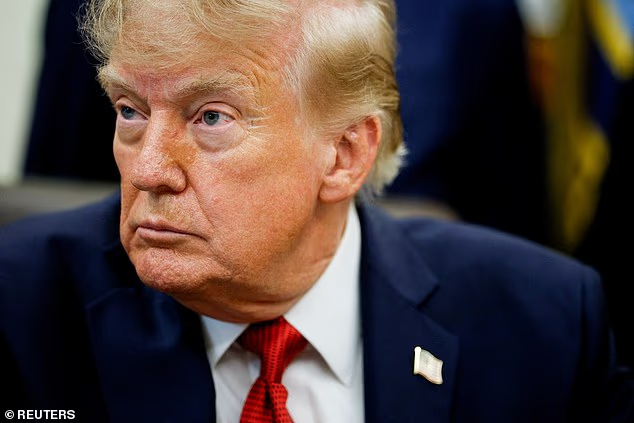
Donald Trump has asked his Truth Social followers to vote on a new name for artificial intelligence, as the US president continues to promote the technology despite growing concerns about its risks and environmental impact.
He offered three alternatives: Superior Intelligence, Extreme Intelligence and Supreme Intelligence. More than 50,000 votes had been cast by late Saturday, with Superior Intelligence leading on 41 per cent, followed by Extreme Intelligence on 38 per cent and Supreme Intelligence on 21 per cent.
“Many people think that the words ‘Artificial Intelligence’ are inaccurate, and very ineloquent, relative to AI, or Artificial Intelligence,” Mr Trump wrote.
He described the suggested replacements as “a far more elegant and accurate description of this new phenomena” and asked supporters to take part in what he called an ever-growing “Revolution”.
Trump’s proposed names for artificial intelligence
The poll followed a lengthy post in which Mr Trump compared criticism of the environmental effects of data centres with climate change and other contentious political issues.
His renewed backing for artificial intelligence came as he announced plans for an “AI Force” to monitor the technology, while accusing opponents of presenting “an attack on our data centers” as a “Democrat hoax”.
“We will not in any way hinder or stifle the Growth of this incredible Industry. Rather, we will cherish it, help it, and watch over it, as it grows!” Mr Trump said.
He added: “However, we will also be looking for BAD, and we can do that, very easily, with our already existing Criminal and Civil Justice System.”
Mr Trump gave few details about how the AI Force would operate, but compared it with Space Force, the sixth branch of the US military that he launched in 2019. It was not clear whether the new body would also come under the Department of Defense.
He said an “AI Czar” would be appointed to oversee development and encouraged “high IQ” applicants to apply. He also called artificial intelligence the “next Industrial Revolution”.
The president said the United States was leading China and the rest of the world in the field and intended to maintain that position. He is due to meet Chinese President Xi Jinping next week, with US officials previously saying that artificial intelligence would be discussed.
The two countries have each identified the technology as important to their economic strength and are competing for dominance in the sector.
Concerns over artificial intelligence
Mr Trump’s decision to double down on artificial intelligence came a day after an intelligence report generated with the help of an AI chatbot reportedly misidentified material aboard a Chinese ship in the Middle East.
Multiple sources said a US special operations analyst had used the chatbot to examine the ship’s manifest before incorrectly concluding that it was carrying components linked to a nuclear weapons programme.
Military planners began preparing an operation to intercept the vessel, with planes already airborne, according to the report. Officials reviewing the assessment shortly before the mission was due to begin discovered that artificial intelligence had contributed to it and found that the material had been misidentified.
One source described the report as “entirely false” and said it had “almost started a war” with China, because military action against the ship could have triggered a conflict between the two powers.
Former employees of major artificial intelligence companies have also raised concerns about the technology. Jacob Coxon, a former researcher at Anthropic, said he resigned because the company and OpenAI were “racing straight to self-improving superintelligence and gambling with our lives”.
His comments prompted Anthropic chief executive Dario Amodei to say that the company needed to slow down and that safeguards were required to prevent AI agents from taking over the internet within the next year.
Meanwhile, the expansion of data centres has faced opposition from communities where the large facilities are being built. Supporters say they bring technological progress and jobs, while critics have focused on their environmental impact.
