


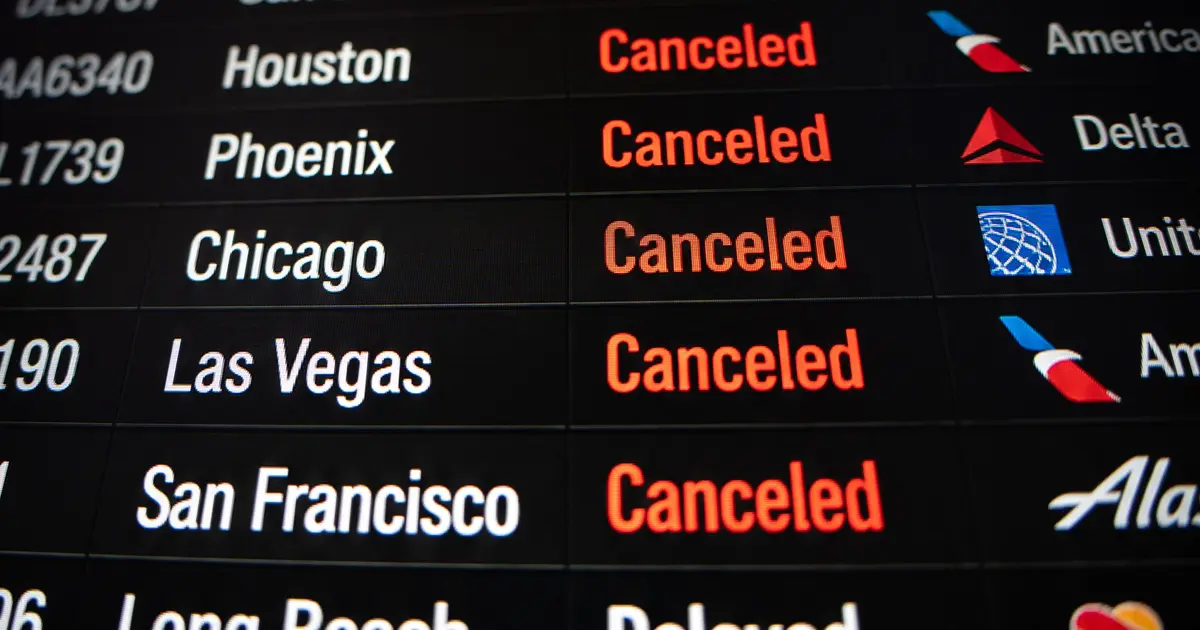
Thousands of flights were cancelled across the United States on Saturday after a nationwide Federal Aviation Administration (FAA) ground stop exposed serious disruption in the country’s air traffic control communications network.
Transportation Secretary Sean Duffy said the FAA had restored full operations following the incident on Friday 13 November, but warned that the effects would continue to be felt as airlines worked to reposition aircraft and passengers.
More than 2,500 US flights were cancelled on Saturday and hundreds were delayed, according to FlightAware. That followed more than 9,000 cancellations and 7,000 delays on Friday.
What caused the FAA ground stop?
Officials said the disruption began during work to replace ageing copper telecommunications lines with fibre-optic connections at a remote FAA facility.
The contractor carrying out the work, L3Harris, was replacing a router when the equipment began flooding other routers with more than 1,000 connection attempts every four to five seconds, Mr Duffy said.
The resulting instability affected communications between air traffic controllers and aircraft, as well as some radar feeds. Investigators are still examining whether the failure was caused by a faulty router or an error during installation.
There was no indication that the outage was the result of a cyberattack, officials said.
“Once we were able to isolate the work that was being done at this remote location, all of our systems came back online,” Mr Duffy said.
The FAA said the ground stop was ordered after communication problems affected several Air Route Traffic Control Centres. It was the first nationwide grounding of US flights since January 2023, when an outage involving a pilot-notification system halted departures for about 90 minutes.
L3Harris said it was working with the FAA and telecommunications partners to establish what had led to the disruption. The company said more than 70 per cent of the planned conversion from legacy copper lines to fibre had been completed.
The Professional Aviation Safety Specialists union, which represents FAA technicians, said the agency would normally consult its own technical staff when assessing the risks of major upgrades or repairs. It claimed that had not happened in this case.
When will flights return to normal?
FAA Administrator Bryan Bedford said airlines should have restored their normal schedules by the end of Sunday, although passengers were likely to face further cancellations and delays before then.
Mr Duffy praised air traffic controllers and pilots for safely managing aircraft already in the air when the ground stop was imposed. The FAA has said passengers should check directly with their airline for the latest information.
Airlines are required to offer passengers a refund if a cancelled flight means they no longer wish to travel. Those who still want to make their journey can generally request free rebooking, subject to the carrier’s arrangements.
Delta Air Lines and United Airlines introduced travel waivers after the disruption, allowing affected passengers to change their bookings without the usual fees.
Mr Duffy has called for further investment in the US air traffic control system, arguing that the ageing infrastructure needs to be modernised. The FAA says 69 per cent of its copper communications network has now been replaced with fibre using funding approved by Congress.
Officials said the system was expected to be ready for the Thanksgiving travel period later this month, although Mr Duffy warned that further disruption could not be ruled out while the investigation continued.
