


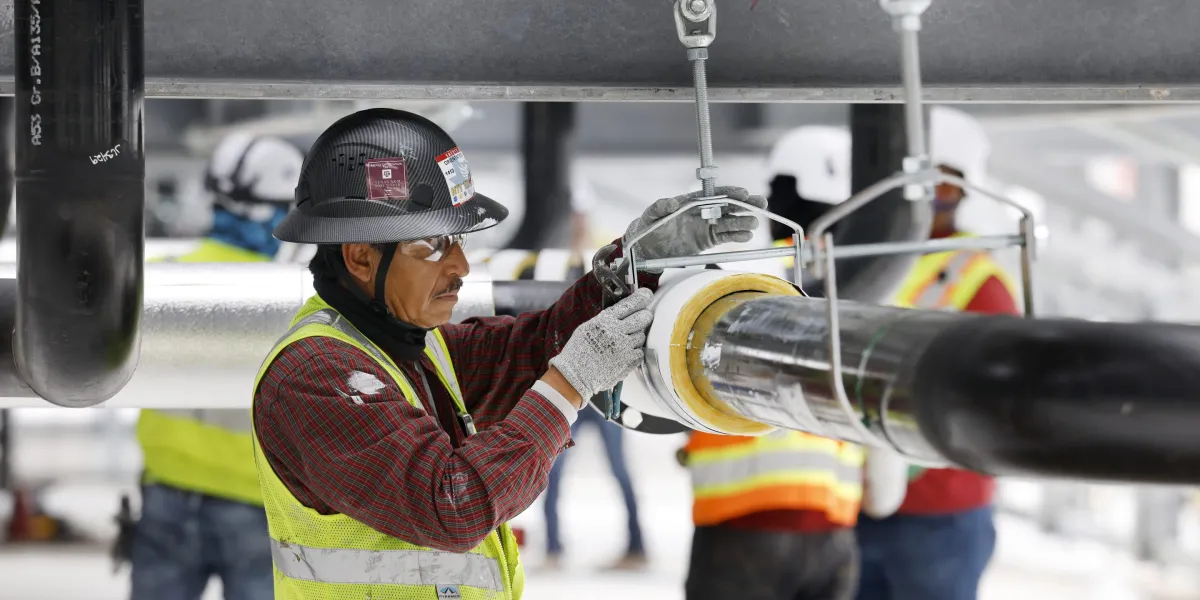
Data-centre investment is generating hundreds of thousands of skilled trades jobs in the US, as demand for electricians, pipefitters and project managers rises alongside the expansion of artificial-intelligence infrastructure.
Tim Chadwick, Google’s data-centre operations area lead for Ohio and Indiana, said roles were available across the country and offered the prospect of long-term financial stability without requiring a four-year university degree.
“Currently there are hundreds of thousands of skilled trade roles open across the U.S. just waiting to be filled,” Mr Chadwick wrote. “These are jobs like master electrician, lead pipefitter, and project manager—high-growth careers that offer long-term financial stability.”
The opportunities come amid a broader shortage of workers in technical and construction occupations. Estimates cited in a JLL report suggest that 2.1 million skilled trades jobs in the US could remain unfilled by 2030.
Technical training, apprenticeships and workplace experience can provide routes into the sector, rather than the traditional path from school to a four-year degree. However, employers are struggling to attract enough new workers to replace an ageing workforce.
Data-centre construction faces growing competition for skilled workers
Worldwide, data centres are projected to require $6.7 trillion (£5 trillion) of investment by 2030 to keep pace with demand for computing power, according to McKinsey.
Nvidia chief executive Jensen Huang has described the expansion as the “largest infrastructure build-out in human history”, arguing that it will create substantial employment. “The skilled craft segment of every economy is going to see a boom,” he told Channel 4 News in the UK in 2025.
Mary Barra, chief executive of General Motors, has also said that skilled trades should not be regarded as less desirable than office-based professions. She said a technician could earn between $80,000 and $90,000, potentially more depending on hours worked, and described the work as “a little more AI-proof than some others”.
Yet filling the roles remains difficult. Vocational and technician training has historically received less investment than university education and has sometimes been stigmatised, while the work can involve long hours, physical demands and outdoor conditions in extreme weather.
Construction is also largely project-based. Workers may need to move between sites, or across the country, as developments are completed. At an individual data-centre site, construction can create hundreds or thousands of jobs, but staffing requirements typically fall to a few dozen once the facility becomes operational.
A 2026 survey of construction firms involved in data-centre projects found that 58% had seen increased competition for skilled workers and 49% had experienced greater pressure on wages. A further 37% said the availability of workers or subcontractors was their biggest challenge in pursuing or delivering projects.
Companies join efforts to expand the skilled trades workforce
Businesses are developing their own schemes to widen access to vocational careers. Ford, Carhartt, BlackRock and Google formed the Alliance for America’s Skilled Trades earlier this year to build pathways into technical training.
“We must change the kitchen table conversation and encourage more young people to take that first step toward a career in the skilled trades,” the companies’ leaders, including Ford chief executive Jim Farley, wrote in July.
In September, the Lowe’s Foundation launched the Building Futures Skilled Trades Coalition, aimed at changing perceptions of such careers and encouraging closer co-operation between education, workforce organisations and industry.
Nvidia, AT&T, Bank of America, Carrier, General Motors, DEWALT and Duke Energy were among the coalition’s early partners as companies sought to address the labour pressures accompanying the data-centre build-out.
