


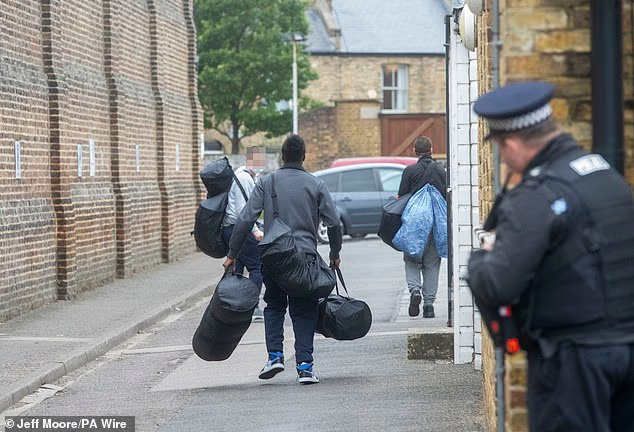
Victims of domestic abuse will be left “living in fear” as a new prison early release scheme begins freeing hundreds of offenders on Thursday, the domestic abuse commissioner has warned.
Dame Nicole Jacobs said survivors were being forced to make their own arrangements for protection, including uprooting their lives, because they did not believe adequate safeguards were in place.
About 700 prisoners serving sentences of up to 19 months are due to be released across England and Wales from Thursday morning. More than 4,500 inmates are expected to be freed under the programme by June.
Dame Nicole said: “As the first perpetrators start to be released, survivors across the country will be looking over their shoulder and living in fear because the government and our criminal justice system has failed to protect them.”
She added: “It is frankly shameful that as the scheme begins – which ministers have had months to prepare for – I still have no assurance that the danger perpetrators pose has been properly considered and assessed with meaningful input from victims and the specialist services supporting them.”
She said she had heard from survivors who felt they had been treated as “an afterthought”, adding that the scheme had caused “untold damage” to victims’ confidence in the justice system.
“Especially when survivors are now likely to face a longer fight for justice than their perpetrator will spend in prison,” she said.
Dame Nicole called on Prime Minister Andy Burnham and the Labour Government to take urgent action to improve victim safety. She warned that many domestic abuse perpetrators remained eligible for early release despite changes to the scheme.
Prison early release scheme expanded
Under the new arrangements, most prisoners who would currently serve 40 or 50 per cent of a sentence will be released after serving one-third. Some offenders convicted of violent or sexual offences who would previously have been released after two-thirds of their sentence will instead be freed at the halfway point.
The scheme was devised by Shabana Mahmood during her time as Justice Secretary. Ministers have said prisoners will undergo thorough risk assessments before release and that there will be a presumption that they will be electronically tagged.
However, concerns have been raised about the effectiveness of electronic monitoring. A National Audit Office report warned that criminals ordered to take part in tagging schemes had sometimes not been fitted with devices, while more than 5,400 people who were supposed to have been tagged by the end of March had not received one.
The spending watchdog also questioned whether electronic monitoring could be safely expanded to replace prison sentences, warning that problems with the service increased the risk to public protection as demand grew.
A separate report by His Majesty’s Inspectorate of Probation found that almost half of electronic tags were not fitted on time. Some offenders waited as long as five months, resulting in repeated breaches of court and prison orders.
A joint report by probation and police inspectors also warned that dangerous stalkers had remained at liberty despite breaching electronic tagging orders more than 30 times.
The Government has amended the release plans after criticism. Offenders convicted of rape, serious child sexual offences and grooming were excluded, followed by those convicted of manslaughter and other forms of unlawful killing.
The changes came after Lissie Harper, the widow of murdered PC Andrew Harper, condemned the scheme when it emerged that two of her husband’s killers could have been eligible for early release. The Prime Minister subsequently altered the rules to exclude all offenders convicted of unlawful killing.
The previous Labour early release programme, introduced in September 2024, freed 70,066 criminals by the end of March. It allowed offenders to leave prison after serving 40 per cent of their sentences.
Ministry of Justice figures showed the proven reoffending rate rose to 29.9 per cent between July and September 2024, up 1.9 percentage points on the same period a year earlier. An MoJ document said that “various policy changes”, including early release, “may have impacts upon … reoffending rates”.
The Sentencing Act also introduced measures which largely prevented courts from imposing prison sentences of 12 months or less from March this year. Senior police chiefs have warned that the measures could increase crime and cost forces £400 million a year to deal with.
