


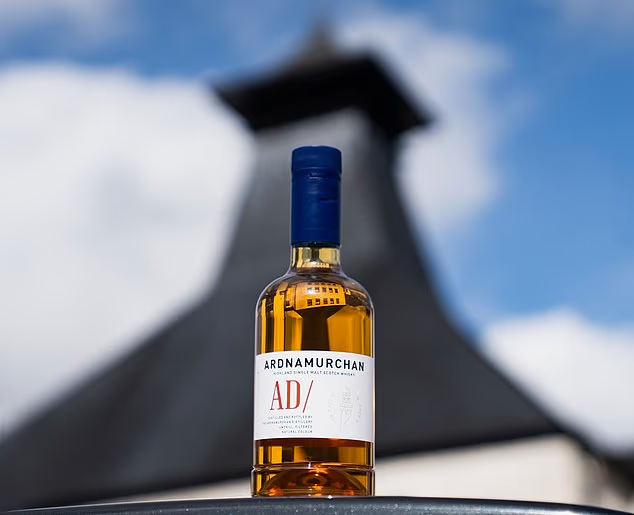
A Highland distillery has launched what it describes as the world’s first single malt Scotch whisky in a plastic bottle, with its flagship Ardnamurchan AD/ now being sold in Norway.
The 50cl container is made from PET, or polyethylene terephthalate, a lightweight plastic commonly used for drinks packaging. The release is being introduced through Norway’s state alcohol retailer, Vinmonopolet, where it went on sale nationwide on 2 September for 399 Norwegian kroner.
Ardnamurchan Distillery, on Scotland’s west coast, said the decision was driven by the environmental advantages of the packaging and Norway’s established recycling system. The bottle is substantially lighter than glass, reducing transport emissions, and is intended to enter a closed-loop recycling system.
The whisky is bottled at 46 per cent alcohol by volume, slightly below the 46.8 per cent strength of the distillery’s standard AD/ expression. Ardnamurchan describes the spirit as a blend of peated and unpeated Highland single malt matured in former bourbon and sherry casks. ([ardnamurchandistillery.com](https://ardnamurchandistillery.com/news/a-week-in-whisky?utm_source=openai))
Graeme Mackay, the distillery’s international sales manager, said the project represented “the next step” in Ardnamurchan’s sustainability programme.
He said the distillery was powered entirely by biomass and that Norway’s recycling rates, which he put at more than 90 per cent, made the country a suitable first market for the new format.
“We will be the world’s first single malt Scotch whisky in PET,” Mr Mackay said.
Ardnamurchan said the plastic bottle would preserve the whisky’s quality and flavour in the same way as a glass container. The distillery has also presented the release as a challenge to the assumption that PET packaging is associated only with inexpensive or low-quality alcohol.
Why the plastic bottle is permitted
The move does not breach the rules governing Scotch whisky. The Scotch Whisky Association’s guidance says single malt Scotch being sent overseas must be transported in a bottle labelled for retail sale, but specifies that the container must be made from an “inert material” rather than requiring glass specifically. ([scotch-whisky.org.uk](https://www.scotch-whisky.org.uk/media/1519/swr-guidance-for-bottlers-and-producers.pdf?utm_source=openai))
The association has acknowledged that glass has traditionally been favoured for its inert properties and finish, while also noting that it is the heaviest commonly used packaging material for alcoholic drinks and therefore carries a comparatively higher transport impact. ([scotch-whisky.org.uk](https://www.scotch-whisky.org.uk/industry-insights/sustainability/circular-economy/?utm_source=openai))
Ardnamurchan Distillery began production in 2014. Its conventional AD/ single malt remains available in glass, with the PET version currently being produced specifically for the Norwegian market.
