


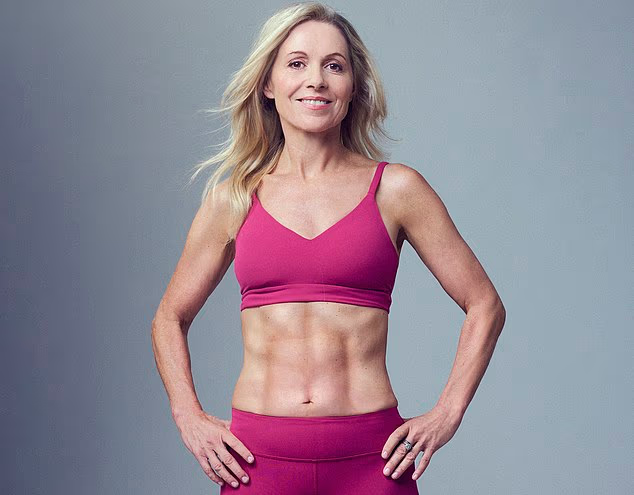
After losing more than two-and-a-half stone with weight-loss injections, Charlotte Cripps says she has achieved defined abdominal muscles without following a conventional exercise regime, combining cosmetic radiofrequency treatment with electrical muscle stimulation.
Cripps, 49, said the transformation became clear during a holiday in Puglia, southern Italy, when she saw her reflection in a mirror and noticed a defined waist and firm-looking stomach.
“Oh my goodness,” she said. “I have a six pack!”
Her weight fell from 10st 8lb to just under 8st in 2024. She said the rapid loss initially left loose skin and a sagging stomach, which she compared to “a blancmange”.
Cripps, a single mother of two, said she had been reluctant to show her body in swimwear before the treatment. She has continued to take small doses of Mounjaro to maintain her weight, but wanted to improve the appearance of her midriff.
Radiofrequency and electrical muscle stimulation
Rather than commit to months of core workouts, Cripps consulted aesthetician Sadaf Jaffari in July. She considered Quantum RF, a more invasive procedure involving small incisions and probes inserted beneath the skin, but decided against it.
The treatment costs from £8,500 and uses radiofrequency energy to target fat cells and tighten loose skin, with results expected to emerge after about three months.
Cripps instead opted for three sessions of Morpheus8 Body, priced at £1,801 per session, alongside a course of six truSculpt flex treatments costing £3,005. The combined programme came to £8,408 over four months.
Morpheus8 uses microneedles to create tiny injuries in the skin while delivering radiofrequency energy below its surface. The treatment is intended to stimulate collagen and elastin, improve texture and tighten lax skin.
During truSculpt flex sessions, electrical pads were placed across Cripps’s abdomen and sides. She said the machine caused repeated contractions, creating a sensation similar to involuntary muscle spasms while she lay down watching television.
She was told the course could increase muscle mass by 30 per cent after six sessions. Jaffari also advised that the best results would be achieved alongside exercise, although Cripps said her responsibilities as a working mother made regular workouts difficult.
The Morpheus8 treatment proved considerably more uncomfortable. Despite the use of numbing cream, Cripps described each pulse as an intense pinch, followed by a hot sting, particularly around the ribs.
Afterwards, her abdomen was red and bleeding from the tiny needle punctures. She said the burning continued after she returned home and that she took paracetamol for the discomfort.
She was advised to avoid direct sunlight for two weeks after each session and to use factor 50 suncream. Her stomach remained mildly swollen for between a week and ten days following treatment.
Cripps said she began noticing changes as the weeks passed. By the time she was beside the pool in Italy, she believed her abdominal muscles were more visible and said she had lost an inch from her waist.
Her final Morpheus8 session took place in mid-September, meaning the full effect is not expected to be visible for several months. She said annual maintenance treatments would be needed.
Jaffari said the procedures were designed to address both muscle tone and loose skin. She also said she could identify body dysmorphia and would not treat women who were preoccupied with flaws that did not exist.
At the school gates in west London, Cripps said a friend noticed the outline of a six-pack and asked how she had achieved it. She told her the result had come from cosmetic treatments rather than a rigorous fitness routine.
Cripps said the change had not become a measure of her self-worth, but admitted she was pleased with the result and intended to wear clothes that showed off her stomach as she approached her 50th birthday.
