


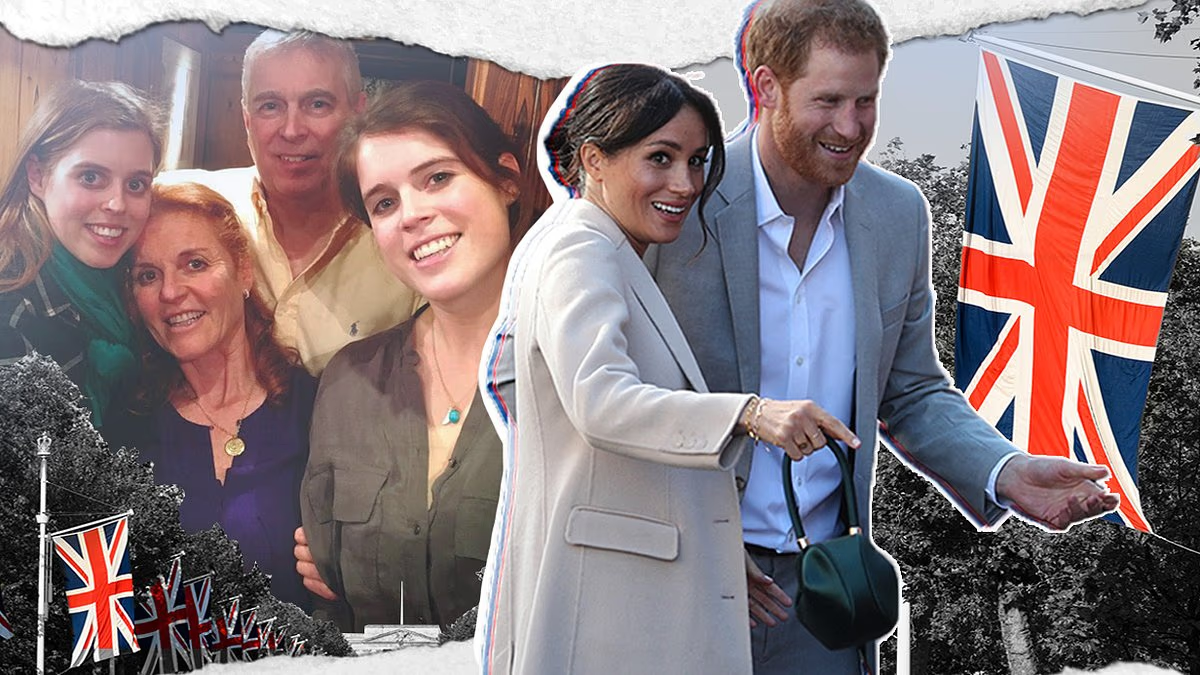
Every family has its bad apples. But the Royal Family is becoming overrun with them.
The execrable Andrew Mountbatten-Windsor, soon likely to face another raft of misconduct allegations, is the worst of them.
But even if he is treated as a special case, the King is beset by others – a whole lot of them, with the return next month of his younger son Prince Harry and wife Meghan, the Duchess of Sussex.
They join Andrew’s daughters, the princesses Beatrice and Eugenie, around whom rumours swirl connecting them to their father’s paedophile close pal, the billionaire financier Jeffrey Epstein.
Their mother Sarah Ferguson, Andrew’s ex-wife, though not in any way a royal, is also a lingering presence impossible to ignore, unseen but forever there, like a foul odour.
The question is no longer how the monarchy deals with its wayward family members, but whether it can survive being beset by so many of them. This is now a crisis unprecedented in the modern history of the Royal Family, stretching back to its reinvention almost 200 years ago by Queen Victoria and her Consort, Prince Albert.
One way to establish which of them presents the greatest threat is to ask which has most to gain from the current chaos. And the answer to that is self-evident. It is the Sussexes.
Harry’s return may be occasioned by a desire to be closer to a father who may not have long to live but it may also be opportunistic – to get his feet under the royal table while his father is in power and before his brother removes his titles and those of his children, Archie, seven, and Lilibet, five.
Andrew Mountbatten-Windsor with daughters Beatrice and Eugenie and ex Sarah Ferguson

Harry and Meghan are returning to the UK after living in the US for the past six years
If the Sussex brand is to grow, it is imperative that Archie and Lilibet remain a prince and princess. The monetary value of those titles is incalculable. It might be argued that, even if the future King William V were to banish them, the children could continue to insist on their royal handles. But the titles would be devalued.
Just as the demoted princes and princesses of Russia and Eastern Europe, from whose ranks Prince Philip came, were regarded as second-class royalty, Archie and Lilibet would never enjoy the glamour that is the birthright of their cousins, Princes George and Louis, and Princess Charlotte.
That would be gall and wormwood to the Duke and Duchess – assuming they still were a duke and duchess. They have evidently realised this, and decided that they need to return to the fold.
And the King seems to have accepted this. We are told Charles was informed of the move only on Sunday and will be pleased to have the chance of spending more time with grandchildren he has hardly seen.
This is the culmination of Project Thaw, entrusted to the King’s assistant private secretary Theo Rycroft, to bring Harry back into the fold.
If it’s true the timing of the Sussexes’ return was a complete surprise to the monarch – and it is well to regard all Palace communications with a measure of scepticism – this suggests it has come as a shock to Archie and Lilibet as well.
After all, it seems unthinkable that Meghan and Harry will have told the children in advance but forbidden them to breathe a word, even to their grandfather, whom they saw at Highgrove only six weeks ago.
The King’s stamp of approval on the plan is crucial for Harry and Meghan. And it seems certain to be given, not least because there are advantages for Charles himself. Of course he wanted to reconcile with his younger son, but the news will also distract from the awkward questions currently being asked about what he knew of Andrew’s business dealings, as well as wider issues about royal privilege, accountability and governance.
For the next few months, at least, all the talk will be of Harry and Meghan. No one will be looking at the other royal miscreants, unless Andrew becomes the focus of more revelations about Epstein or his former role as the UK’s Special Representative for International Trade and Investment.
Princess Eugenie, who is still on very amicable terms with the Sussexes, and Princess Beatrice will appreciate the shift of focus away from them. So, doubtless, will their mother, who for practically the first time in her life has been keeping a low profile – not even attending the funeral of her ex-lover and sugar daddy, Formula One tycoon Paddy McNally.
But if the assorted villains of the family, some less petty than others, are glad of the distraction, the Prince of Wales has been confronted with an unenviable and unexpected dilemma.
William detests his brother so deeply that it is said he refuses to have Harry’s name spoken in his presence.
Yet how will he be able to strip the Sussexes of all their baubles when he becomes King, if their father has publicly forgiven them? Perhaps the greatest test will come at Christmas. By then, Harry, Meghan and their children will have been back in the UK for three months.
Will the couple join the Royal Family at Sandringham? William has made it clear he and his family will not tolerate the presence of the former Prince Andrew, let alone his ex-wife. I strongly suspect he will take the same hard line with his brother.
This places the King and Queen in an appalling position. Do they tell Harry that he isn’t welcome at Christmas? Or do they insist that forgiveness means forgiveness, and that all the Sussexes will be carolling round the Sandringham tree with them?
In that case, William and Catherine may well feel that Christmas with the Middletons, the Princess of Wales’s family, is the only bearable option. That risks driving a wedge between the heir to the throne and his father, and will certainly cause Charles untold grief.
Such are the problems caused by the bad apples. The rest of the family must manoeuvre constantly to accommodate them. There are no good solutions, only bad compromises.
It appears that Harry and Meghan Markle have achieved all this without issuing an apology for their heinous behaviour, which included accusing the Royal Family of racism and denouncing them on a US chat show.
They have also won the ‘half in, half out’ strategy for which they argued six years ago and were refused by Queen Elizabeth. It is thought Harry will focus on next year’s Invictus Games and charity work, while his wife has reportedly been offered an acting role in Britain and will continue to oversee her lifestyle brand, As Ever.
The couple’s hope is that they may be called to fill in at garden parties as the Palace tests the public mood and that eventually they may return to partial royal duties. This is a cynical and hypocritical reinvention, but creating new narratives has never worried them.
This is how such characters operate, by refusing to be ashamed of anything they do. The others strive to do nothing that will compromise their reputations. How much easier for the ones without conscience, who can behave as they like and kick out at anyone who dares criticise them for it.
There have been signs for the past year that Harry was keen to set up his own alternative royal court in Britain. The Daily Mail’s royal commentator Richard Eden revealed Project Thaw last December, outlining how it involved not only the King but also government officials.
This was confirmed by US journalist Rob Shuter who quoted a royal insider as saying: ‘Harry wants legitimacy. He wants to operate in the UK on his own terms – meetings, charitable work, high-level engagements – without being treated as a guest in his own country.’
It would be dangerous to assume he is willing to settle for life on the edge of the Royal Family, as his uncle Andrew has been forced to do. He wants pride of place, with his wife and children beside him.
And he may well get it. However egregious and selfish his behaviour, he is protected by a natural charisma. Harry is easy to loathe but difficult to dislike. It’s little surprise that his approval rating rose six points in the last year, with 33 per cent of the British public viewing him favourably according to YouGov polling last month.
Meghan will have more difficulty in winning over the public, many of whom retain an affection for her husband despite his actions over the past five years. Last month’s poll showed around 22 per cent of respondents viewed her favourably.
But the couple have a formidable PR machine, and must hope that attitudes within the family and country will eventually change, perhaps helped by a wave of sympathy with the 30th anniversary of Princess Diana’s death next August.
All the sympathy for now is with those who lose most by making room for the bad apples. The biggest losers are the Prince and Princess of Wales. They have done their duty while coping with Kate’s cancer diagnosis and will feel betrayed and humiliated.
The news has also undermined the other working royals. Just as Diana used to upstage Charles, Harry and Meghan’s activities are more likely to be reported than the latest charitable work by Princess Anne or Prince Edward.
Royal annals offer just one precedent. In the late 1940s, as King George VI’s health deteriorated, his older brother the Duke of Windsor, formerly King Edward VIII, harboured ambitions of a return to England.
For more than a decade, after renouncing the throne to marry American divorcee Wallis Simpson, he had lived in exile abroad.
But his niece Elizabeth was regarded by many as too young and inexperienced to succeed her father. The Duke began dropping hints that he might be prepared to return to Britain and act as Regent, if needed. He gave up this conceited notion when he was told he would not have the tax free status he enjoyed in France.
It might be that, ultimately, the expense of living in the UK will drive away the Duke and Duchess of Sussex, especially if they are required to shoulder the expense of their own security arrangements, put at up to £5 million a year.
They will also face a drain on their finances if they decide not to sell their mansion in Montecito, California – or if they cannot sell it without suffering a serious loss.
As other royal troublemakers have discovered before them, being a bad apple comes at a heavy cost.
Entitled: The Rise And Fall Of The House Of York, the biography of Andrew Mountbatten-Windsor and Sarah Ferguson, by Andrew Lownie, is published by William Collins
