


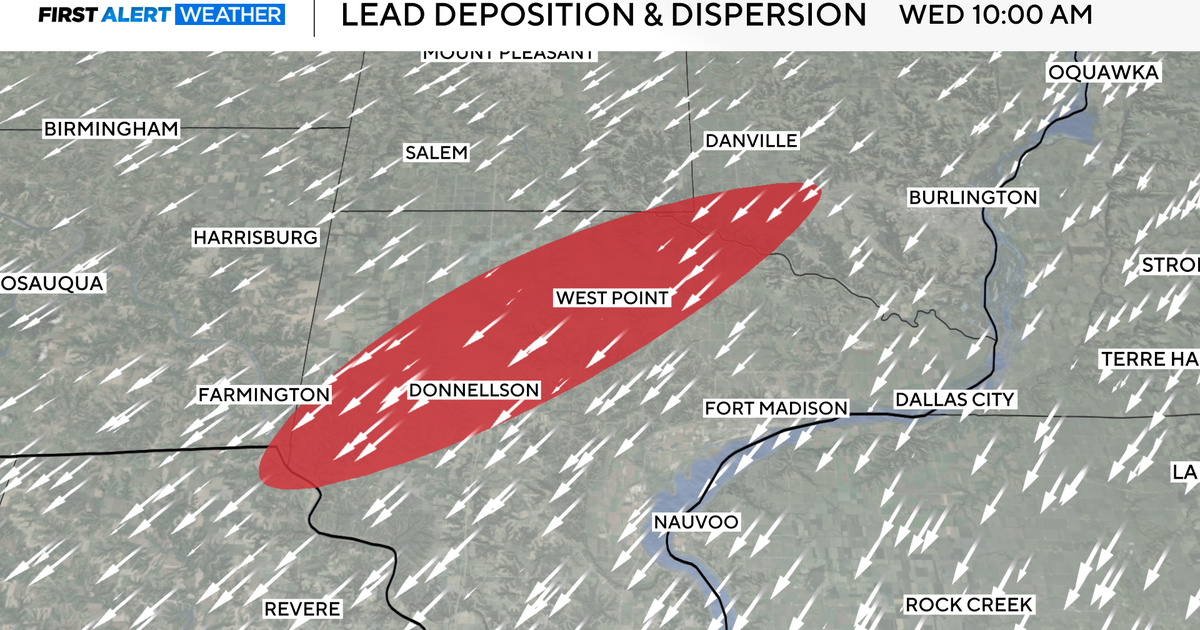
New maps show how dust from the planned lead azide detonation in Iowa could drift south-west towards north-east Missouri, prompting warnings for people living near the Iowa Army Ammunition Plant in Middletown.
The Army intends to destroy about five tons of degraded lead azide, held in 68 barrels, at 9am on Wednesday. An emergency alert advised some residents within five miles south-west of the plant that they might be evacuated, while people up to 20 miles away were told to remain indoors with windows closed.
Officials expect winds to carry the plume away from Burlington, a city of almost 25,000 people on the Mississippi River. The forecast maps show the projected area of lead dust developing between 9am and 5pm, although the modelling is expected to change with weather conditions.
At first, the projected plume appears as a circle around the plant. By 9.45am, it becomes an elongated area stretching from near Burlington towards the Missouri border.
By early afternoon, the shaded zone reaches into north-east Missouri, passing near Knox City. Later, it narrows into a band extending from the Burlington and Keokuk area towards Macon, Missouri, with Quincy in Illinois lying just to the south-east.
Illinois officials said the latest model from the National Oceanic and Atmospheric Administration showed that no Illinois counties would be affected. The Illinois Environmental Protection Agency had requested updated modelling from the Army but had not received it, while Governor JB Pritzker directed state agencies to remain on alert.
Missouri Governor Mike Kehoe said state agencies were preparing additional monitoring of air and water quality. Officials have advised people to stay indoors during the detonation and rinse outdoor surfaces with water afterwards.
The Army must issue an updated plume forecast six hours before the operation under the terms of an Environmental Protection Agency permit, and update it hourly until the detonation is complete. The forecasts do not show that harmful exposure will occur at every location within the projected area, and sampling will be needed to establish where lead settles on land and other surfaces.
Why the Iowa lead azide detonation is going ahead
The operation was moved forward from Friday after officials cited more favourable winds and additional time to install safety measures. A federal appeals court cleared the way for the detonation on Monday, following several delays caused by legal challenges and concerns from elected officials in Iowa and Illinois.
The Army says the material has been stored at the plant for more than 20 years in containers covered with earth, submerged in a mixture of ethanol and water intended to keep it stable. A routine inspection this year found that some of the water had evaporated and that the lead azide had recrystallised, making it more sensitive to friction and shock.
Military officials say moving the barrels could trigger an explosion. They also say the stockpile could become more volatile as temperatures fall, because reduced liquid in the containers makes the material more likely to freeze and increases the risk of a chain reaction.
Blast barriers have been added around the bunkers where the lead azide will be destroyed. The Army also plans to use ballistic gels and foams to contain dust, and to apply thousands of gallons of water in an effort to keep as much of the material as possible within the plant grounds.
Maj Gen Eric Shirley, who is leading the operation, said: “Inaction is no longer an option.” Acting Army Secretary Adam Telle said officials had considered “every viable solution” before concluding that controlled detonation was the safest option.
The plan has faced opposition from environmental groups and politicians from both parties. A bipartisan group of Iowa and Illinois officials called for a delay and urged the Army and the EPA to examine alternatives, while Illinois Senator Tammy Duckworth described the operation as a “failure of leadership of epic proportions”.
Earthjustice challenged the EPA’s emergency permit on behalf of the Iowa Environmental Council and the Iowa chapter of the Sierra Club. The 8th Circuit Court of Appeals briefly blocked the detonation before declining to stop it, saying the groups had not shown they were likely to succeed and that the degraded explosives posed a risk of an uncontrolled blast without the permit’s safety measures.
The court said the Army had considered a range of alternatives, including neutralising the lead azide with other chemicals and using heat treatment. The EPA issued the emergency permit on 13 November.
President Donald Trump said he wanted Iowa Governor-elect Rob Sand to approve the operation, although Mr Sand has said the decision rests entirely with the administration. Governor Kim Reynolds said on Tuesday that she supported the plan after speaking with military leaders.
