


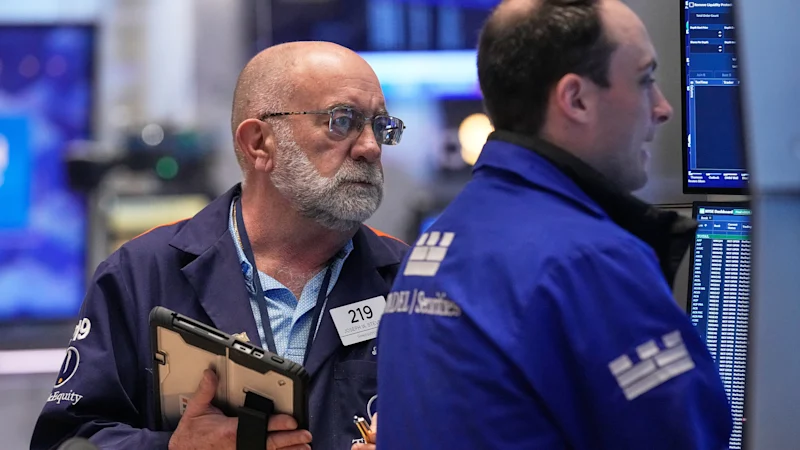
Wall Street falls extended a recent sell-off in technology shares, with artificial intelligence stocks again leading losses as investors awaited Nvidia’s results. The S&P 500 fell 1 per cent, while the Dow Jones Industrial Average dropped 848 points, or 1.6 per cent.
The Nasdaq composite declined 0.7 per cent, despite Nvidia reporting robust results after the closing bell and forecasting quarterly revenue above Wall Street expectations. The company’s shares rose by almost 4 per cent in extended trading.
Australian share futures pointed to a weaker opening, indicating a fall of about 63 points, or 0.7 per cent, for the ASX. The index had already slumped 1.8 per cent on Tuesday, while the Australian dollar was steady at US67.41¢.
Nvidia remained at the centre of the market’s volatility. Its shares were still down about 17 per cent for the year at Tuesday’s close, leaving the chipmaker valued at roughly US$3.8 trillion.
The company’s chief executive, Jensen Huang, had resigned, prompting further uncertainty around the long-time market leader. Mr Huang later said on X that he would return as chief executive if “the Board of Directors decides that my return is in the best interest of our shareholders, our employees, the company, and America.”
Other AI-related companies also swung sharply during the session. Advanced Micro Devices moved from a 1.6 per cent gain to a 4.7 per cent fall before ending down 0.2 per cent, while CoreWeave shifted from an initial rise of 1.8 per cent to a 6.1 per cent loss before finishing almost unchanged.
AI stocks have faced months of pressure over concerns that valuations rose too far during the sector’s surge, that high interest rates could restrict funding for expansion and that tougher regulation might follow Democratic victories in the US midterm elections.
Seventeen out of every 20 companies in the S&P 500 fell. Home Depot lost 2.4 per cent, despite reporting quarterly profit slightly ahead of analysts’ expectations, as the retailer continued to contend with a housing market affected by expensive mortgage rates.
The yield on the 10-year US Treasury note rose towards 5.15 per cent from 5.12 per cent before retreating to 5.10 per cent. Higher yields were initially supported by figures showing stronger underlying retail spending than economists had expected.
Bank shares also weakened amid concerns about the effect of any reduction in AI-related spending on the wider US economy. JPMorgan Chase fell 2.4 per cent, while United Airlines dropped 4 per cent after a system outage delayed flights and oil prices increased.
Brent crude rose 0.8 per cent to US$93.14 a barrel amid uncertainty over the war with Iran. Apple slipped 0.2 per cent and Marriott International fell 0.7 per cent after outages affecting their systems, while Walt Disney declined 1.5 per cent despite reporting stronger quarterly revenue than expected.
The S&P 500 closed down 76.06 points at 7,340.53. The Dow finished 848.75 points lower at 50,759.42, and the Nasdaq composite fell 181.37 points to 24,328.38.
Markets also fell across much of Europe and Asia. South Korea’s Kospi dropped 2.6 per cent to its lowest closing level since February.
