


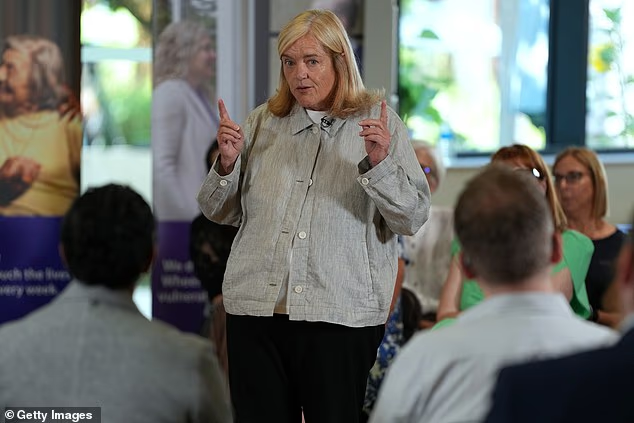
Ministers must make dementia Britain’s next great national mission, Baroness Louise Casey has said, arguing that the condition should be tackled with the same sustained determination that transformed cancer care.
Lady Casey, chair of the Independent Commission on Adult Social Care, will make the call at the Alzheimer’s Society annual conference in London alongside Professor Sir Mike Richards, the former national cancer director.
The intervention comes as a report from Alzheimer’s Society and The King’s Fund warns that dementia care in England remains “stuck in the last century” and requires a radical overhaul.
The report says the progress made against cancer offers a blueprint for dementia, with stronger leadership, clear diagnosis and treatment targets, better data and investment in research all needed.
Lady Casey said cancer had once been widely regarded as a death sentence, with little available beyond comfort in the final stages of life. Since the 1970s, however, research, earlier diagnosis, public awareness, clinical trials and improved treatments have transformed outcomes.
“This tremendous progress did not come from one miracle cure or one government,” she said. “It came because the country decided that cancer mattered, deserved our national effort, and kept up the fight, year after year.”
“It is time we gave dementia that same seriousness and ambition.”
The number of people living with dementia in the UK is expected to rise from one million to 1.4 million by 2040, while the economic cost is predicted to double. Dementia currently claims 76,000 lives a year and is described as the UK’s biggest killer.
Dementia care needs clear national targets
A survey of 1,000 people caring for someone with dementia found that, among those able to compare dementia and cancer services, 51 per cent said their experience of dementia care was worse. Only 11 per cent said it was better.
Michelle Dyson, chief executive of Alzheimer’s Society, said people with cancer received an urgent diagnosis and a clear route through treatment and care, while those with dementia could wait years for answers and sometimes be sent home with little more than a leaflet.
“Urgency is critical,” she said. “Dementia is the UK’s biggest killer and we cannot afford for this to take 50 years.”
Alzheimer’s Society is calling for people to receive a dementia diagnosis, care plan and access to treatment within 18 weeks of referral by a GP. The organisation has previously accused the NHS of treating dementia patients as “second-class citizens”.
Sir Mike, who oversaw three national cancer strategies after becoming the first cancer tsar in 1999, said dementia was “in many ways” where cancer had been decades ago.
He said the cancer experience showed what could be achieved through investment, collaboration, leadership and hope, as well as clear diagnosis and treatment pathways with timed targets and a national registry to monitor progress.
“Dementia deserves the same ambition that has transformed cancer care,” Sir Mike said. “Now is the time to build momentum.”
Sarah Woolnough, chief executive of The King’s Fund, said recent scientific advances offered hope that dementia treatment could be on the cusp of a cancer-style revolution. But she warned that health and care services were not currently prepared to diagnose the condition swiftly or introduce new treatments on a wide scale.
The Government has committed to appointing a dementia tsar. Lady Casey said responsibility was currently too scattered and that someone was needed to lead the long-term effort and drive accountability.
Social care minister Alison McGovern is expected to acknowledge at the conference that dementia has been “neglected for far too long”. She will announce that the Government plans to publish the first Modern Service Framework for Frailty and Dementia this year, setting out national standards for health and care support.
She is expected to say the framework will bring health and care workers together, set clearer priorities and establish the level of help people with dementia and their families should receive.
Lady Casey said a national mission would need to include research, expanded clinical trials, better treatments, support after diagnosis and a workforce equipped to deliver new care. “Dementia can be that next national mission,” she said.
