


Wing Commander Andy Green OBE, better known as the ‘fastest man on Earth’, has set another land-speed record, this time using hydrogen power.
The former Royal Air Force fighter pilot, who remains the only person ever to break the sound barrier in a car, reached 406.320mph (653.908kph) in JCB’s 1,600bhp Hydromax streamliner less than two weeks after celebrating his 64th birthday.
The achievement has been hailed as a major boost for hydrogen technology.
On Tuesday, Green rocketed across the crystalline crust of Utah’s famous Bonneville Salt Flats in the bullet-shaped vehicle, powered by two hydrogen combustion engines developed by JCB for its signature yellow construction machinery.
The pair of engines within the 32ft (9.75m) streamliner mix pressurised hydrogen gas with air and ignite it to create bursts of power.
The record has been verified by the Fédération Internationale de l’Automobile (FIA), the governing body of world motorsport, as the highest speed ever achieved by a hydrogen-powered car.
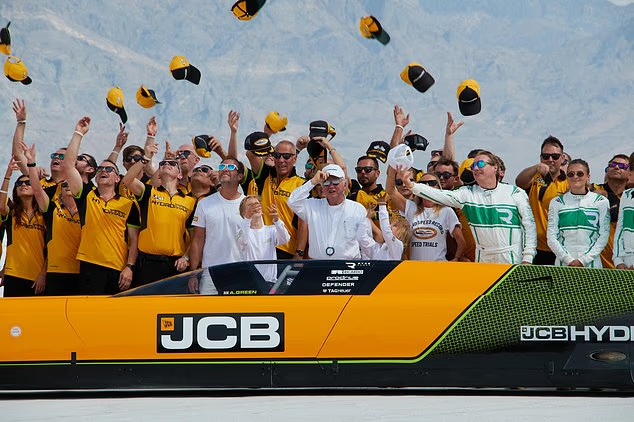
British driver Andy Green, centre, and the JCB engineering team celebrate setting a new land speed record for a hydrogen-powered vehicle at the Bonneville Salt Flats in Utah on Tuesday

The former RAF pilot – the only person ever to break the sound barrier in a car – reached 406.320mph in JCB’s 1,600bhp Hydromax streamliner less than two weeks after turning 64
‘It’s magic to be able to showcase this technology and demonstrate just how good the engineering is on the best racing surface in the world, Bonneville Salt Flats,’ Green told The Associated Press shortly after the run on Tuesday.
The feat was still some way short of the outright land-speed record Green famously set in 1997.
That year, he climbed into the jet-powered Thrust SSC, a black needle-like machine flanked by two enormous jet engines, and hit 763.035mph (1,227.985kph), becoming the first and only person to break the sound barrier on land.
His runs in Nevada’s Black Rock Desert generated sonic booms that rattled the nearby town of Gerlach.

JCB Hydromax: The streamliner uses power delivered from two 800bhp hydrogen digger engines

Company chairman Lord Bamford has long argued that hydrogen can meet the demands of construction and agricultural machinery more effectively than battery-electric alternatives
Join the discussion
Should we be investing in hydrogen engines for a cleaner future or is this just greenwashing by big industry?
Green also holds the diesel land-speed record, having reached 350.092mph (563.4kph) at Bonneville in JCB Dieselmax in 2006.
Twenty years on, his return to the salt flats has seen him eclipse that benchmark with a vehicle that produces zero tailpipe emissions.
Green’s 406.320mph this week comfortably trumped the previous hydrogen-combustion record of 185.5mph (298.5kph) set by BMW’s H2R in 2004.
Using a 10-mile (16km) straight course, Green steadily built up speed as dozens of JCB staff and reporters watched from afar through cameras and binoculars.
He admitted conditions inside the cockpit were ‘probably a little hotter’ than in the Thrust SSC, with temperatures regularly exceeding 122F (50C).
‘But I have been training for four months for that, both in the gym and by getting used to it with hot baths,’ he said.

The 32ft Hydromax is powered by two hydrogen combustion engines that mix pressurised hydrogen gas with air and ignite to create a burst of power. JCB is using them in its greenest construction vehicles

British driver Andy Green and the JCB engineering team pose with the car used to set the new land speed record for a hydrogen-powered vehicle on Tuesday

JCB’s Hydromax follows in the tyre tracks of the 2006 Dieselmax, which set a diesel land speed record using diesel engines taken from its famous diggers

Andy Green, right, celebrating having set a new world diesel powered land speed record of over 328mph on the Bonneville Salt Flats in Utah in the JCB Dieselmax on 22 August 2006
JCB’s hydrogen mission
While Green’s latest achievement fell well short of supersonic speeds, JCB believes the record demonstrates hydrogen’s potential as a clean-energy solution for heavy industry.
Company chairman Lord Bamford has long argued that hydrogen can meet the demands of construction and agricultural machinery more effectively than battery-electric alternatives.
It was his idea to showcase the capabilities of JCB’s in-house hydrogen combustion technology by pursuing a new world land-speed record.
Lord Bamford said: ‘Twenty years ago we came to Bonneville with JCB Dieselmax and showed what British engineering could do with diesel power.
‘Today we have done it again, this time with engines powered by hydrogen.’

Lord Bamford pictured with JCB’s green hydrogen combustion engine, which it will roll out for its larger construction vehicles to meet emissions targets
He added: ‘This record was set by production-based engines, the same engines powering JCB machines right now.
‘That is the point of JCB Hydromax. It shows hydrogen works, and it works today at the highest level with zero emissions.’
Hydrogen’s environmental credentials depend largely on how it is produced. Most hydrogen is currently made using fossil fuels.
However, JCB has signed an agreement to purchase green hydrogen, which is produced using renewable energy, although it currently accounts for only a small fraction of global hydrogen production.
