


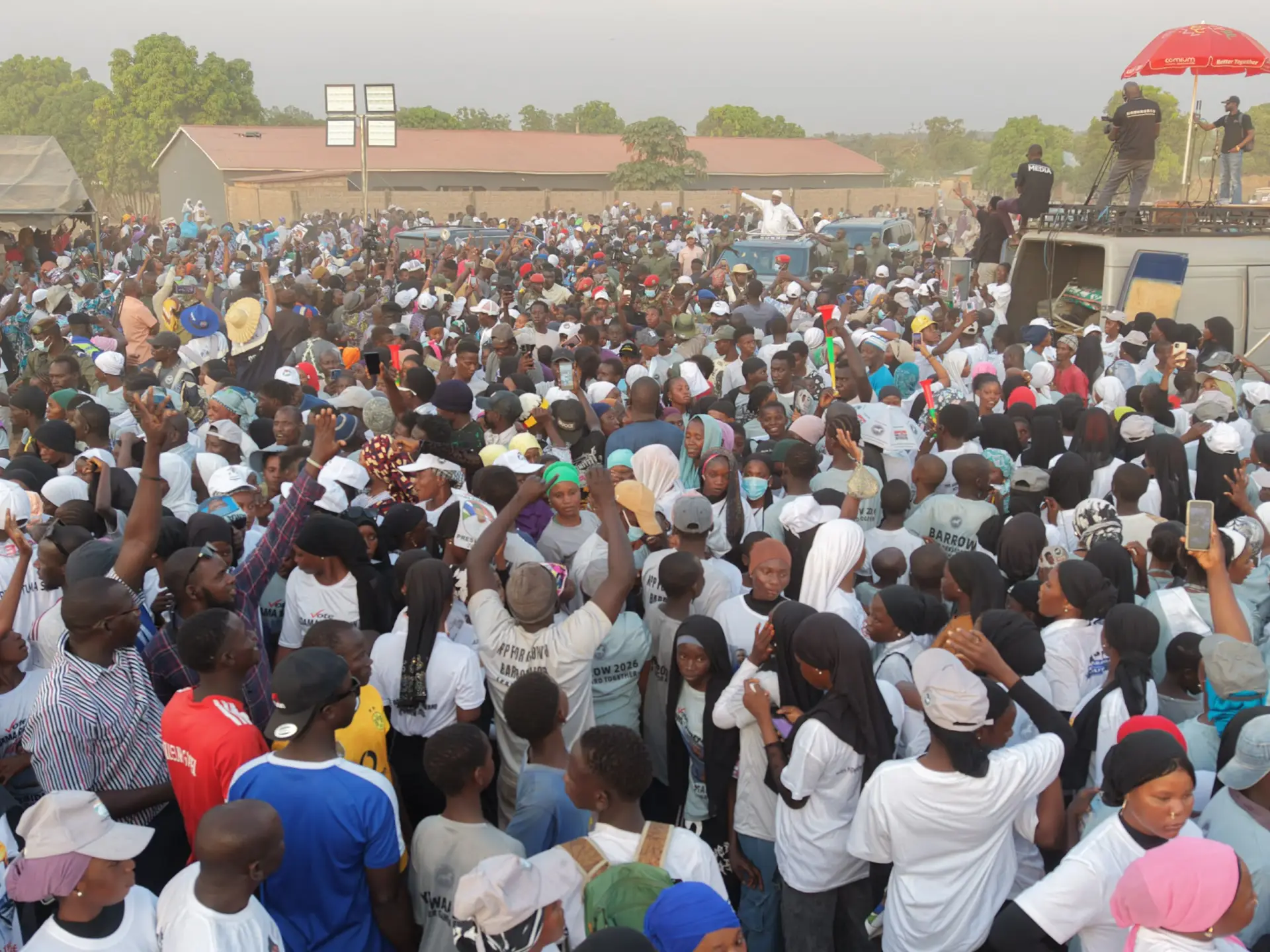
The Gambia’s presidential election on December 5 will test whether the country’s democratic transition can deliver meaningful improvements after nearly a decade of promises. Unemployment, rising living costs, unreliable public services and delays in prosecuting alleged abuses under former ruler Yahya Jammeh are dominating voters’ concerns.
President Adama Barrow is seeking a third term in a contest involving eight candidates. He came to power in 2017 after defeating Jammeh, who had ruled The Gambia for 22 years.
For many voters, however, the election is less about personalities than whether the next administration can create jobs, improve basic services and bring justice to victims of the previous regime.
The Gambia presidential election and the struggle to make a living
Sosseh Jagne, who founded Ya Anna’s Catering in 2020 before expanding it into a restaurant in early 2025, said repeated power cuts had undermined her business.
Outages have affected food preparation, refrigeration and customer service. Between August and October, she said, electricity was sometimes unavailable for 19 hours or more.
Jagne estimated that spoiled food had cost her more than 40,000 Gambian dalasis, or about $532. She has also stopped selling homemade iced juices because she cannot guarantee that they will remain chilled.
“Electricity is not a luxury; it is a necessity for people’s everyday lives and, especially, for businesses that depend on it to operate,” she said.
The difficulties faced by businesses are mirrored in the jobs market, particularly for young people. The 2025 Gambia Labour Force Survey put overall unemployment at 8.3 per cent, up from 7.6 per cent in 2022–23.
Among people aged between 15 and 35, unemployment stood at 11.5 per cent. The survey also found that 41.3 per cent of people in that age group were neither employed nor in education or training.
Maram Mendy, 26, graduated from the University of The Gambia but has been unable to find work. She said her parents had made sacrifices to pay for her education, making the lack of opportunities particularly painful.
“I’m now fed up with looking for a job,” she said.
Mendy said employers often required previous experience, leaving graduates trapped between the need to work and the need to have worked before.
For Buba Sanneh, 28, who has been unemployed since graduating in 2023, the lack of prospects has prompted thoughts of travelling to Europe through irregular migration, known locally as the backway.
Hakeem Touray’s family has already suffered the consequences of that journey. His elder brother, Bob, was 27 when he attempted to reach Europe in 2021 and died while trying to cross the Mediterranean Sea.
Figures cited by UN special rapporteur Morris Tidball-Binz after a visit to The Gambia in October 2026 indicated that 1,603 Gambians died attempting irregular migration in 2024 and 893 in 2025, most of them at sea. The International Organization for Migration has separately recorded at least 408 Gambians missing along migration routes since 2014.
Touray said the deaths reflected the consequences of unemployment, poverty and the limited opportunities available at home.
Rising prices and unreliable public services
Economic pressure extends beyond the search for work. Figures from the Gambia Bureau of Statistics show that 53.4 per cent of the population, around 1.1 million people, lived below the national poverty line in 2020.
The proportion was higher in rural areas, at about 76 per cent, compared with 34 per cent in urban communities.
At Bakoteh Market, vegetable seller Fatoumatta Jawara said rising prices were making it increasingly difficult to support her family. She also wants the next government to make healthcare more affordable.
“Survival is becoming harder with each passing day. We need a president who will improve our lives for the better,” she said.
Isatou Ceesay, 22, a mother of two, said she had become disillusioned with repeated election promises.
“All they do is promise, and after the election you don’t hear from them again. We are tired of their endless promises,” she said.
Security is also a concern in communities close to Senegal’s Casamance region, where instability has raised fears for border communities and for livelihoods dependent on cross-border movement.
Families still waiting for justice after Jammeh
The transition that followed Jammeh’s departure raised expectations that those responsible for abuses would be held to account. Nearly a decade later, many victims’ families say the process remains incomplete.
Sainabou Camara Lowe was 17 when security forces violently suppressed student demonstrations in April 2000. More than a dozen students were killed, while Camara Lowe survived with a spinal injury that required two operations.
Now 43 and widowed, she is raising five children while living with limited mobility. She received about 900,000 dalasis, or $11,970, through the reparations process, but said the payment had done little to relieve her family’s hardship.
“We are forgotten as victims and continue to wallow in pain and poverty,” she said.
Kebba Jome, national coordinator of the Gambia Centre for Victims of Human Rights Violations, said fewer than a quarter of the 263 recommendations made by the Truth, Reconciliation and Reparations Commission had been fully implemented.
He said a special tribunal to prosecute alleged crimes committed under Jammeh was expected to begin hearings early next year. Jome argued that the next president would be responsible for ensuring that the accountability process moved forward.
For Muhammed and Fatoumatta Sandeng, the children of opposition activist Ebrima Solo Sandeng, justice remains central to the promises made after Jammeh left office.
Their father died in state custody in April 2016 after being tortured, according to the findings of the Truth, Reconciliation and Reparations Commission. They want the next administration to implement the commission’s recommendations and ensure that those responsible are prosecuted.
“Victims have been waiting, victims are dying,” Fatoumatta Sandeng said. “Justice is long overdue.”
Competing promises of political reform
The election is also taking place against a backdrop of stalled constitutional change. A replacement for the 1997 Constitution, one of the key pledges of the post-Jammeh transition, has not been secured.
A draft constitution produced after a public review process in 2020 proposed a two-term presidential limit among other institutional reforms. It failed to win the required two-thirds majority in the National Assembly in September that year.
Disagreement centred in part on whether Barrow’s first term should count towards the proposed limit. Barrow blamed opposition resistance for the draft’s failure and has said he would revisit constitutional reform if re-elected.
His principal challenger, Ousainou Darboe of the United Democratic Party, has pledged to reintroduce the 2020 draft within his first 100 days in office. His party’s 2026 manifesto also promises that he would serve a single five-year term.
The manifesto includes proposals to reform state institutions and the security sector, reduce the budget of the Office of the President, tackle public debt and improve healthcare, education, electricity and water services.
Other candidates include Talib Ahmed Bensouda, the former mayor of Kanifing Municipality, and independent candidate Almameh Gibba, who has said he would facilitate Jammeh’s return if elected.
Former vice-president Isatou Touray is seeking to become The Gambia’s first woman president. Campaigning under the symbol of a broom, she has promised a new constitution and better living conditions.
Political scientist Essa Njie said economic conditions, candidates’ personalities and party loyalty would shape the result. He said voters would also make choices along ethnic, religious and political lines, even as unemployment, the cost of living and corruption remained important issues.
Whoever wins will face the challenge of converting campaign commitments into reforms while dealing with institutional constraints and competing political interests.
For Jagne, the immediate priority is dependable electricity so that her restaurant can operate. For Mendy, it is a route into the workforce; for Sanneh, a future that does not require risking his life on the backway.
Market traders want to feed their children and afford healthcare, while families of victims want accountability and recognition that their losses have not been forgotten.
Touray said his brother’s death showed what was at stake for a generation with few prospects at home.
“Our young people are not necessarily running away from The Gambia; many are running away from hopelessness,” he said.
