


Greater Bay Area integration is beginning to produce a powerful Hong Kong–Shenzhen economic partnership, but the wider project remains uneven, with ambitious new districts yet to attract the people and businesses envisaged for them.
The Guangdong–Hong Kong–Macau Greater Bay Area brings together nine cities in Guangdong province, including Shenzhen, Zhuhai and Guangzhou, alongside Hong Kong and Macau. It has about 88 million residents and an economy worth roughly $2.1 trillion, but spans three legal systems, currencies and customs territories.
Beijing’s aim is to link the region’s financial capital, research, entrepreneurs and manufacturing capacity into a single innovation and industrial ecosystem. The initiative was formalised in 2017, building on more than four decades of economic development around the Pearl River Delta.
Its progress is most visible in the relationship between Hong Kong and Shenzhen. Hong Kong supplies financial expertise while Shenzhen contributes strength in hardware, software and rapid product development. The other cities, however, have yet to benefit to the same extent.
Greater Bay Area integration remains uneven
Hengqin, an island in Zhuhai opposite Macau, illustrates the challenge. Once home to oyster farmers and fishermen, it is now a vast development zone intended to help Macau diversify beyond gambling by combining mainland talent and manufacturing with the city’s economy.
Hengqin is three times the size of Macau and features broad highways, striking buildings and landscaped parks. Yet its population stood at only 50,000 at the end of 2025, well below the 280,000 residents authorities had hoped to attract by 2020.
Mehran Gul, author of The New Geography of Innovation, said: “There are very few Chinese cities where the idea of ‘build it and they will come’ has not worked out.” He believes Hengqin and other underused areas will eventually attract residents and companies.
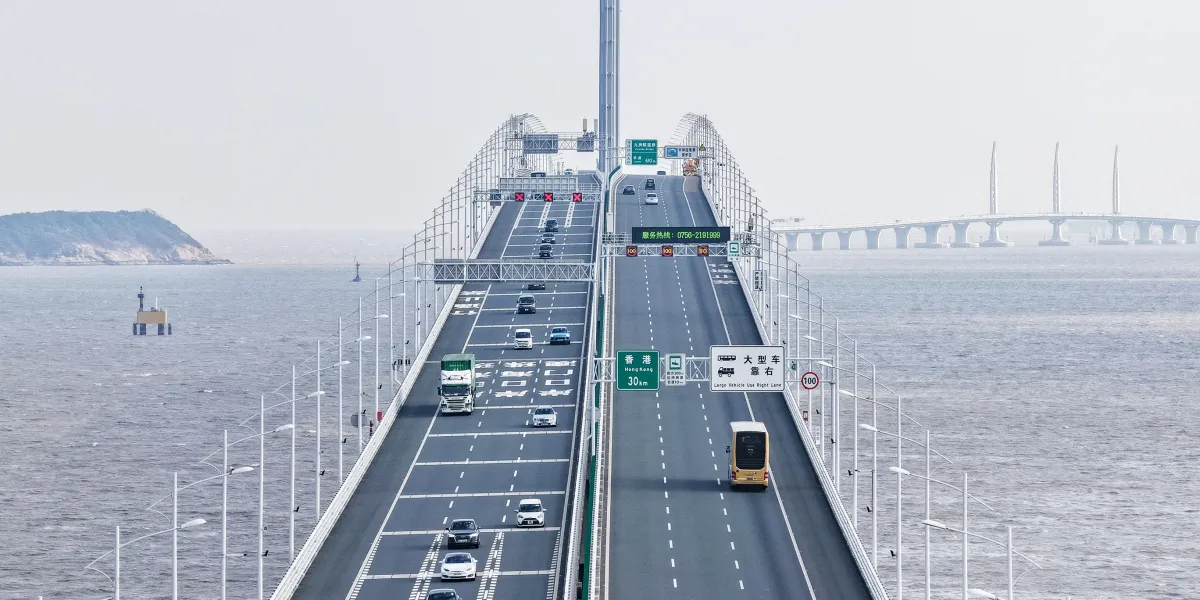
Major infrastructure has been central to the project. Hundreds of kilometres of railway have been built, alongside the Hong Kong–Zhuhai–Macau Bridge, a sea crossing whose bridge-and-tunnel system cost an estimated $20 billion. Officials want to establish a “one-hour living circle” linking the region’s principal cities.
But physical connections have not removed the region’s institutional and economic differences. Pamela Lam, Hong Kong’s commissioner for the development of the Greater Bay Area, said the objective was not to make the cities identical, but to create “interoperability and complementarity across different cities and systems”.
The region’s innovation credentials are strengthening. The Shenzhen–Hong Kong–Guangzhou cluster was ranked the world’s leading innovation cluster in 2025 and 2026 by the Global Innovation Index. The nine mainland cities also accounted for more than a third of China’s international patent applications in 2025 and a fifth of its unicorn start-ups, according to state media.
Gul said Chinese technology had moved beyond simply following the United States, with companies increasingly developing fundamental innovations. He added that the connections between research, finance, manufacturing and technology in the Greater Bay Area had played a significant part in that transition.
The economic picture is less uniform. Guangdong grew more slowly than China as a whole in every year from 2021 to 2025, with the property downturn and youth unemployment weighing on the province. Increased industrial automation driven by artificial intelligence has added to pressure on young workers.
Jerry Patchell, associate professor emeritus at the Hong Kong University of Science and Technology, said the gains in productivity and value creation had not been spread evenly. Shenzhen and Hong Kong were pulling away, he said, while Guangzhou was close behind and several other cities were advancing more slowly.
Hong Kong’s financial strength has also not yet been channelled primarily into its neighbouring cities. Alicia Garcia-Herrero, chief economist for Asia-Pacific at Natixis, said Hong Kong was effectively financing the mainland as a whole rather than the Greater Bay Area on preferential terms.
There are signs of renewed momentum. Guangdong’s economy grew by 4.6 per cent in the first three quarters of 2026, matching China’s national growth rate for the first time since the third quarter of 2021.
Artificial intelligence infrastructure, robotics, autonomous vehicles and other physical AI applications are creating further opportunities. Stephanie Gao, a professor of practice at City University of Hong Kong, said the region’s close links between hardware design, component supply and software development gave it an advantage.
That advantage is reflected in the speed of development, with companies able to refine products in days rather than months, according to Gul. Elwin Ho, a Macau-born entrepreneur whose speech-recognition company is based in Hengqin, said software and algorithms were often developed in the US while hardware production was carried out in Shenzhen.
The Greater Bay Area has therefore achieved part of its ambition: a highly connected innovation and manufacturing base led by Hong Kong and Shenzhen. Whether that success can be extended across the rest of the region will depend on turning new infrastructure and industrial capacity into sustained population growth and more widely shared prosperity.
