


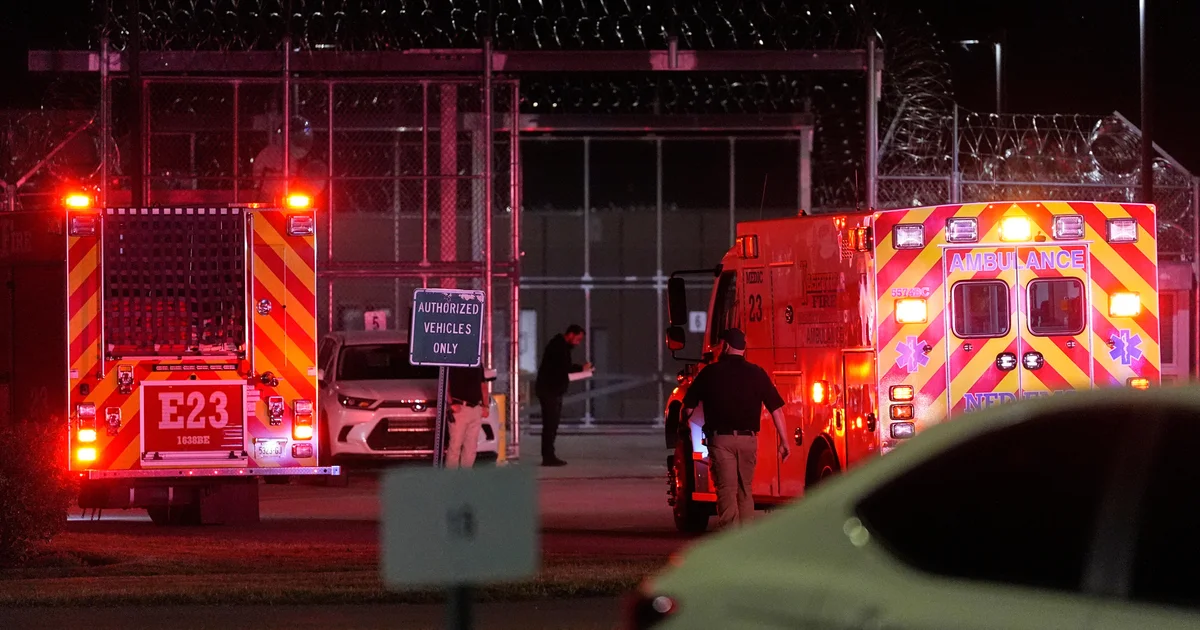
Christa Pike survived a botched execution in Tennessee after receiving two doses of the lethal drug pentobarbital, in what experts have described as an unprecedented failure of a modern execution by lethal injection.
The 50-year-old remained alive after the procedure at Riverbend Maximum Security Institution in Nashville on Wednesday night and was taken to hospital for what her lawyers described as “lifesaving medical care”. The extent of her injuries was not immediately clear, although a doctor told BBC News she would likely have suffered a traumatic brain injury.
Pike’s legal team said she had not lost consciousness and still had a heartbeat after the drugs were administered. She could reportedly be heard snoring on the gurney and, at one point, asked prison officials: “if it was supposed to feel that way.”
Her survival prompted Tennessee Governor Bill Lee to cancel the state’s only other scheduled execution this year. He said the decision would allow “a comprehensive, third-party review to determine exactly what occurred” during the failed procedure.
Tennessee execution halted after lethal drugs administered
Steve Ferrell, one of Pike’s lawyers, said the incident had been predictable given Tennessee’s previous problems with its lethal injection system. “All of this was predicted, and the court did nothing,” he told reporters.
The Tennessee Department of Correction said it had “followed every step of the State’s lawful, established execution protocol”. It added: “The lethal injection chemical in the protocol has consistently been effective, and the protocol does not allow for additional procedures beyond what was carried out this evening.”
Pike was sentenced to death for the 1995 murder of her former classmate Colleen Slemmer, who was 19. Pike was 18 when Slemmer was tortured and killed by Pike and two other people, and was 20 at the time of sentencing.
She became the youngest woman sent to death row in the modern era of capital punishment in the United States. Pike is the only woman currently on Tennessee’s death row.
Volker Turk, the United Nations human rights chief, said the case raised concerns about the death penalty and unresolved questions relating to Pike’s trial. He described the “prolonged suffering — physical and mental — arising from multiple failed execution attempts” as “abhorrent, and cruel”.
A history of troubled lethal injections
The failed execution followed another serious incident in Tennessee earlier this year. In May, officials halted the planned lethal injection of death row inmate Tony Carruthers after spending more than an hour trying to establish an intravenous line.
Carruthers’s lawyer said the prisoner had groaned and bled as staff made repeated attempts to insert needles into his chest, arms, feet and neck. His legal team argued that the ordeal amounted to cruel and unusual punishment, but a Tennessee district court rejected the request to stop the execution, saying the required burden of proof had not been met.
Governor Lee later granted Carruthers a one-year reprieve. The state is expected to return him to the execution chamber after that period, and Lee said he would not reconsider his clemency petition despite doubts raised publicly about aspects of the forensic evidence in his murder conviction.
Researchers have identified seven prisoners in the modern US death penalty era whose lethal injections failed because officials could not establish an intravenous line, although the number may be higher. Similar incidents have been reported in Alabama, Arizona, Florida, Oklahoma and Texas.
Robin Maher, executive director of the Death Penalty Information Center, said Pike’s case was “singular and unparalleled”. She said it was the first known execution in which a prisoner remained alive after being given lethal drugs, rather than an attempt failing before the chemicals could be administered.
“Christa Pike is the only person who has ever survived after being given lethal doses of an execution drug,” Maher said. “That fact alone tells us that something went seriously wrong in the execution chamber. It is an unprecedented event in the modern death penalty era.”
Her organisation compared the incident with the 2014 execution of Clayton Lockett in Oklahoma. Lockett appeared to survive the procedure before dying of a heart attack while still in the execution chamber.
Concerns over Tennessee’s execution protocol
Tennessee resumed executions in 2025 after a three-year pause prompted by criticism of its procedures. Governor Lee had ordered a review after officials failed to test the lethal drugs intended for Oscar Smith’s execution for bacterial contamination.
The review led Tennessee to change its method from a three-drug combination to a protocol using pentobarbital alone. Maher said it was too early to determine whether that change had contributed to the failure involving Pike, adding that officials first needed to establish what went wrong.
She also called for greater openness from the state, saying secrecy surrounding execution procedures had contributed to mistakes in both Pike’s and Carruthers’s cases.
Pike’s lawyers had warned before the execution about difficulties with the protocol. In a letter written on Monday, Pike said she was not afraid to die but was “nervous about the process”.
After the attempt, her lawyers said the outcome had confirmed their concerns, alleging “difficult vein access, blown veins, degraded pentobarbital, no emergency medical care available when things inevitably go wrong, all under a protocol that remains veiled in secrecy”.
