


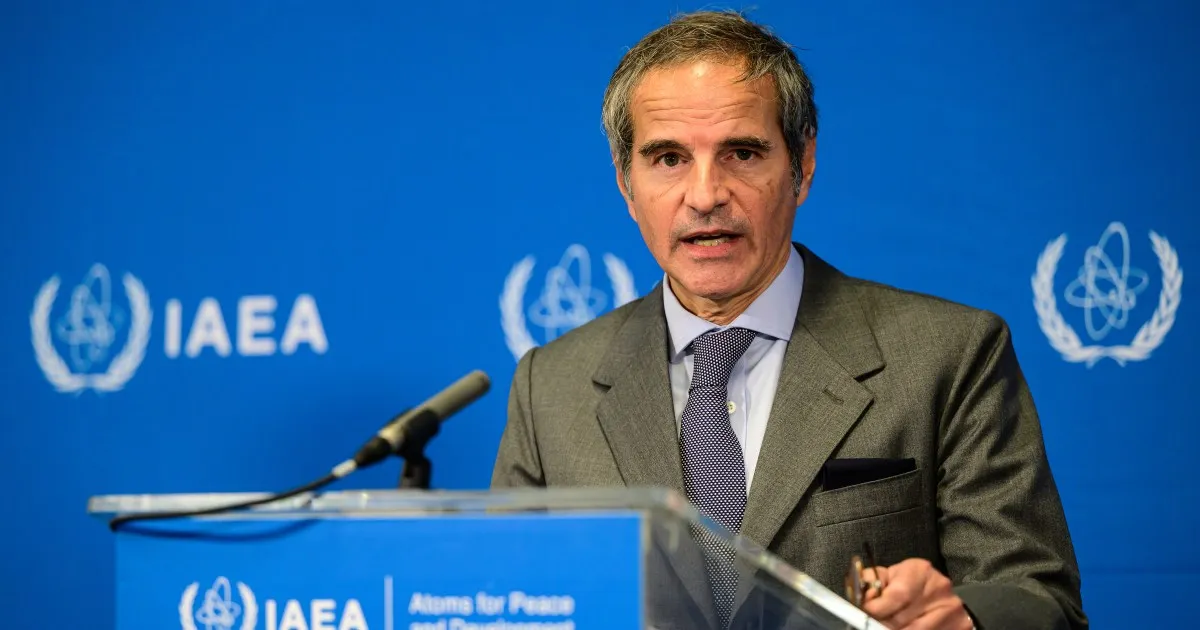
Rafael Grossi’s bid to become the next UN secretary-general has gathered momentum in the latest Security Council straw poll, but his perceived closeness to Donald Trump and Javier Milei could ultimately damage his prospects.
The head of the International Atomic Energy Agency (IAEA) came second behind Costa Rica’s Rebeca Grynspan, receiving nine “encourage” votes and four “discourage” votes. Eight candidates remain in the contest to replace António Guterres, who must leave office on 31 December.
Grossi, 65, has built a reputation as an active crisis diplomat during his time leading the nuclear watchdog. Since taking charge in 2019, he has personally led inspection teams to Ukraine’s Zaporizhzhia and Chernobyl nuclear power plants following Russia’s full-scale invasion in 2022.
Jan Wouters, professor of international law and international organisations at KU Leuven in Belgium, said Grossi had “transformed the technical watchdog into a highly visible, proactive diplomatic actor”.
His approach in Ukraine, focused on nuclear safety rather than territorial sovereignty, helped broker eight localised ceasefires to allow repairs at critical facilities, Mr Wouters said.
But Grossi’s high-profile diplomacy has also drawn criticism. Ezequiel Jimenez Martinez, an adjunct professor at Pompeu Fabra Law Faculty in Barcelona, said Russia had been angered by what it regarded as the IAEA chief overstepping his role.
Grossi’s UN campaign faces opposition
The candidate has also faced sustained opposition from Iran, which has accused the IAEA of being overly influenced by the United States and European countries in its reporting on Tehran’s nuclear programme.
Iranian foreign ministry spokesman Esmaeil Baghaei described the agency’s reporting as “one-sided and biased”. Iran is not a member of the Security Council, but Mr Jimenez Martinez said the criticism was unlikely to substantially alter the voting picture because most of the agency’s governors supported Grossi’s approach.
Winning the post requires at least nine votes from the 15-member Security Council, while avoiding a veto from any of its five permanent members: the US, UK, France, Russia and China. The eventual choice must then be approved by the 193-member UN General Assembly.
None of the permanent members has publicly declared a preference. However, Beijing has reportedly ruled out Grossi because of his perceived closeness to Washington and is expected to support Ms Grynspan instead.
Grossi has called for leaders to have the “courage to reform” the United Nations. His campaign is viewed as favouring a smaller organisation, with fewer overlapping mandates and a stronger focus on security and peace rather than development.
Alvina Hoffmann, a senior lecturer in diplomatic studies at SOAS University of London, said Grossi was seen as prioritising “improving the system and cutting overlapping mandates, rather than addressing the structural drivers of inequality”.
She said his preference for personal leadership, private negotiations and preventive diplomacy could come at the expense of publicly condemning breaches of international law at a time when the rules-based system was under increasing strain.
Pressure for the first woman UN secretary-general
Support for Grossi is further complicated by the political positions of Mr Milei, Argentina’s president, and Mr Trump, the US president.
Mr Milei has described the United Nations as “useless” and its diplomats as “fatally arrogant parasites”. He has also revived Argentina’s dispute with the UK over the Falkland Islands, which Buenos Aires calls the Malvinas, and argued that self-determination should not apply to the islands’ population.
The Trump administration has been a strong critic of the UN, withdrawing the US from key agencies and cutting its funding. Mr Jimenez Martinez said Grossi was viewed as close to both leaders and could promote an agenda reflecting their foreign policies.
That association may prove a liability in a contest where candidates are expected to defend the UN Charter, international law and human rights instruments.
The next secretary-general is also expected, under the tradition of geographical rotation, to come from Latin America. Five women are standing in the race, and campaigners are pressing for the first woman to lead the organisation in its 81-year history.
Ms Grynspan, who currently leads the Security Council straw poll, would satisfy both expectations. Ben Donaldson, an adviser to the 1 for 8 Billion campaign, said selecting a candidate on merit was compatible with taking gender balance into account.
“The United Nations has existed for 80 years without ever appointing a woman as secretary-general,” he said. “This persistent imbalance stands in contrast to the organisation’s own commitments to equality, parity and nondiscrimination.”
