


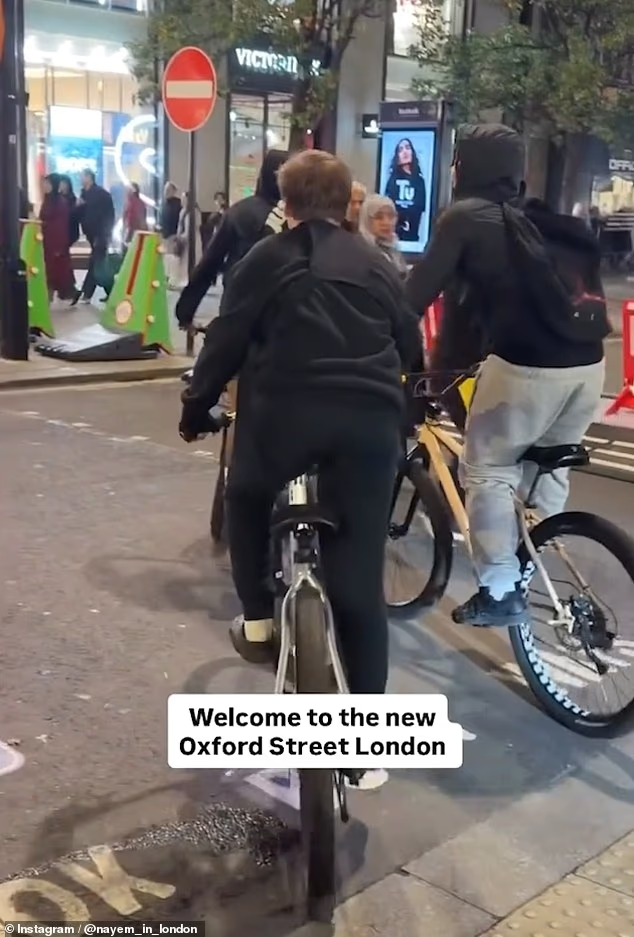
Oxford Street pedestrianisation has descended into congestion and confusion within days of its launch, with cyclists filmed riding through the new zone and black cab drivers warning that journeys across central London have become longer.
Footage from the shopping street shows groups of cyclists weaving between pedestrians despite instructions to dismount. Security guards can be seen attempting to stop riders at newly installed bollards, with mixed results.
In one evening video, dozens of cyclists gather near a crossing where vehicles can still pass before riding through the pedestrianised section. A voice can be heard referring to a guard with outstretched arms and saying: “He’s given up.”
The scenes contrast with the vision presented for the scheme, which depicted shoppers moving peacefully among trees while traffic was diverted smoothly around the thoroughfare.
Oxford Street was closed to cars, buses, taxis and bicycles from Monday morning along a 0.9-mile stretch between Selfridges and Ikea. New signs were later installed telling cyclists to get off their bikes and walk through the area.
But cyclists continued to pass through the barriers and ride over a large green marking placed on the road. The disruption has been accompanied by loud music and growing concerns about how the surrounding roads will cope.
Traffic diverted around Oxford Street
Five bus routes – the 98, 139, 390, N98 and N207 – have been redirected on to neighbouring roads, with new stops introduced for passengers. Other services have been shortened or changed, while taxis and private hire vehicles are barred from the closed section.
Videos from Wigmore Street showed cars and buses backed up, while traffic on Regent Street was reported to have come to a standstill at times. The diverted routes also include Henrietta Place and Cavendish Place, where road arrangements have been altered.
Tim Barnes, Westminster City Council’s cabinet member for growth and planning, said the problems had been foreseeable because traffic had been moved from a major east-west route on to smaller roads.
“You just can’t take that much traffic out of central London and push it on to roads that are smaller, less well suited to taking big vehicles, and not expect it to cause problems,” he said.
Mr Barnes said there had been congestion on Regent Street and that a waste truck had been forced to turn around and travel the wrong way up the road. He also warned that buses making sharp turns on Wigmore Street could create risks for pedestrians and cyclists.
“I also think it’s only a matter of time until we see more incidents with cyclists hitting pedestrians on Oxford Street itself,” he said.
Black cab driver Bahrain “Baha” Mujagata, who at 21 is thought to be London’s youngest black cab driver, said the new layout had made some journeys around the capital more difficult.
“Yesterday, I felt the real-time repercussions – there was so much traffic on Regent Street with nowhere else to go,” he told the Local Democracy Service. “Sitting through traffic that I used to bypass makes life much harder.”
Mr Mujagata said northbound Regent Street was particularly crowded because of the cycle lane, central reservation and buses stopping to collect passengers. He added that he was not opposed to pedestrianisation in principle, but did not believe the current scheme was the right approach.
“We will evolve and get used to it, like whenever they change a road or turn,” he said. “But drivers who knew how it was before will always remember.”
Westminster City Council and residents in nearby Marylebone had warned before the closure that congestion, noise and pollution could be pushed on to residential streets. The Marylebone Association had estimated that Wigmore Street could face about 46 additional bus movements an hour during peak periods.
The changes are intended to transform one of Britain’s best-known shopping destinations, which attracts around 500,000 visitors a day. But the first days of Oxford Street pedestrianisation have instead been marked by diverted traffic, altered bus routes and cyclists continuing to ride through the restricted area.
